

A lot of businesses invest in content and wonder why it does not rank. The content is well-written, the topic is relevant, the page is published. And nothing happens. Understanding what is on-page SEO, and what it actually requires beyond writing, is usually where the answer lives.
On-page SEO is the practice of optimizing individual pages on your site so search engines can clearly understand what each page is about, evaluate its quality, and rank it for the right search terms. It covers everything on and within the page itself: the title, the headings, the content structure, the keyword signals, the internal links, and the technical elements that tell Google how to interpret the page.
It is not complicated. But it does require intention. A page that ranks is rarely an accident.
Why “Just Writing Good Content” Is Not Enough
Let’s be honest about the gap between content that exists and content that performs.
Good writing is necessary. It is not sufficient. A well-written page with no keyword alignment, a weak title tag, missing header structure, and no internal links is invisible in search. Not because the content is bad, but because the signals that help Google understand and rank it are absent.
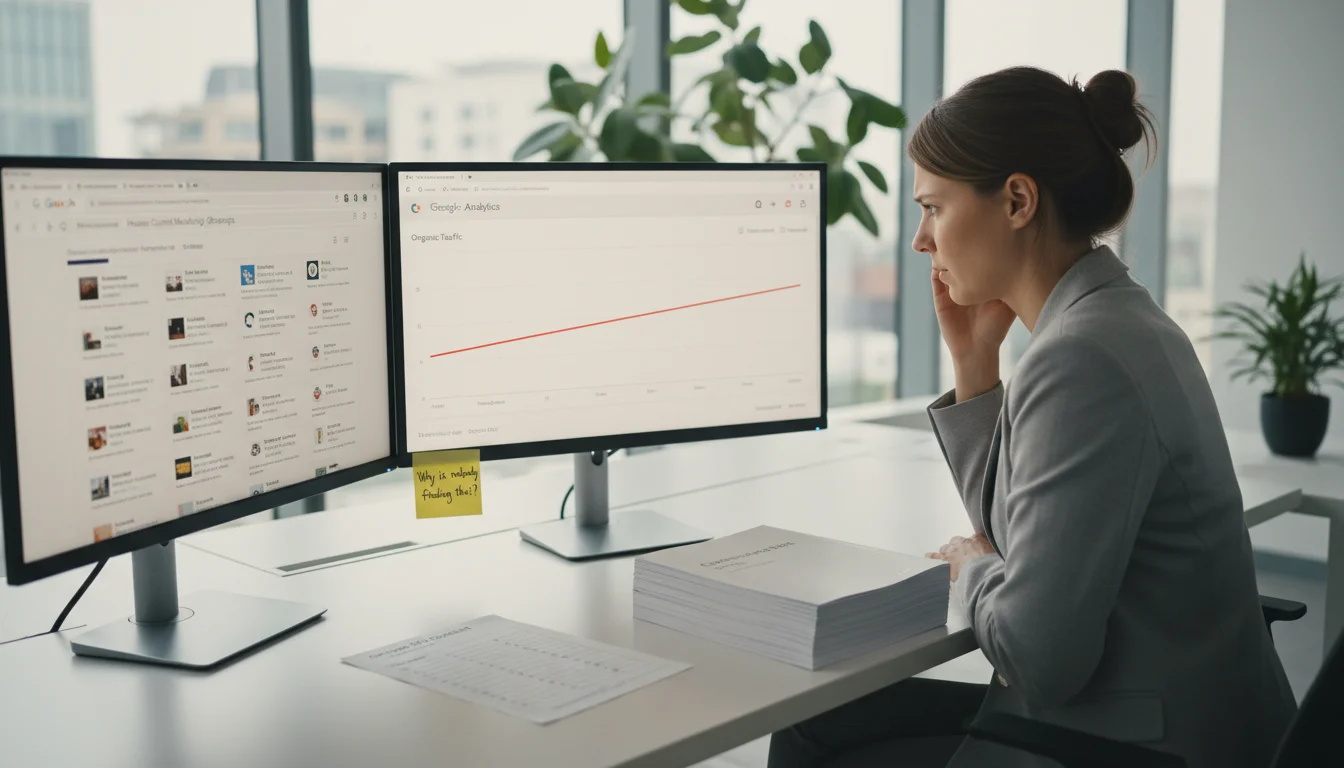
Here is what actually happens without on-page SEO. Google crawls the page, cannot determine with confidence what the primary topic is, and either does not rank it or ranks it for terms so loosely related that the traffic, if any comes, does not convert. The content investment produces nothing.
We have seen this pattern repeatedly across US businesses in healthcare, legal services, and eCommerce. Well-resourced companies publishing consistent content without a structured on-page process and wondering why their organic traffic is flat. The fix is rarely more content. It is better-optimized content.
What Is On-Page SEO: The Core Elements
On-page SEO covers a defined set of elements, each sending a specific signal to search engines. Here is what each one does and why it matters.
Title Tage
The title tag is the clickable headline that appears in search results. It is one of the strongest on-page ranking signals Google evaluates. Your primary keyword should appear in the title tag, ideally toward the beginning. Keep it under 60 characters so it does not get truncated in results. Write it to earn the click, not just to satisfy the algorithm.

Meta Description
The meta description does not directly influence rankings, but it influences click-through rate, which does. It is the two-line summary under your title in search results. Write it to complement the title, include a natural reference to the primary keyword, and give the reader a clear reason to click. A blank or auto-generated meta description is a missed opportunity every time your page appears in search.
H1 and Heading Structure
Every page should have exactly one H1, and it should include the primary keyword. Below that, H2 and H3 headings should organize the content logically and signal the subtopics covered on the page. Heading structure helps both readers and search engines navigate the content. Pages with no heading structure, or with headings used decoratively, are harder to evaluate and harder to rank.
Keyword Placement
The primary keyword should appear in the first 100 words of the page, in the H1, and naturally throughout the body. Secondary keywords and semantically related terms should appear where they fit without forcing them. Google’s ability to understand context and topical relationships has improved significantly. Strategic, natural placement works. Keyword stuffing does not.
Content Depth and Quality
Google evaluates how comprehensively a page covers its topic relative to what is already ranking. A page that answers the searcher’s question more completely than the current top results is a candidate to outrank them. This does not mean longer is always better. It means relevant depth. Cover what the searcher needs, not just the surface-level answer.
Internal Linking
Internal links connect pages within your site and pass authority between them. Every page should link to relevant related pages, and every important page should have internal links pointing to it. Our audits consistently show that internal linking is one of the most underused on-page levers. Pages with strong internal link structures rank more consistently than those that exist in isolation.
URL Structure
URLs should be short, descriptive, and include the primary keyword where it fits naturally. Avoid parameter-heavy or auto-generated strings. A clean URL like /what-is-on-page-seo is clearer to both search engines and users than /page?id=4823.
Image Alt Text
Every image should have an alt attribute that describes the image accurately and, where it fits naturally, includes a relevant keyword. Alt text helps search engines understand image content and is also an accessibility requirement. Blank alt attributes are a missed signal on every page they appear.
On-Page SEO vs. Technical SEO vs. Off-Page SEO
These three disciplines get grouped under the broad term SEO but they operate differently and solve different problems.
| Area | What It Covers | Who Controls It |
| On-Page SEO | Content, keywords, structure, internal links, tags | You and your content team |
| Technical SEO | Crawlability, speed, indexability, site architecture | Developers and SEO specialists |
| Off-Page SEO | Backlinks, authority signals, brand mentions | External publishers and outreach |
On-page SEO is the area where your content team has the most direct control. You cannot force another site to link to you. You cannot change Google’s algorithm. But you can optimize every element on every page you publish.

That control is the reason on-page SEO is always the starting point.
Small, consistent on-page improvements compound over time. A business that correctly optimizes every new page it publishes builds a stronger content foundation over 12 to 24 months. A business that publishes without optimization is creating work it will eventually have to redo.
Common On-Page SEO Mistakes
Most on-page SEO problems are predictable and fixable. These are the ones we see most often.
Writing for the wrong keyword intent
Publishing an informational blog post targeting a term where search results are all product pages, or building a landing page for a term where results are all guides, means the format does not match what Google has determined satisfies that search. Always check what already ranks before writing. Format follows intent.
Duplicate or missing title tags
Multiple pages sharing the same title, or pages with no title tag at all, are common audit findings. Each page needs a unique, optimized title that reflects its content and includes the relevant keyword. Duplicate titles dilute the signal and confuse search engines about which page to rank.
No internal links to new content
New pages published with no internal links pointing to them are effectively invisible until discovered some other way. Every new piece of content should be linked from at least two to three relevant existing pages. This is fast, low-cost, and consistently overlooked.
Keyword in the H1 but nowhere else
Placing the keyword in the H1 and then never using it or related terms in the body is not optimization. Google looks for topical relevance throughout the page. Use the keyword naturally in the introduction, in a subheading where it fits, and in the body without forcing it.
Thin content on important pages
Service pages, location pages, and category pages are often the most important pages on a site for ranking. They are also the most commonly underdeveloped. A service page with two paragraphs of generic copy is not giving Google enough signal to understand what the page covers or who it serves.
A structured on-page-seo-audit-checklist gives you a repeatable process for reviewing every element before and after publication so nothing gets missed.
On-Page SEO and the Connection to Keyword Research
On-page optimization without keyword research is guessing. Every on-page decision, which keyword goes in the title, how headings are structured, what subtopics to cover, what intent to serve, is downstream of knowing what the page is supposed to rank for and who is supposed to find it.
The keyword-research-guide covers how to find the right terms, evaluate their competition, and map them to the right content format before any on-page work begins. If you are optimizing pages without that foundation, you are building on uncertain ground.
FAQ
What is on-page SEO and how is it different from technical SEO?
On-page SEO covers the content and structural elements within a page: title tags, headings, keywords, internal links, and content quality. Technical SEO covers the infrastructure of the site: crawlability, page speed, and indexation. Both matter. On-page SEO is where content teams have the most direct control and the fastest ability to act.
How important is the title tag for rankings?
Very. The title tag is one of the strongest signals Google uses to understand what a page is about. Include the primary keyword, keep it under 60 characters, and write it to earn a click. A weak or missing title tag consistently underperforms a properly optimized one. Fix these first.
Can I do on-page SEO without tools?
For basic on-page work, yes. You can manually check title tags, heading structure, keyword placement, and internal links without specialist tools. For auditing at scale or for a site with more than 20 to 30 pages, tools like Ahrefs, Screaming Frog, or Semrush make the process significantly faster and more thorough.
How long does it take for on-page SEO changes to affect rankings?
Google needs to crawl and re-index the updated page before any change takes effect. For frequently crawled pages, that happens within days. Ranking movement after re-indexing typically becomes visible within two to six weeks. Competitive terms need supporting authority signals alongside on-page optimization to move meaningfully.
Does on-page SEO matter for local businesses?
Yes, and in specific ways. Local businesses need geographic signals throughout their on-page optimization: city and region names in title tags, headings, and body content where they fit naturally. Location pages each need unique content targeting the specific geography. Generic content replicated across location pages is one of the most common on-page failures we see in local SEO audits.
The Bottom Line
On-page SEO is the part of search optimization that connects what you publish to what people are searching for. Without it, content exists but does not rank. With it, every page you publish becomes a properly signaled, intent-matched asset that can compete in search.
Understanding what is on-page SEO is the beginning of treating your website as a strategic channel rather than a digital brochure. The businesses that build this discipline into every page they publish compound their organic visibility over time in ways that shortcuts and one-time fixes cannot replicate.
Not sure how well your current pages are optimized?
Start with a free SEO audit and find out exactly where your site stands. We will identify the on-page gaps holding your content back and give you a clear picture of what needs to change. Visit our On-Page SEO Service Page to learn more about how we approach this work.