

Here is a question that comes up constantly in SEO conversations: do meta descriptions actually matter anymore? Understanding meta descriptions of 2026 context requires a clear answer, not a hedged one. The short version is that meta descriptions do not directly affect your rankings. But they significantly affect your click-through rate, and click-through rate is something Google pays attention to.
The businesses that ignore meta descriptions are leaving a free conversion lever on the table. Every time your page appears in search, the meta description is your two-line pitch to the person deciding whether to click your result or the one above or below it. Writing it badly, or not writing it at all, costs clicks without any offsetting benefit.
This post explains what meta descriptions actually do, how to write them well, and why they are still worth your attention in 2026.
What Meta Descriptions Actually Do
A meta description is an HTML attribute that provides a brief summary of a page’s content. It typically appears as the snippet of text beneath the title in Google search results. You write it. Google decides whether to show it.
That last part is important. Google does not always use the meta description you write. Studies consistently show that Google rewrites or replaces meta descriptions more than 60 percent of the time, pulling content from the page body that better matches the specific search query. This is not a reason to skip writing them. It is a reason to write them well enough that Google chooses to use them.
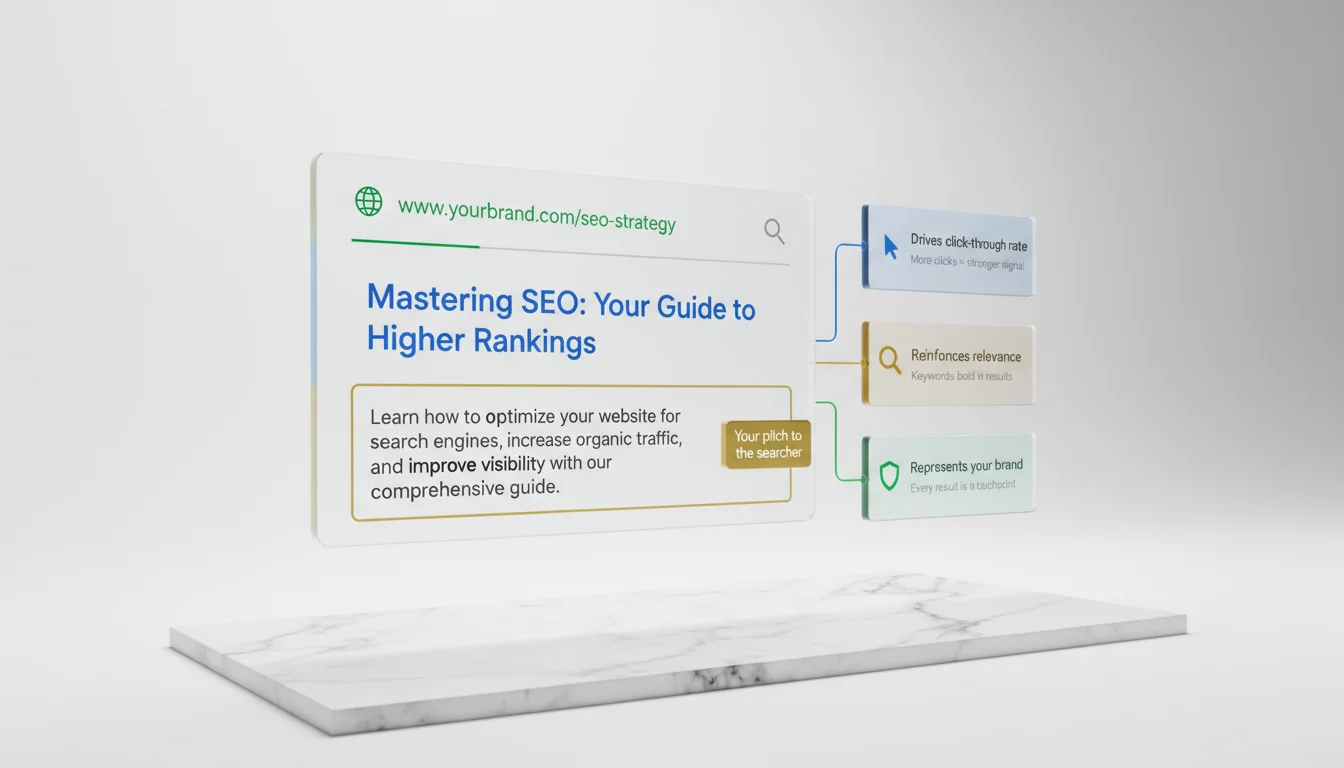
What meta descriptions do, concretely:
They influence click-through rate
A well-written description that matches search intent and includes a clear reason to click earns more clicks than a generic or auto-generated description. More clicks on a result signal to Google that the page is relevant and satisfying for that query. That behavioral signal feeds into rankings indirectly over time.
They reinforce relevance signals
Google bolds the words in the description that match the search query. A description written with the primary keyword and related terms naturally included helps the searcher quickly confirm that your result is relevant to what they searched for.
They represent the brand
Every search result is a brand touchpoint. A poorly written or missing meta description is a missed opportunity to communicate quality, credibility, and value before the visitor even arrives on your site. This matters more than most businesses realize
How to Write Meta Descriptions That Get Clicks
The goal of a meta description is not to describe the page. It is to give the searcher a compelling reason to click your result rather than the results above or below it. That requires intent matching, specificity, and a clear value signal.

Here is a framework for writing effective meta descriptions:
Match the search intent
The description should immediately confirm that the page delivers what the searcher is looking for. If someone searches “how to fix a slow WordPress site,” the meta description should signal that the page contains the fix, not a general overview of site speed.
Include the primary keyword naturally
Google bolds matching terms in the description. Including the primary keyword helps the result look visually relevant to the searcher and confirms alignment with their query. Do not force it. If it does not fit naturally, prioritize the other elements.
State the specific value
Generic descriptions like “Learn more about our services” earn no clicks. Specific descriptions like “Five technical fixes that reduced page load by 40 percent for WordPress sites” give the searcher a concrete expectation of what they will get.
Keep it under 160 characters
Descriptions longer than 160 characters get truncated with an ellipsis in search results. If your key message appears after the cut, it is invisible. Write within the limit and front-load the most important information.
Include a soft call to action where appropriate
Phrases like “See how,” “Find out,” “Get the guide,” or “Learn what actually works” give the searcher a direction. This is especially useful on service pages and conversion-focused content.
Here is a quick comparison of weak versus strong meta descriptions:
| Page Type | Weak Description | Strong Description |
| Service page | “We offer SEO services for businesses.” | “We help US businesses rank and grow organic traffic. See what a real SEO strategy looks like.” |
| Blog post | “Read our article about meta descriptions.” | “Meta descriptions do not affect rankings directly, but they drive clicks. Here is how to write them correctly.” |
| eCommerce | “Shop our selection of running shoes.” | “Brooks, ASICS, and New Balance running shoes with free shipping. Find the right fit for your stride.” |
The strong versions are specific, intent-matched, and give a concrete reason to click
Common Meta Description Mistakes

Leaving meta descriptions blank
When you do not write a meta description, Google auto-generates one by pulling a snippet from the page body. The auto-generated version is often a navigation element, a call-to-action button label, or a sentence fragment that does not represent the page well. Filling in a written description, even a basic one, almost always produces a better outcome than leaving it to automation.
Writing the same description for multiple pages
Duplicate meta descriptions across a site are a common audit finding. A description that applies to every page actually applies to none of them. Each page needs a unique description that reflects its specific content and target audience. Identical descriptions also confuse search engines about the difference between pages.
Stuffing the description with keywords
A description loaded with keyword repetition reads unnaturally and earns fewer clicks because it does not sound like something a real business wrote. Google also does not use meta descriptions as a ranking signal, so stuffing them produces no ranking benefit and a real click-rate cost.
Writing descriptions that misrepresent the page
A description that promises more than the page delivers drives clicks and then drives bounces. Bounce behavior is a negative quality signal. A description that accurately represents the page content sets the right expectation and produces engaged visitors rather than frustrated ones who leave immediately.
Ignoring meta descriptions on high-traffic pages
Many businesses focus meta description effort on new content and neglect the pages already receiving significant impressions in search. A page generating 10,000 monthly impressions with a missing or weak description is a significant untapped click-through opportunity. Start your optimization effort where the impression volume is already high.
Meta descriptions are one element of the broader on-page optimization system. The title-tags-seo-guide covers the element that works directly alongside the description in every search result, and the what-is-on-page-seo guide places both within the full context of what drives page-level rankings.
FAQ
Do meta descriptions affect Google rankings?
Not directly. Google has confirmed that meta descriptions are not a ranking signal. They do influence click-through rate, and user behavior signals, including click patterns on search results, feed into Google’s understanding of which pages are satisfying for a given query. The ranking impact is indirect but real over time.
How long should a meta description be?
Keep it under 160 characters. Google typically truncates descriptions that exceed this length. Front-load the most important information so the core message is visible even if the description is slightly long and gets cut.
Should I write meta descriptions for every page?
Yes. Every page that could appear in search results should have a written meta description. Pages without one are left to auto-generation, which rarely produces the best outcome. Prioritize your highest-impression pages first if you are working through a backlog.
Does Google always use the meta description I write?
No. Google rewrites or replaces meta descriptions more than half the time, pulling from the page body when it determines the query-specific match is better. Writing a clear, accurate, keyword-aligned description reduces the likelihood of an unhelpful replacement. Even when Google rewrites it, a well-written description often gets used for queries closely matching the intent you wrote for.
What happens if I leave the meta description blank?
Google auto-generates a snippet, usually pulling from whatever text appears near the top of the page or near the most relevant section. This can produce a readable result or a fragment that makes no sense out of context. Writing your own description is always better than relying on auto-generation.
The Bottom Line
Meta descriptions seo 2026 relevance is not about ranking directly. It is about what happens between your page appearing in search and the click that sends a visitor to your site. That gap is where meta descriptions do their work, and businesses that write them thoughtfully earn meaningfully more clicks from the same search impressions.
A page that ranks in position four with a compelling description can outperform a page in position two with a generic or missing one. That is a free performance advantage. Take it.
Want to know how your current meta descriptions and on-page elements are performing?
Start with a free SEO audit and find out exactly where your site stands. We will identify missing, duplicate, and underperforming descriptions across your key pages and show you exactly what needs to change. Visit our On-Page SEO Service Page to learn more about how we approach this work.