

HARO, or Help a Reporter Out, is one of the most cited link building tactics on the internet and one of the most poorly executed. A HARO link building strategy done right produces links from publications like Forbes, Business Insider, HuffPost, and dozens of high-authority industry outlets. Done wrong, it produces hundreds of unanswered pitches and a lot of wasted time.
The gap between businesses that earn consistent press links through HARO and those that spend months with nothing to show for it comes down to two things: whether responses are genuinely useful to the journalist, and whether the process is systematic enough to produce volume over time. Both are learnable. Neither happens by accident.
Here is how to build a HARO process that actually produces links.
Why Most HARO Efforts Fail Before They Start
HARO sends three email digests per day containing journalist queries across industries. The volume is high, the window to respond is short, and the competition is real. Every query that is relevant to your business is also relevant to dozens or hundreds of other companies, consultants, and PR professionals who are pitching simultaneously.
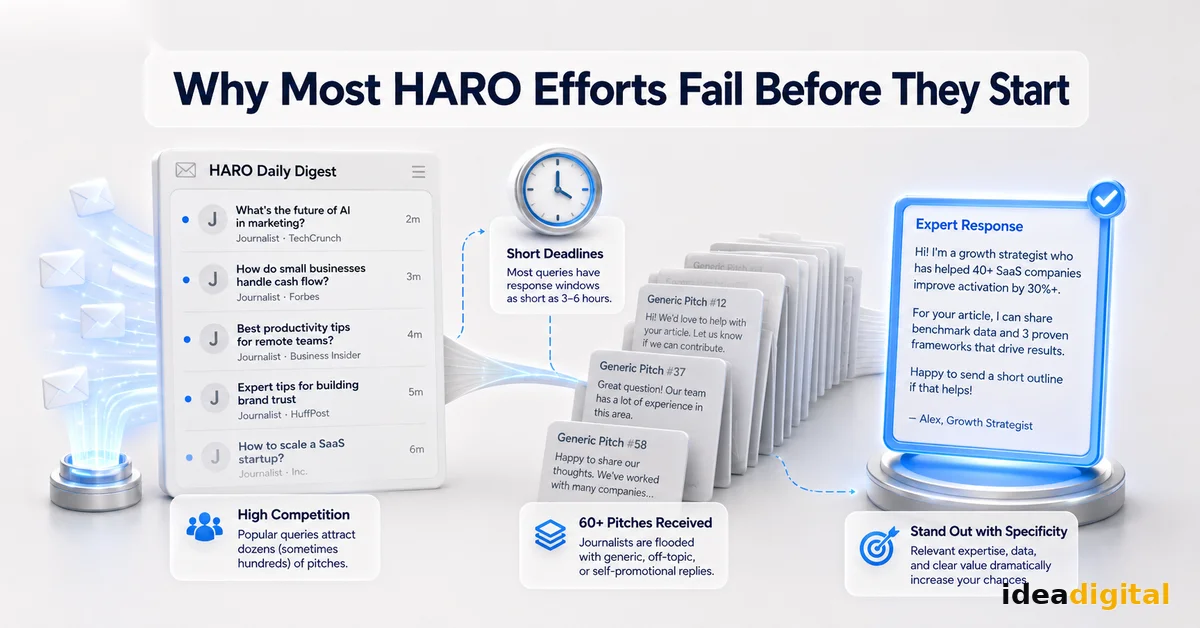
Most businesses get this wrong by treating HARO like a lottery. They read through the digest, find a vaguely relevant query, write a few sentences about their company, and hit send. The journalist receives 60 pitches. Most of them are self-promotional, vague, or not actually answering the question asked. They select the three that are specific, credible, and genuinely useful to the story. The rest go unanswered.
Here is what actually happens when HARO is executed correctly. A journalist is writing about tax planning mistakes small businesses make. An accountant with a firm in Dallas responds with a specific example of a common mistake, the tax code it violates, the dollar impact it typically creates, and how they advise clients to avoid it. That response gets included because it is specific, credible, expert-level, and directly usable in the story. The journalist does not have time to check dozens of pitches for quality. They take the ones that are immediately obvious.
The businesses that earn HARO links consistently are not the ones that respond to the most queries. They are the ones that respond to the right queries with the right level of specificity.
The HARO Link Building Strategy That Produces Consistent Results
A repeatable HARO process has four components: query filtering, pitch construction, follow-up, and tracking.

Component 1: Query Filtering
Not every relevant query is worth responding to. Filtering for the right ones before writing anything saves significant time and concentrates effort where the return is highest.
The filters to apply:
- Publication authority: Skip queries from outlets with low domain authority or no audience. Target queries from journalists at publications with DR 50 or above where possible.
- Specificity of the query: Vague queries (“looking for tips on marketing”) attract generic pitches. Specific queries (“looking for a B2B founder who used LinkedIn to close their first enterprise deal”) attract focused, credible responses. Specific queries have less competition and higher placement rates.
- Fit with your genuine expertise: Only respond to queries where you have a real, specific perspective. Pitching adjacent expertise that you cannot speak to with depth will show in the response and will not get selected.
- Deadline: Most HARO queries have same-day or next-day deadlines. If you see a query the day after it went out, it is almost certainly already filled.
Component 2: Pitch Construction
The pitch itself is the variable that determines whether a response gets selected. The components of a pitch that gets used:
- A direct answer to the question in the first sentence. Do not build to the answer. Start with it.
- Specific details that can only come from genuine experience: numbers, named examples, named frameworks, specific client outcomes.
- Credibility context, briefly: your title, company, and why you are a credible source on this topic. Two sentences maximum.
- No sales language: the journalist is not your customer. Any pitch that sounds promotional will be immediately dismissed.
- Quote-ready formatting: write a clear sentence or two that could be pulled directly into the article as a quote without editing.
A pitch that follows this structure typically runs 150 to 250 words. Longer pitches are less likely to be read in full. Shorter pitches that are still specific and credible are ideal.
Component 3: Tracking and Follow-Up
Most publications do not notify sources when their pitch is used. You find out when you do a periodic search for your brand name or quotes. Set a Google Alert for your name and company name, and do a manual check of the publications you pitched quarterly.
When a link is earned, verify it is a followed link and that it is pointing to the right destination URL on your site. Some publications link to a homepage when a specific page would be more valuable. A polite email to the journalist sometimes results in an updated link.
Component 4: Volume Over Time
A realistic HARO success rate for well-executed pitches from a credible source is 5 to 15 percent. That means responding consistently to 10 to 20 relevant queries per month to earn one to three links per month. Compounded over 12 months, a consistent HARO process can add 12 to 36 high-authority editorial links to a domain. That is meaningful authority growth that compounds into competitive ranking improvements.
HARO sits well within a broader link building program. For a full picture of how it fits alongside other white-hat approaches, the white hat link building strategies guide covers the full stack of legitimate link acquisition tactics and how they work together. For a comparison of HARO versus content-first approaches like guest posting, the guest posting seo guide covers where each method is most effective.
Common HARO Link Building Mistakes

Mistake 1: Responding to Queries Outside Your Genuine Expertise
Pitching adjacent topics because the publication is attractive always reads as inauthentic. Journalists are experienced at detecting when a source does not genuinely know the subject. A weak pitch from a borderline-qualified source is not just ignored. It can flag your email address as a low-quality sender, reducing your placement rate on future queries from the same journalist. Only respond where you have genuine expertise and something specific to say.
Mistake 2: Using a Template Response
Templates exist in HARO pitching because the volume of queries makes templating feel efficient. The problem is that templated responses are identifiable by journalists who receive many pitches, and they signal low effort. Every response should be specifically written for the query. The framing, the example, and the specific angle should reflect what that particular journalist is asking for, not a generic description of what your company does.
Mistake 3: Pitching Without a Specific Example or Data Point
The fastest way to get a HARO pitch ignored is to make a general claim without backing it up. “Many businesses overlook the importance of cash flow planning” is not a useful pitch. “In the past year, three of our clients in the Houston area came to us with cash flow crises that were caused by extending payment terms to new clients without adjusting their own vendor payment schedules, costing them an average of 90 days of working capital” is a useful pitch. Specificity is what makes a source quotable.
Mistake 4: Treating HARO as a Standalone Strategy
HARO produces editorial links, which are among the highest-quality links you can earn. But a HARO-only link building program is limited in volume and scope. The publications that use HARO tend to be general interest and business press rather than industry-specific publications. A complete link building program pairs HARO with industry-specific outreach, guest content on niche publications, and authority building in your specific vertical.
FAQ’s
Is HARO still worth using in 2026?
Yes. Despite increased competition from more businesses using the platform, HARO and its alternatives, including Qwoted, SourceBottle, and Help a B2B Writer, continue to produce high-authority editorial links that are difficult to earn through other methods. The key is response quality rather than volume. Businesses with genuine expertise and a consistent, specific pitching process continue to earn links from top-tier publications through these platforms.
How long does it take to get a HARO link?
Publication timelines vary widely. Some stories are published within days of the query. Others are long-form features that may not be published for weeks or months. You may respond to a query in March and see the article go live in June. Track your pitches and check periodically for publication. For budgeting and reporting purposes, treat HARO as a channel that produces links on a one-to-three-month rolling lag rather than expecting immediate results.
Does a HARO link need to be a followed link to have SEO value?
Followed links pass link equity directly and have clear SEO ranking value. No-follow links from high-authority publications still carry indirect value through brand visibility, referral traffic, and the credibility signal of being cited in a major publication, which can influence other journalists and content creators who link to you in the future. When possible, verify link attribution after publication and use the Rich Results Test or a link checker to confirm follow status.
How do I know which HARO queries are worth responding to?
The highest-priority queries are from publications with DR 50 or above, are specifically written with a clear question you can genuinely answer, have a short deadline that has not passed, and match the core expertise of your business or leadership team. Queries using language like “looking for an expert” or “seeking a business owner who has experienced” are often more responsive to direct, experience-based pitches than open-ended topic queries. Start with one to two responses per digest and scale from there as you calibrate which query types produce results.
Conclusion
A HARO link building strategy is not a passive play. It requires consistent attention, specific expertise, and the discipline to pitch quality over quantity. The businesses that build press link profiles through HARO over 12 to 18 months end up with a category of inbound authority that is very difficult for competitors to replicate quickly, because those links come from real editorial decisions by real journalists, not from outreach at scale.
If you want to understand how HARO fits into a broader link building program and what a realistic authority-building plan looks like for your specific domain and industry, book a free strategy call with our team. We will walk through your current link profile and the highest-leverage acquisition opportunities for your market. Schedule your call here.