

The reason most SEO content fails is not keyword density or heading structure. It is that the content sounds like it was written for an algorithm instead of a person. If you want to write SEO content that ranks, you have to start from a different premise: the content that earns top positions is content that fully serves the reader, and SEO is the discipline that makes that content findable.
Most businesses producing content that does not rank are not writing badly. They are writing for the wrong goal. They optimize titles and headings, hit a word count, and wonder why the content sits on page three. The page is technically correct and humanly unreadable, which is the worst possible combination for organic search in 2026.
This guide covers how to build content that satisfies both requirements without sacrificing either.
Why SEO Content Fails Even When It Looks Right
Let’s be honest: the vast majority of SEO content on the web is interchangeable. Same structure, same keywords in the same positions, same surface-level coverage of the topic. When dozens of pages are nearly identical in their approach, Google has to choose between them on the margin, and the margins are where most pages lose.
Here is what actually happens. A writer receives a brief with a target keyword, a word count, and a list of related terms to include. They write 1,500 words that cover the topic broadly, place the keyword in the expected positions, and deliver a post that passes a superficial SEO check. The post gets published. It ranks on page two or three. It never reaches page one.
The problem is that the content covered the topic without owning it. Covering a topic means writing about it. Owning it means saying something that the top-ranking pages do not say, in a way that serves the reader better than anything currently in the top three results. That difference is what determines whether content earns a place on page one or sits in the middle pages indefinitely.
We have reviewed content programs across dozens of US businesses in B2B, SaaS, and professional services, and the highest-performing content is almost always the piece where the writer brought a genuine perspective, a specific example, or a framework that does not exist anywhere else in the search results. That originality is not a soft editorial preference. It is a measurable SEO differentiator.
How to Write SEO Content That Ranks: The Framework

Step 1: Start with Search Intent, Not a Keyword
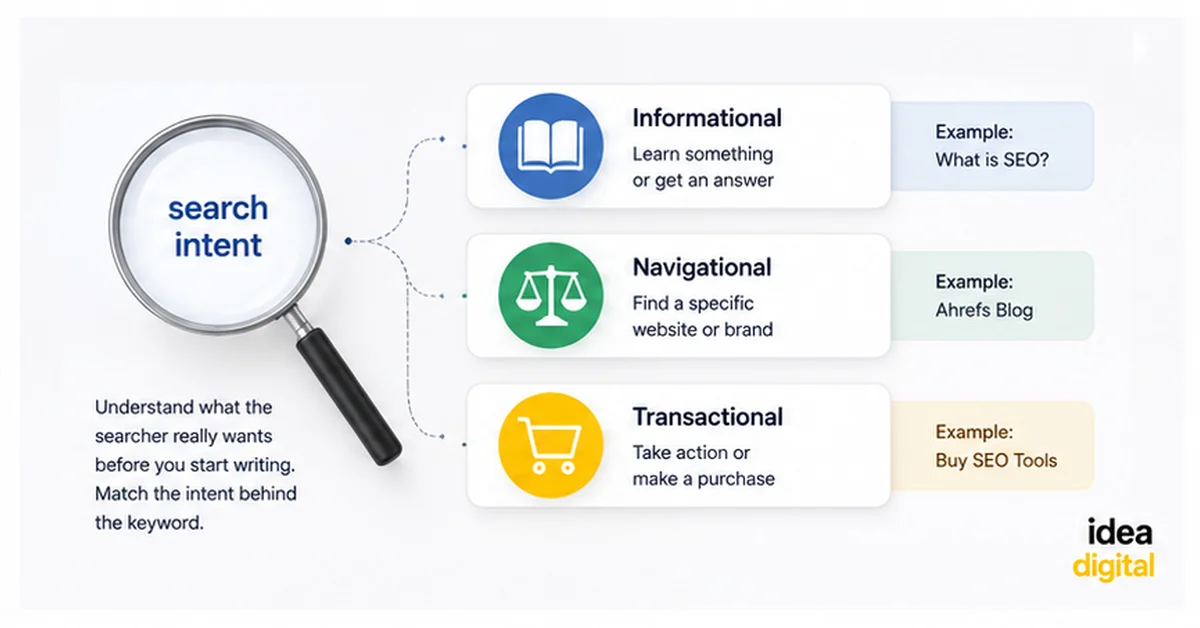
A keyword is a signal of what someone wants. The search intent behind it is what you are actually writing for. Before starting any piece, open the search results for the target keyword and study what is there.
Ask three questions:
- What format does the content take? (Guide, list, comparison, definition, tool)
- Who is it written for? (Expert, beginner, decision-maker, researcher)
- What does it deliver? (Step-by-step process, overview, data, opinion)
The answers tell you what Google believes searchers want when they type that query. If every page-one result is a practical how-to guide written for practitioners, and you write a strategic overview for executives, your content does not match the intent, regardless of how well it is optimized on the page. Match the intent first, then build the content.
Step 2: Build a Structure That Reflects Real Expertise
The structure of good SEO content is not a template. It is a logical progression through a topic that reflects genuine knowledge of the subject. Templates produce content that checks boxes. Structure that comes from understanding the topic produces content that earns trust.
Start with the reader’s state of mind at the moment of the search. What do they already know? What do they specifically not know? What would change if they fully understood this topic? Write the structure around that progression, not around a generic heading framework.
Practically, this means your H2s should represent the actual stages of understanding the reader needs to go through, not just topic categories you identified in competitor research. A reader searching for “how to fix crawl budget issues on a large eCommerce site” needs to understand what crawl budget is, how to diagnose the problem, what the specific eCommerce-related causes are, and how to implement fixes in priority order. That is the structure that serves the reader. It is also the structure that ranks.
Step 3: Keyword Placement That Serves Clarity, Not Just Algorithms
Keywords should appear in the places they naturally belong when someone is writing accurately about a topic. The title, the first paragraph, the primary headings, and throughout the body where the concept is actually being discussed.
What not to do: stuff a keyword phrase into a heading that does not need it, repeat the exact keyword phrase four times in the introduction, or create sections specifically to include a secondary keyword rather than because the section adds value.

What to do instead: write clearly and accurately about the topic. If the content is genuinely about the keyword’s topic, the keyword will appear naturally. If you are fighting to include the keyword in certain places, it is a signal that the content is not actually focused on what the keyword represents.
For a complete guide to keyword placement that covers the specific positions, frequencies, and semantic variation strategies that drive rankings, the keyword placement strategy guide provides the detailed framework.
Step 4: Add the Layer That Competitors Have Not
This is the differentiator that separates content that ranks top three from content that ranks position seven to fifteen. Every piece of content you publish should include at least one element that the current top-ranking pages do not have.
This could be:
- A specific example drawn from real client work or real experience that illustrates a concept that others only describe abstractly
- An original framework or system for approaching a problem that gives the reader a mental model rather than just information
- A data point or statistic from your own business or industry that is not available in the generic sources others cite
- A specific counterargument to a commonly held belief in the industry, backed by reasoning that most content avoids because it is uncomfortable
Originality does not mean novelty for its own sake. It means contributing something to the reader’s understanding that they could not have gotten from the other pages they visited before yours.
Step 5: Write for Scannability Without Sacrificing Depth
Most people who land on SEO content do not read it linearly from start to finish. They scan to find the section relevant to their specific question, read that section, and then either go back to search or continue reading if the content earns it.
Structure your content to support that behavior without letting it undermine depth. Short paragraphs of two to four sentences make scanning easier. Specific, descriptive H2 and H3 headings help readers navigate to what they need. But within each section, the content needs to deliver actual substance, not just confirm that the topic was mentioned.
A section that can be scanned in ten seconds but teaches nothing has failed both the reader and the SEO goal. The standard for each section: if a reader reads only this section, do they understand the concept it is covering? If the answer is no, the section needs more substance.
For a practical process for optimizing existing content that is underperforming, including how to identify and fill coverage gaps relative to competing pages, the content optimization guide provides the step-by-step workflow.
Common Mistakes When Writing SEO Content

Optimizing the Structure Without Optimizing the Substance
SEO structure, meaning title tag, H1, H2 hierarchy, keyword placement, is necessary but not sufficient. A perfectly structured page with thin, generic content will not hold a top three position in a competitive search environment. The businesses that consistently hold top rankings are the ones that invest equally in structure and substance, not primarily in structure. Google’s quality evaluation is increasingly capable of distinguishing between content that is formatted like expertise and content that is expertise.
Writing to a Word Count Instead of a Coverage Standard
Word count is a rough proxy for depth, not a measure of it. A 2,500-word post that covers a topic shallowly is not better than an 1,100-word post that covers the same topic completely. The standard should be: have I addressed the question fully, covered the related questions a reader would naturally have, and left the reader with something genuinely useful? If the answer is yes at 900 words, stop there. If the answer is no at 2,000 words, keep writing.
Avoiding Specific Examples to Keep Content “Universal”
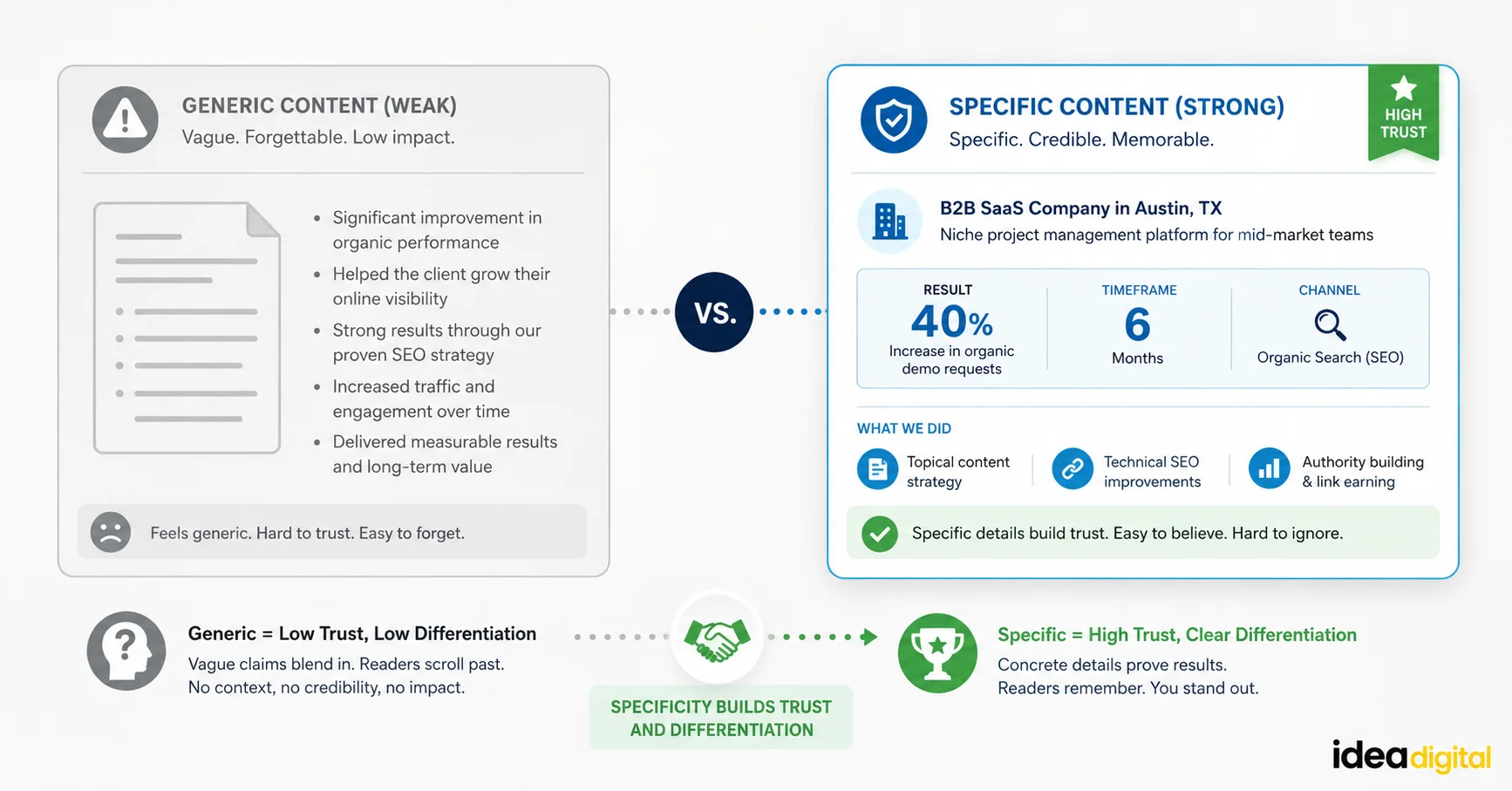
Generic SEO content avoids specific examples because examples make claims that can be challenged. But specificity is exactly what builds credibility with readers and what differentiates the content in a pool of generic alternatives. A reader who encounters “we worked with a B2B SaaS company in Austin that increased organic demo requests by 40 percent within six months by rebuilding their category content architecture” trusts that claim more than “our clients typically see significant improvement in organic performance.” Specificity, not universality, builds trust.
Treating Every Post as Standalone Rather Than Part of a Content System
Individual posts that do not link to related pieces, do not receive internal links from related authority pages, and are not part of a topical cluster structure earn authority slowly and independently rather than benefiting from the surrounding content architecture. Every piece of SEO content should be planned with its internal link context in mind: what does it link to, what should link to it, and how does it fit into the broader topical authority the site is building in that subject area?
FAQ’s
Can AI-generated content rank on Google?
Google has stated that AI-generated content is not automatically penalized, and that content is evaluated on quality regardless of how it was produced. In practice, AI-generated content that is generic, lacks genuine perspective, and does not add value beyond what competitors already say tends to underperform because it fails the quality signals that determine whether content earns and holds rankings. AI is a writing tool. The strategy, the expertise, the original examples, and the differentiating perspective still need to come from a human with genuine knowledge of the subject.
How important is the introduction for SEO performance?
The introduction does two things for SEO. It signals to Google what the page is about through early keyword placement, and it signals to the reader within the first few seconds whether the content is worth reading. Both matter. A strong introduction includes the primary keyword naturally in the first one to two sentences, establishes the specific problem or question being addressed, and gives the reader a clear reason to continue. Pages where visitors immediately leave send negative engagement signals that suppress rankings over time. The introduction is where that decision is made.
How do I balance writing for readers versus writing for search engines?
The tension between these two goals is mostly false. Content that genuinely serves readers, by fully answering their questions with appropriate depth and original perspective, is also the content that performs best in search. The practical resolution is to write for the reader first and verify the SEO elements afterward. If the content is genuinely about the target topic, the keyword will appear naturally. If it does not, the content needs to be refocused, not keyword-stuffed.
How often should I update existing SEO content?
Content on competitive topics with time-sensitive information should be reviewed and updated every six to twelve months. Evergreen content on stable topics can be reviewed annually. The trigger for an update is not time alone. It is whether the page is losing ground in rankings, whether statistics or examples in the content have become outdated, or whether competitor pages have been updated to cover subtopics your page does not address. Updating content and signaling that freshness through updated publish dates can recover rankings on pages that have slipped due to content decay.
Conclusion
The difference between content that ranks and content that does not is usually not a technical SEO problem. It is a substance problem. To write SEO content that ranks consistently, you need the structure that helps Google evaluate it and the originality that makes it worth ranking above everything else. Businesses that get both right, at scale, over time, are the ones that build organic channels that compound in value rather than requiring constant reinvestment.
If you want to understand why your current content is not performing at the level your business needs, and what a content strategy built for your specific market and goals would look like, book a free strategy call with our team. We will walk through your content performance data and show you exactly what needs to change. Schedule your call here.