

A Google penalty is one of the most disruptive events an online business can experience, and the path to recovery is slower and more methodical than most businesses want to hear. Google penalty recovery in SEO is not a fix you apply over a weekend. It is a structured process that takes weeks to execute and months to see full results, and doing it wrong the first time adds significant time to the timeline.
We have worked through penalty recovery with businesses across the US, from eCommerce brands in Los Angeles to professional service firms in Chicago. The ones that recover fastest are not the ones that move quickest. They are the ones that diagnose accurately before they act, because the treatment depends entirely on what caused the penalty.
Here is the full process, in order.
Step 1: Identify Whether You Have a Manual Action or an Algorithmic Penalty
This is the most important diagnostic step, and most businesses get it wrong by assuming they know which one they have before checking.
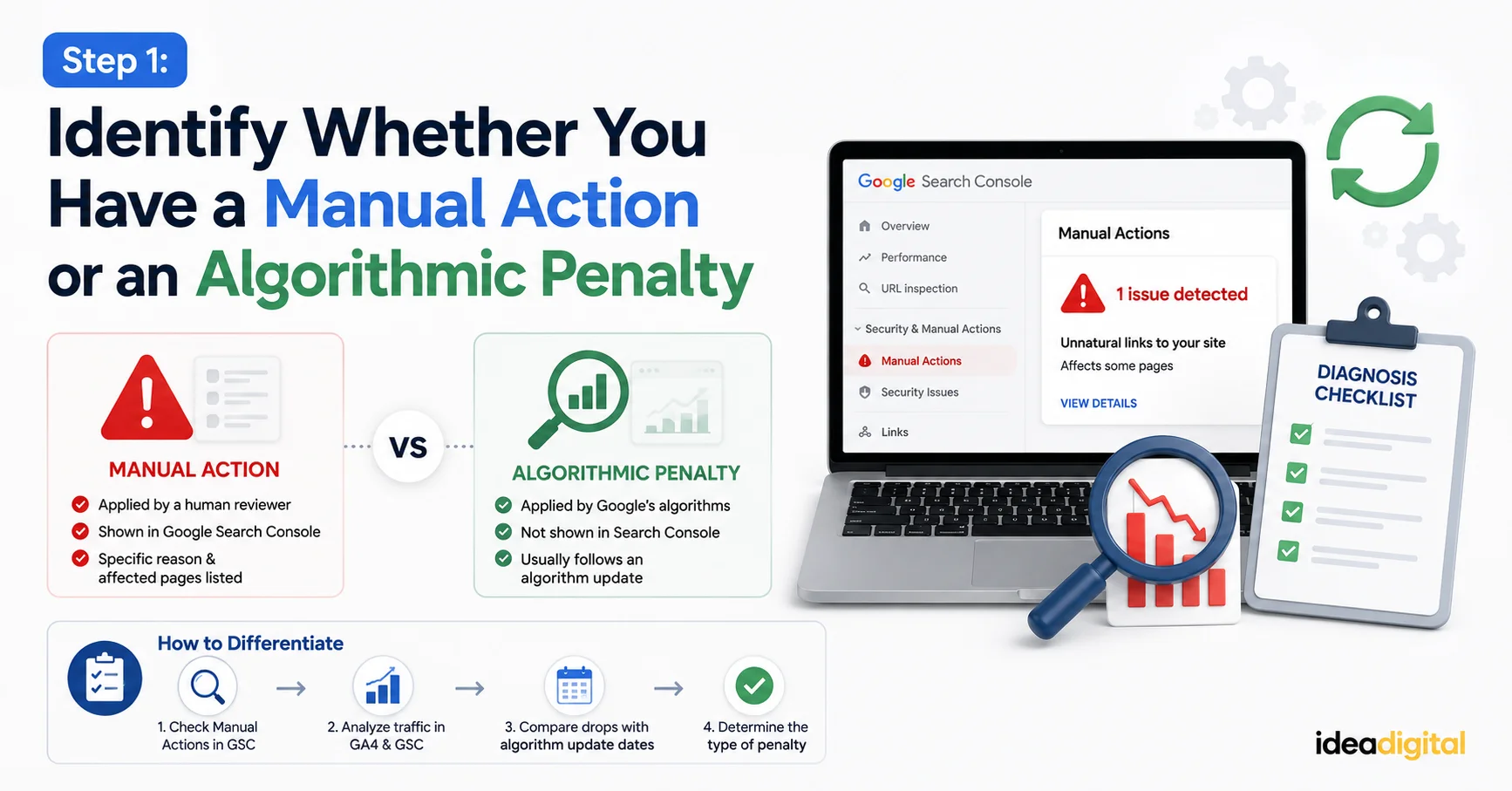
A manual action is applied by a human reviewer at Google and will appear explicitly in Google Search Console under Security and Manual Actions, then Manual Actions. If a manual action is present, you will see the specific category of the violation, the pages affected, and the date applied. Manual actions are the more serious category, but they are also more specific and therefore more straightforward to resolve once the root cause is addressed.
An algorithmic penalty is not flagged in Search Console. It is an invisible devaluation applied by Google’s automated systems, typically following an algorithm update that better identifies a pattern the site’s strategy relied on. Algorithmic penalties look like traffic drops correlated with known algorithm update dates, without any notation in Manual Actions.
How to differentiate them:
- Check Search Console Manual Actions section. If anything is listed, you have a manual action.
- Pull your organic traffic data from GA4 and Google Search Console for the past 12 to 24 months.
- Cross-reference traffic drops against Google’s confirmed algorithm update dates using a resource like Google’s algorithm update history or Semrush’s Sensor tool.
- If the drop aligns precisely with an update date and no manual action appears in Search Console, you are dealing with an algorithmic issue.
The recovery path is different for each, and mixing them up wastes significant time and resources.
Step 2: Google Penalty Recovery SEO: The Recovery Process by Penalty Type
Manual Action Recovery
Manual actions are issued in specific categories. The most common are: unnatural links to the site, unnatural links from the site, thin content, cloaking or sneaky redirects, pure spam, and user-generated spam. Each requires a different corrective action.

The recovery process for a manual action follows a structured sequence:
- Read the manual action notice carefully. Google’s notice specifies the category and usually provides example pages or links. This is the starting point, not general guidance.
- Address the root cause completely. For link-related manual actions, this means auditing the full backlink profile, identifying all manipulative links, attempting to remove them by contacting site owners, and documenting the removal attempts. For content-related actions, this means identifying and improving or removing the thin, duplicate, or manipulative content cited.
- Build a comprehensive disavow file for links that cannot be removed. The disavow file instructs Google to ignore specific links or entire domains when evaluating your site. This file needs to be precise: over-disavowing legitimate links causes additional ranking damage.
- Submit a reconsideration request through Search Console. The request needs to demonstrate specifically what caused the issue, what actions were taken to resolve it, and why it will not recur. A vague reconsideration request will be rejected. Google’s review team reviews these manually, and a rejected request sends you back to the beginning of the queue.
- Wait. Manual action reviews can take weeks. During this period, additional changes to the site can reset the review process.
For a structured approach to identifying and removing problematic links as part of the recovery process, the backlink audit remove toxic links guide covers the methodology in detail.
Algorithmic Recovery
Algorithmic recovery is often slower than manual action recovery because there is no formal resolution process and no Google confirmation that the issue is resolved. The site simply needs to address what the algorithm is penalizing, and then wait for the next algorithmic refresh.
The most common algorithmic issues and their fixes:
| Algorithmic Issue | Signal | Fix |
| Thin or low-quality content | Large volume of pages with limited unique content | Improve or consolidate thin pages, remove low-value content |
| Unnatural link profile | High proportion of low-quality, irrelevant, or paid links | Disavow toxic links, build legitimate editorial links |
| Core update quality issues | E-E-A-T signals low on YMYL pages | Add author credentials, improve content depth and accuracy |
| Helpful Content system | Content appears written for search engines rather than readers | Rewrite for genuine reader value, add original perspective |
| Technical quality issues | Crawl issues, duplicate content, poor Core Web Vitals | Full technical audit and remediation |
The technical seo checklist covers the full range of technical issues that can contribute to algorithmic ranking suppression and serves as the foundation for any technical recovery effort.
Algorithmic recovery timeline is typically six to twelve months after the corrections are made and another major update rolls through to re-evaluate the site.
How to Audit the Root Cause Before Starting Recovery
Before any recovery action, a complete audit is essential. Starting recovery without a complete diagnosis produces incomplete fixes that leave the underlying problem partially intact.

The audit covers:
- Full backlink profile review: use Ahrefs, Semrush, or Majestic to pull all referring domains. Classify each by quality: editorial and relevant, low-quality but benign, potentially manipulative, and clearly violating Google’s guidelines.
- Content audit: crawl the site and identify pages that are thin, duplicated, or clearly keyword-focused rather than user-focused. Map these to the manual action or algorithmic pattern being addressed.
- Technical audit: check for crawl errors, indexation problems, Core Web Vitals failures, security issues, and duplicate content created by URL parameters or site architecture. Technical problems compound the recovery timeline if left in place during the recovery process.
- Historical traffic analysis: identify the specific pages, keyword categories, and time periods where rankings were lost. This provides the baseline for measuring recovery progress.
Working from assumptions rather than data is the most common reason recovery takes longer than it should.
Common Mistakes in Google Penalty Recovery

Mistake 1: Submitting a Reconsideration Request Too Early
The reconsideration request is often submitted before the underlying problems are fully resolved. The reviewer assesses the site, finds remaining issues, and rejects the request. Each rejection adds delay. The right sequence is to fully resolve the issue, document everything, and only then submit the request with comprehensive supporting documentation. Rushing the submission wastes the most valuable resource in penalty recovery: the reviewer’s time and attention.
Mistake 2: Disavowing Too Aggressively
Businesses responding to a link-related manual action sometimes submit disavow files that include legitimate, high-quality links alongside the problematic ones, out of caution. Disavowing good links removes real authority from the domain, which compounds the ranking suppression from the penalty itself. The disavow file should include only links that are clearly manipulative or toxic. When in doubt about a borderline link, err on the side of leaving it in place rather than disavowing it.
Mistake 3: Not Addressing the Process That Created the Problem
A recovered site that re-engages the same practices that caused the penalty will be penalized again, typically more severely the second time. If the penalty was caused by a link building service that used PBN links, replacing that service with another PBN-based service after recovery leads directly back to the same outcome. Recovery must include changing the process, not just cleaning up the current evidence of it.
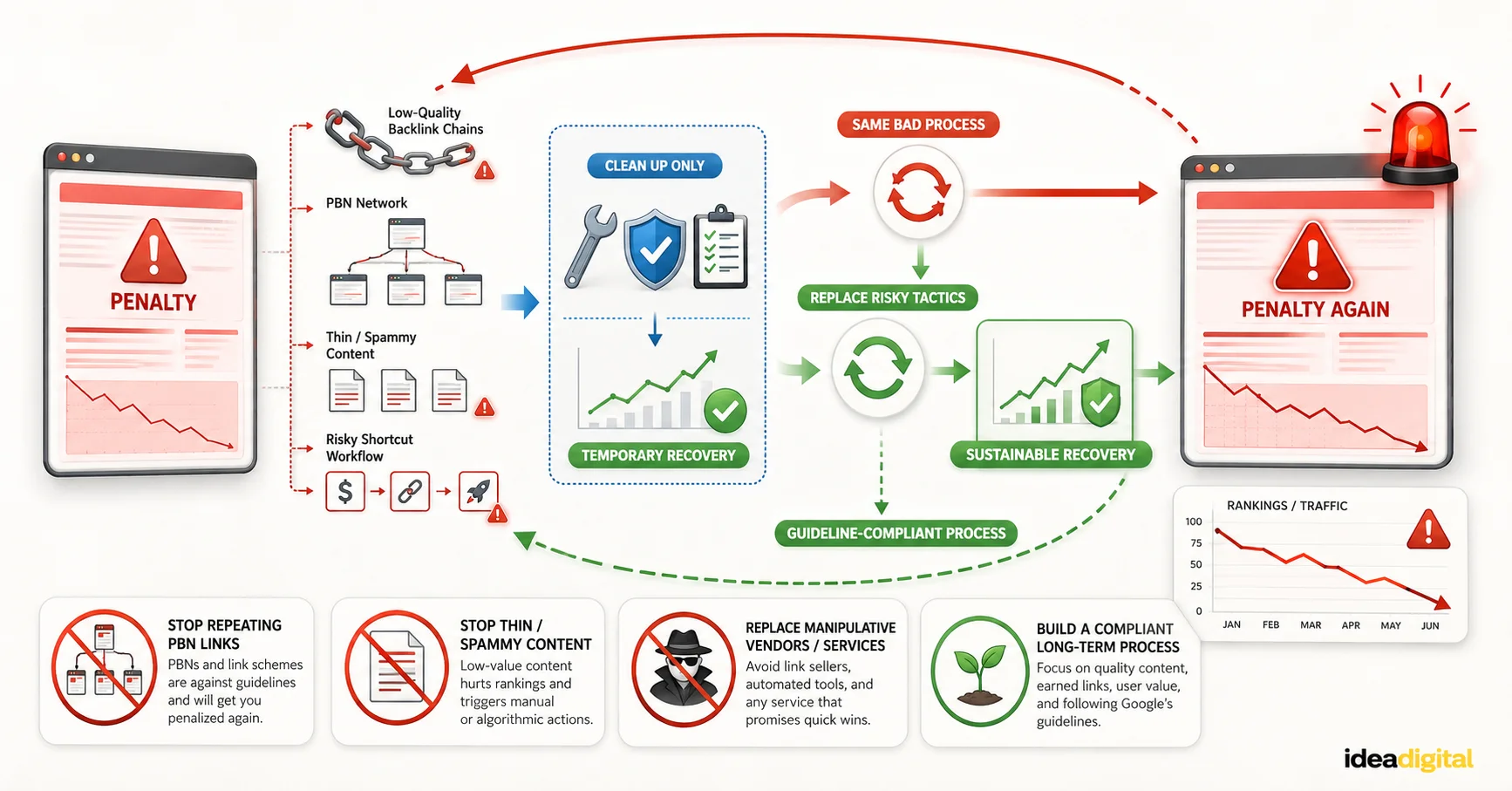
Mistake 4: Treating Algorithmic Recovery as a One-Time Fix
Algorithmic issues are not resolved by a single cleanup. They require ongoing improvement to content quality, link profile, and technical health. Google re-evaluates sites continuously, not just during named core updates. A site that completes a cleanup and then plateaus will be evaluated on the new baseline, which may be an improvement but may still fall short of the threshold required for recovery. Sustained improvement over six to twelve months is the standard, not a one-time action.
FAQ’s
How long does it take to recover from a Google manual action?
After a reconsideration request is submitted with complete remediation documentation, Google’s review team typically processes it within two to six weeks. If the request is approved and the manual action is lifted, rankings begin recovering as Google recrawls and re-evaluates the cleaned-up site, which can take an additional four to eight weeks. The total timeline from penalty identification to meaningful ranking recovery is typically two to five months for manual actions when the process is executed correctly on the first submission.
Can a website fully recover from a Google penalty?
Yes, in most cases. Sites that receive and resolve manual actions typically recover to near-previous ranking levels within six to twelve months of the action being lifted, particularly if the underlying content and link quality are strong.
Algorithmic recovery depends on the severity of the original issues and how comprehensively they are addressed. Sites that were heavily dependent on manipulative tactics may not return to previous ranking levels in competitive categories without building a legitimate SEO foundation that can compete on its own merits.
Does disavowing links help with algorithmic penalties as well as manual actions?
Disavowing is primarily designed for manual link-related actions, but a heavily manipulative link profile can also contribute to algorithmic suppression, particularly in the context of Google’s link spam algorithms.
Cleaning up a toxic link profile through a combination of removal and disavowal can help algorithmic recovery, but it is typically one factor among several rather than a complete solution. Algorithmic issues usually require addressing content quality, E-E-A-T signals, and technical health simultaneously.
Should I continue publishing content during penalty recovery?
Yes, for algorithmic issues, continuing to publish high-quality content that addresses the patterns causing the penalty is part of the recovery. For manual actions, avoid making large-scale content changes while a reconsideration request is pending, as changes can complicate the review. After a manual action is resolved, resuming a content program focused on genuine user value is the right approach. Publishing content during algorithmic recovery signals to Google that the site is actively improving, which is a positive factor in how the next algorithmic re-evaluation will assess the site.
Conclusion
Google penalty recovery in SEO is a disciplined process, not a quick fix. The businesses that recover successfully and rebuild durable organic rankings are the ones that diagnose accurately, fix completely, and change the underlying practices that caused the problem. Recovery is not the end state. It is the starting point for building an SEO program that compounds rather than carries risk.
If your site has experienced a significant ranking drop and you want a clear diagnosis of what caused it and what the recovery path looks like, book a free strategy call with our team. We will review your Search Console data, traffic history, and link profile, and tell you exactly what you are dealing with. Schedule your call here.