

Most businesses that hire an on-page SEO agency have already tried doing it themselves. They have added keywords to title tags, updated headings, published more content, and watched rankings stay exactly where they were. The issue is almost never that they are doing the wrong things. It is that they are doing the right things in the wrong priority order, at insufficient depth, or without the competitive context that determines whether an optimization actually moves a ranking.
A capable on-page SEO agency does not just run through a checklist. It analyzes why specific pages are not ranking, identifies what the current top-ranking pages have that yours do not, and executes improvements that close that gap systematically. The result is ranking movement on pages that drive revenue, not just activity on a report.
Here is what that process actually looks like.
What an On-Page SEO Agency Actually Does
On-page SEO covers everything within the page itself that influences how Google evaluates and ranks it: title tags, meta descriptions, heading structure, content depth and relevance, keyword placement, schema markup, internal linking, image optimization, and page speed signals at the individual page level.
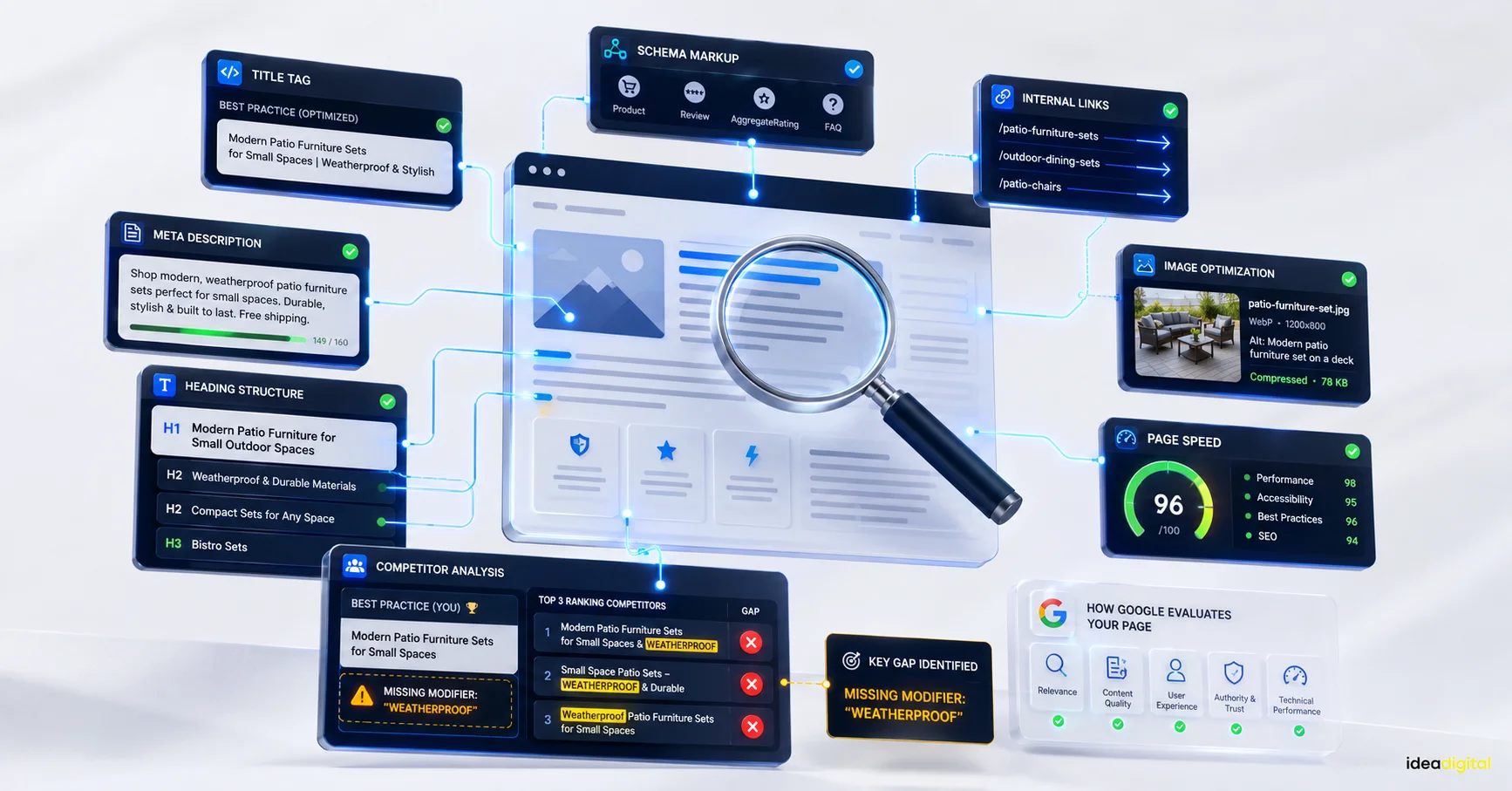
An agency handling on-page SEO should be doing this work in the context of competitive analysis, not just internal audits. There is a meaningful difference between “your title tag is too long” and “your title tag is missing the modifier term that the top three ranking pages all include, which is why you are ranking position eight instead of position two.”
The second type of insight requires someone to actually look at what is ranking above you and understand why. That analysis, applied systematically across your highest-value pages, is where on-page SEO produces measurable outcomes rather than just formatting improvements.
For a full breakdown of the specific elements a proper on-page audit should cover, the on-page seo audit checklist walks through all 15 elements and what each one needs to accomplish to actually affect rankings.
On-Page SEO Agency: What the Work Looks Like in Practice

Page-Level Competitive Analysis
Before touching anything on a target page, a good agency pulls the current rankings for the target keyword and analyzes the pages sitting above yours. This analysis looks at: heading structure and how major subtopics are organized, content length and coverage depth, schema markup presence and type, keyword usage patterns, and internal link context coming from other pages on the site.
This analysis reveals the specific gaps that are holding your page back. It is precise enough to prioritize: if the top three results all have an FAQ section with schema and yours does not, that is a high-priority gap. If all three have original data or examples that yours lacks, that is a content depth gap. The competitive analysis determines what actually gets fixed and in what order.
Title Tag and Meta Optimization at Scale
Title tags are the most leveraged on-page element and consistently one of the most poorly optimized across US business websites. Not because businesses do not know they matter, but because optimizing them correctly at scale requires understanding the specific keyword modifiers searchers use, the character limits that prevent truncation, and the balance between keyword inclusion and click-through rate appeal.
An agency optimizing title tags is not just adding the keyword. It is identifying the modifier terms that appear in competing titles (location terms, use case terms, buying-intent terms), testing the phrasing that most accurately reflects search intent, and ensuring the title tag differentiates the page from the competing pages above it rather than blending in with them.
Content Depth and Gap Filling
Content gaps are the most common reason well-optimized pages cannot break into the top three positions. A page that covers a topic broadly but misses two or three subtopics that competitors cover specifically will consistently rank below those competitors regardless of how clean the other on-page signals are.
An agency identifies these gaps by comparing your content against top-ranking pages and flagging the specific sections, questions, and supporting details that are present in competing content but absent from yours. The fixes range from adding a section to expanding existing sections to rewriting portions that cover the topic at a different level of depth or from a different angle than what buyers are looking for.

Schema Markup Implementation
Schema structured data tells Google explicitly what type of content is on the page and makes certain rich result formats available in search. A service page without LocalBusiness schema, a product page without Product schema, or an FAQ page without FAQ schema is leaving both click-through rate opportunity and ranking signals on the table.
Most businesses either have no schema or have schema that was implemented incorrectly and is generating errors in Google’s Rich Results Test. An agency implementing schema correctly means: the right schema type for the page, accurate data populated in every required field, no errors or warnings, and validation against Google’s current requirements. The ranking and CTR impact of properly implemented schema is one of the faster on-page wins available.
Internal Linking Audit and Restructuring
Internal links are the mechanism through which authority flows from high-authority pages to the pages that need it most. A high-quality content piece that attracts external links but has no internal links pointing to your target service or category pages is generating authority that stops at the content piece rather than flowing to the commercial pages.
An agency auditing internal linking identifies: which target pages have no inbound internal links (orphan pages), which high-authority pages could contextually link to target pages but currently do not, and whether the anchor text of existing internal links reflects the keywords the target pages are trying to rank for. Restructuring internal links on an existing site is often one of the highest-return activities in on-page SEO, because it uses authority already earned rather than requiring new external acquisition.
For broader context on how to evaluate an agency’s approach before committing, the best seo agency local businesses guide covers what separates credible agencies from those that produce reports without results.
What to Expect When Working with an On-Page SEO Agency

Realistic expectations matter. On-page improvements produce ranking movement on a timeline that depends on how frequently Google recrawls the site and how competitive the target keywords are.
| Activity | Expected Timeline for Results |
| Title tag and meta updates | 2 to 6 weeks for ranking movement on affected pages |
| Content depth improvements | 4 to 10 weeks for Google to re-evaluate updated content |
| Schema markup implementation | 2 to 4 weeks for rich result eligibility to appear |
| Internal link restructuring | 4 to 8 weeks as authority redistribution takes effect |
| Page speed improvements | 2 to 6 weeks for Core Web Vitals field data to update |
These timelines assume the work is implemented correctly and that Google crawls the updated pages promptly. Businesses in competitive US markets may see changes at the faster end because their sites are crawled more frequently. Smaller sites with lower crawl frequency may be at the longer end.
Common On-Page SEO Agency Mistakes
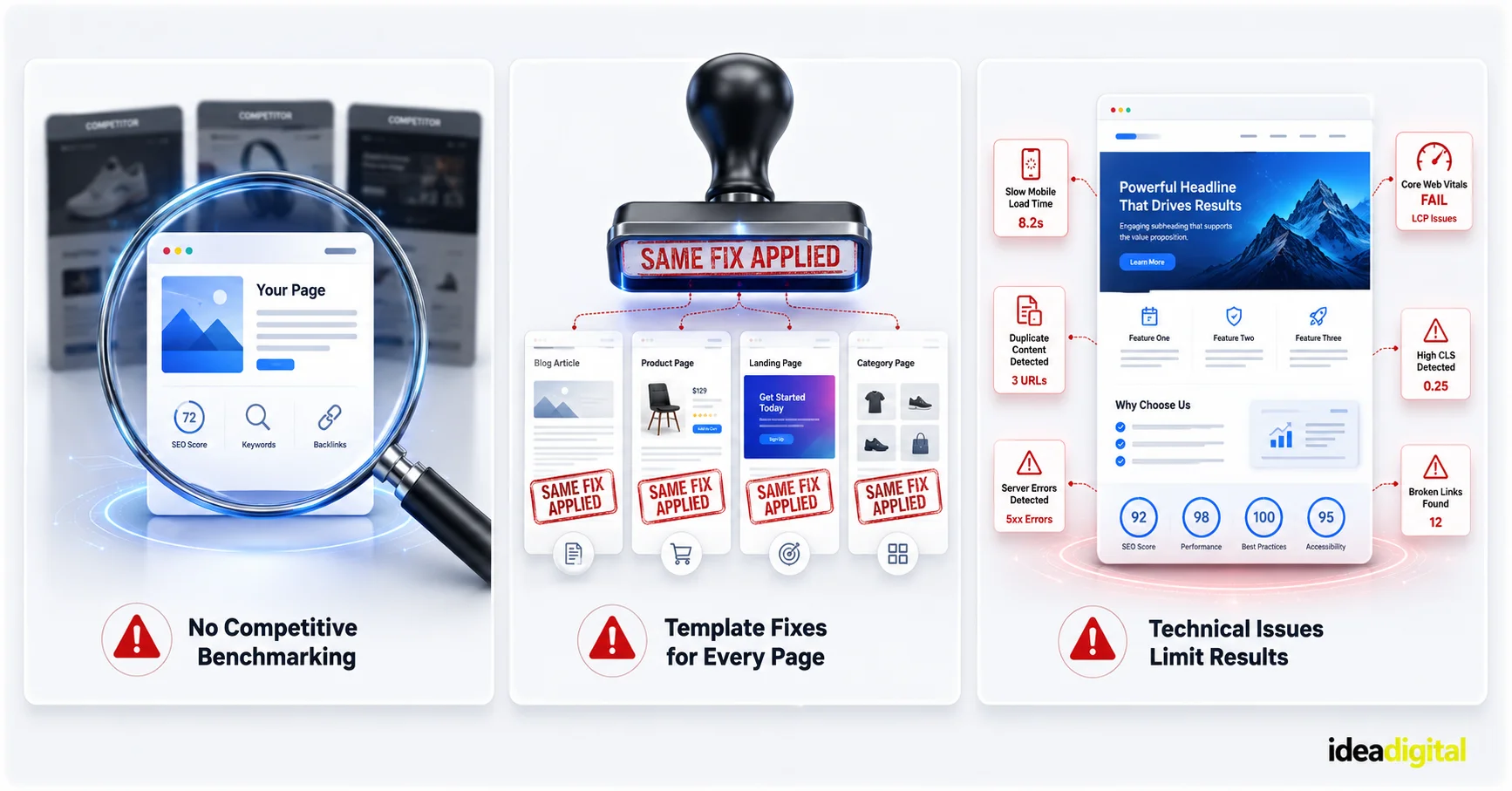
Mistake 1: Optimizing Without Competitive Benchmarking
The most common on-page SEO mistake we see when businesses come to us after working with other agencies is that the previous work was done in isolation. Title tags were improved based on best practice guidelines without looking at what the competing pages are doing. Content was updated to cover more topics without identifying the specific topics that competing pages cover and yours do not. On-page optimization that is not grounded in what is actually outranking you produces improvement without competitive advantage.
Mistake 2: Applying Template Fixes Without Page-Level Diagnosis
Every page that needs on-page improvement has a different reason for underperforming. A page on position eight for one keyword might need content depth work. A page on position eight for a different keyword might need better internal links. A third page might have perfectly good content but a title tag that is driving a low click-through rate from the impressions it is already earning. Applying the same fixes to every underperforming page is not a strategy. It is a hope. The diagnosis determines the fix.
Mistake 3: Separating On-Page Work from Technical Health
On-page optimization applied to pages with significant technical problems produces results far below potential. A page with excellent title tags, strong content, and correct schema that is also loading in six seconds on mobile, failing Core Web Vitals, and sitting within a duplicate content cluster is carrying structural disadvantages that on-page work alone cannot overcome. The agencies that produce consistent on-page results address technical health in parallel with content and element optimization.
FAQ’s
How quickly does on-page SEO produce results?
Most on-page improvements show visible ranking movement within four to eight weeks, with some fast changes like title tag updates showing movement in as little as two to three weeks. Content depth improvements take slightly longer, typically four to ten weeks, because Google needs to recrawl and re-evaluate the updated content. Pages on sites that are crawled frequently by Google, typically higher-authority domains or sites that publish content regularly, tend to show faster response to on-page changes.
Does on-page SEO alone move competitive keywords or do I also need links?
For low-to-moderate competition keywords, on-page optimization often produces meaningful ranking improvement without additional link acquisition. For competitive keywords where the top-ranking pages have significantly more referring domain authority, on-page optimization is necessary but not sufficient. In those cases, on-page work brings the page to a point where it can compete, and off-page authority building determines whether it reaches the top three. The best programs address both in parallel rather than sequentially.
What is the difference between on-page SEO and content marketing?
On-page SEO refers to the technical and structural optimization of existing pages: title tags, headings, schema, internal links, and content depth. Content marketing refers to the creation of new content designed to attract buyers, build topical authority, and generate organic traffic over time.
The two overlap significantly, because new content needs to be on-page optimized to rank, and on-page optimization of existing content is often effectively the same as improving content quality. The distinction matters for scoping: on-page SEO is primarily an optimization discipline, content marketing is primarily a creation and strategy discipline.
How do I know if the on-page SEO work an agency did actually improved performance?
Measure keyword rankings on specific target pages before and after implementation using a rank tracking tool, and cross-reference with Google Search Console impression and click data for the same pages and keywords. Improvements in average position, click-through rate, and organic traffic from target pages within six to ten weeks of on-page changes are the primary signals. An agency should provide before-and-after ranking benchmarks as standard reporting, not require you to pull the data yourself.
Conclusion
An on-page SEO agency that produces results treats every page as a specific competitive problem, not a formatting exercise. The businesses that see consistent ranking improvements from on-page investment are the ones working with an agency that starts with what is actually ranking above them, identifies the specific gaps, and executes the fixes in the order that produces the most ranking movement for the investment made.
If you are ready to work with a team that measures success the same way you do, by revenue not rankings, request your custom growth proposal today. We will audit your highest-value pages and show you exactly what on-page improvements will produce the most competitive impact for your specific market. Request your proposal here.