
Choosing the wrong link building services agency is one of the most expensive mistakes in SEO. Not because you lose the investment, though you do. But because low-quality link building creates a liability that costs more to clean up than it costs to build. And unlike most marketing mistakes, this one can take months or years to fully reverse.
The difference between agencies that produce durable ranking improvements through link building and those that create short-term gains followed by algorithmic penalties is specific and identifiable before you hire. It comes down to how they acquire links, what sites they target, how they report the work, and whether they connect that work to business outcomes or just to domain rating metrics that only an SEO tool can see.
Here is what a credible link building services agency should actually deliver.
What Link Building Services Should Include
A complete link building service is not a single tactic. It is a set of methodologies applied in combination, targeting different types of referring domains and different types of editorial opportunities. Agencies that offer only one link type, or that will not explain what types of sites they target, are almost always cutting corners in ways that create risk.
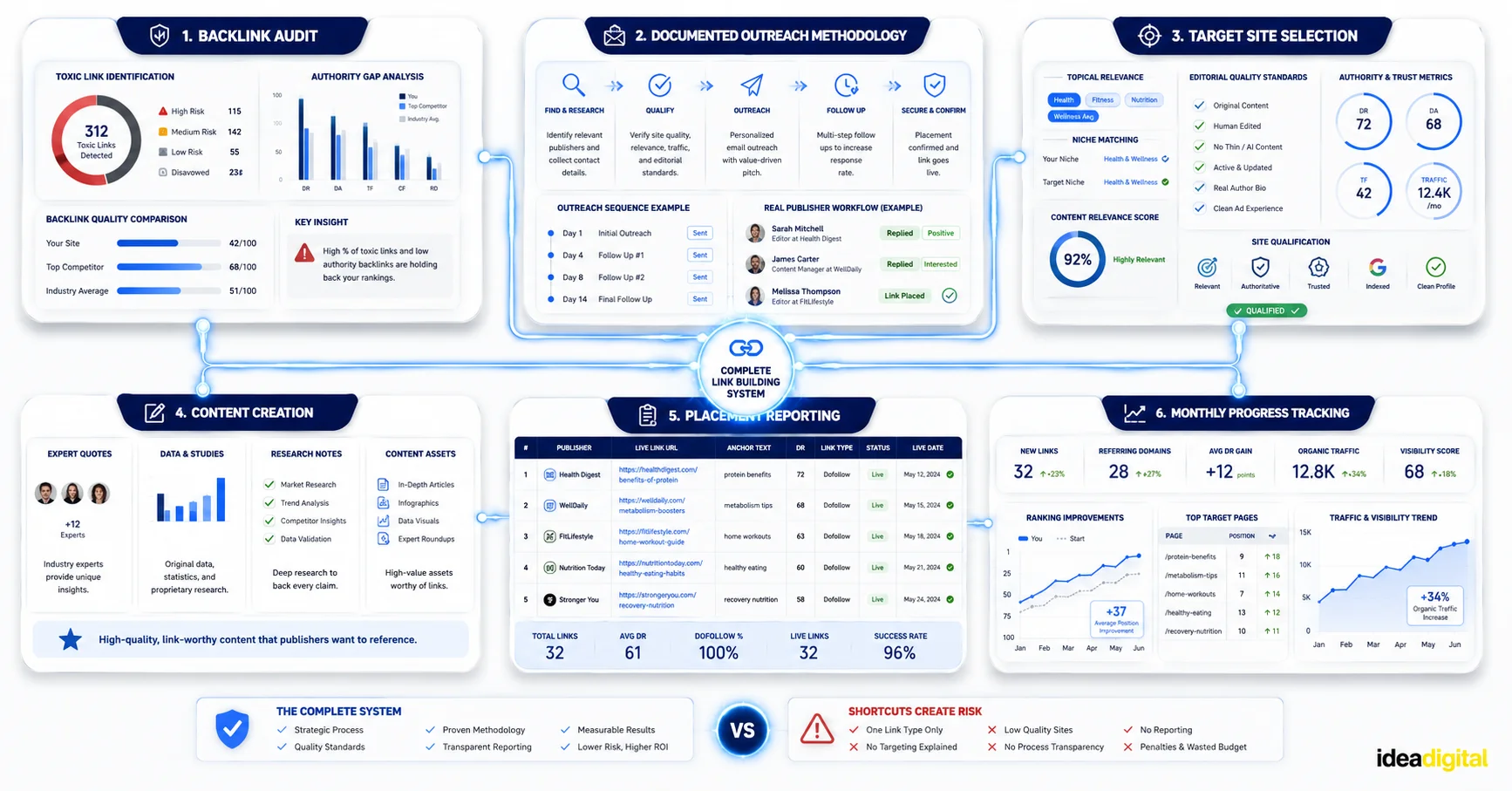
A credible link building program should include:
- A baseline backlink audit of the current link profile.
Before any new links are built, the agency should understand what exists, identify any toxic links that need disavowal, and establish a clear picture of which pages need link support and what authority gap exists between those pages and the pages currently ranking above them. - Documented outreach methodology.
The agency should be able to explain, in plain terms, how they identify link targets, who they contact, what they offer in exchange for the link, and how the editorial relationship is handled. Vague descriptions like “we have a network of publishers” are a red flag. Legitimate link acquisition involves real outreach to real publications. - Target site selection criteria.
Links from sites that are topically relevant to the client’s industry, that have real readership, that maintain genuine editorial standards, and that do not accept links from anyone who pays are worth acquiring. Links from content mills that take payment from any business for any topic are not worth acquiring, regardless of domain authority scores. - Content creation or asset provision.
Most legitimate link placements require something worth linking to: an expert quote, a contributed article, a data study, or a resource that a journalist or publisher considers genuinely useful to their audience. Agencies that build links without producing or working with existing content are either using PBNs or content mills. - Placement reporting with accessible verification.
Every link placed should be reported with the specific URL on the referring domain, the URL on your domain that is receiving the link, the anchor text used, and whether the link is followed or no-follow. You should be able to click the link in the report and see it in the article. No exceptions. - Month-over-month progress tracking connected to ranking movement.
The goal of link building is ranking improvement on specific target pages. Monthly reporting should connect new links to the ranking trajectory of the pages receiving them, not just report a DR increase.
For a complete breakdown of the tactics that constitute legitimate link building and how they differ from manipulative schemes, the white hat link building strategies guide covers every approach and what distinguishes each one.
Link Building Services Agency: How to Evaluate Your Options
The evaluation process before hiring a link building agency comes down to five specific questions. Any agency worth hiring should answer all five clearly and specifically.

Question 1: What types of sites do you build links from?
The answer should include specifics: relevant trade publications, industry blogs, regional news sites, resource pages, journalist-sourced placements. It should not be “high DA sites” or “our partner network.” If an agency cannot or will not name the categories of sites they work with and explain why those categories are appropriate for your business, do not hire them.
Question 2: Can you show me examples of past placements for clients in similar industries?
A credible agency can show you actual published articles or pages where they have placed links for clients in comparable industries. They should be able to share URLs. If they decline to show placements due to confidentiality, ask for anonymized examples with the referring domain visible. A complete refusal to show any placement examples is a red flag.
Question 3: How do you handle link removal requests if a placement goes live on an inappropriate site?
Mistakes happen. A site that appeared credible during research may turn out to be a content mill or part of a link scheme. A credible agency has a policy for addressing this. If they have never considered the question, they are not running a quality-controlled program.
Question 4: What is the expected volume of placements per month and what does each placement cost to produce?
Understanding the economics tells you whether the pricing is realistic for the methodology. Legitimate editorial outreach producing links from real publications costs between $200 and $600 per placement in labor alone. An agency offering 20 links per month for $300 total is either using PBNs or content mills. The math does not support legitimate link acquisition at that pricing.
Question 5: How will you connect link building activity to ranking outcomes?
Reporting that shows links placed without connecting them to ranking movement on target pages is incomplete. Ask what the reporting structure looks like and how they measure the impact of link acquisition on the keywords and pages you care about.
What to Expect: Realistic Link Building Timelines and Outcomes

We have worked with businesses across multiple US markets, and the pattern is consistent. Legitimate link building produces compounding authority improvements that translate to ranking movement on a timeline that is slower than paid advertising and faster than most people expect once the program reaches six months of consistent execution.
| Timeline | What Typically Happens |
| Month 1 | Backlink audit complete, target pages identified, outreach and content production begin |
| Months 2 to 3 | First placements live, Google beginning to discover and evaluate new links |
| Months 4 to 6 | Ranking movement visible on target pages, authority gap narrowing on competitive terms |
| Months 7 to 12 | Compounding effect of accumulated links visible in ranking stability and new keyword entries |
| Year 2 onward | Domain-level authority compounds, new pages rank faster, competitive advantage builds |
Businesses that give up link building at months four to six, when results are starting to appear but are not yet dramatic, consistently underperform compared to those that run programs for 12 to 18 months. Authority building compounds. Stopping before the compound effect arrives is the most common reason link building programs fail to produce the returns they are capable of.
Common Mistakes When Hiring a Link Building Services Agency

Mistake 1: Evaluating Price Per Link Without Evaluating Link Quality
A link that costs $50 and a link that costs $500 are not the same product. The $50 link is almost certainly from a content mill or PBN. The $500 link is a legitimate editorial placement in a real publication. Using cost per link as a primary evaluation metric leads to cheap links that produce no meaningful authority and eventually create disavow cleanup costs. Evaluate the quality of the links being built, not the cost per link in isolation.
Mistake 2: Not Reviewing the Actual Referring Sites Before Committing
Any link building agency should be willing to show you the types of sites they place links on, and ideally sample URLs. Before committing to a program, visit five to ten of the sites where your links would be placed. Check the quality of the content, the nature of the other businesses being linked to, and whether the site has genuine readership. Content mills are easy to identify: they publish on every conceivable topic, the articles are thin, and the content exists to host links, not to inform readers.
Mistake 3: Treating Link Building as a Campaign Rather Than a Program
Campaigns have start dates and end dates. Authority building is continuous. Competitors are building links every month. A company that runs a four-month link building campaign and then stops will see relative domain authority decline as competitors’ programs continue. The businesses that hold top positions in competitive US markets have been running consistent link acquisition programs for years. Framing link building as an ongoing operational investment rather than a campaign changes the return significantly.
For broader context on how to evaluate agency options beyond just link building, the best seo agency local businesses guide covers the evaluation criteria that apply across SEO services.
FAQ’s
How many links do I need per month to see ranking improvement?
Volume alone is not the right metric. Four to eight high-quality links per month from topically relevant, editorially credible sources will produce more ranking impact than 40 links from low-quality directories or content mills. The right benchmark is competitive: pull the referring domain profile of the pages ranking above your target pages and estimate how long it would take to close that gap at your current acquisition rate. That calculation, not an arbitrary monthly target, is how to evaluate whether a program is sufficient.
Does link building still matter in 2026?
Yes. Links remain the primary mechanism through which Google assesses domain and page authority relative to competitors. Changes in AI search, AI Overviews, and answer engine optimization have added new dimensions to organic visibility, but they have not displaced backlinks as a core ranking signal. In fact, AI search systems also use domain authority signals to determine which sources to cite in generated responses. Strong link authority helps across both traditional organic rankings and AI search visibility.
What is the difference between a followed and a no-follow link?
The following link passes link equity directly and contributes to PageRank calculations. A no-follow link includes a tag that instructs search engines not to follow the link, which traditionally meant it passed no equity. Google has shifted toward treating no-follow as a hint rather than a directive, meaning no-follow links from highly authoritative publications may contribute some equity. For link building purposes, following links are preferred and should be the primary target. A mix of followed and no-follow links from real publications is natural and appropriate. A profile that is 100 percent followed by links can itself appear unnatural.
How do I know if a link placement has been indexed by Google?
Use the URL Inspection tool in Google Search Console for the page receiving the link. After the crawl data updates, the “Discover from” data may show the referring URL. Alternatively, use a link checking tool like Ahrefs or Semrush and filter for links discovered recently. The most reliable verification is checking the referring page directly, clicking the link, and confirming it leads to your page with the expected anchor text and that the link has no no index tag on the referring page.
Conclusion
A link building services agency that delivers real results for US businesses is one that can show you exactly what they build, where they build it, and how it connects to ranking improvement over time. The difference between that agency and the ones that sell volume at low prices is the difference between an asset that compounds and a liability that eventually needs to be cleaned up.
If you are ready to build domain authority the right way and work with a team that measures success in revenue terms, request your custom growth proposal today. We will show you our approach, the types of placements we build, and what a realistic authority-building timeline looks like for your market. Request your proposal here.