

eCommerce SEO cost and pricing ranges vary widely enough that almost any number you have seen online is technically correct. A $300 per month package and a $12,000 per month retainer can both be called “eCommerce SEO.” The difference is not just in the work performed. It is in what the investment is actually capable of producing for a store your size in a category as competitive as yours.
The question that actually matters is not what eCommerce SEO costs in the abstract. It is what a program structured for your specific catalog, your market, and your current organic position should cost, and what return that investment should produce over 12 to 24 months. Everything else is just a number without context.
Here is the honest breakdown.
What Drives eCommerce SEO Cost
eCommerce SEO pricing is determined by four factors: the size and complexity of the catalog, the competitiveness of the category, the current state of the site’s technical health, and the scope of services required.

Catalog Size
Catalog size matters because eCommerce SEO is not just page-level work. A store with 50 products has 50 product pages to optimize, a handful of category pages, and a manageable technical surface area.
A store with 5,000 products has structural problems at scale, thousands of potential duplicate URLs, significant crawl budget management requirements, and a category page optimization project that is orders of magnitude larger. Both are eCommerce SEO. They are not the same service.
Category Competitiveness
Category competitiveness matters because reaching and holding top positions in a competitive niche requires ongoing content and link acquisition investment that a low-competition niche does not. A store selling industrial equipment in a niche B2B category can achieve strong rankings with a fraction of the investment required for a store competing in fashion, consumer electronics, or home goods in the US market.
Technical Health
Technical health matters because stores with significant existing technical debt, things like thousands of unmanaged duplicate URLs, crawl budget waste from faceted navigation, broken canonical structures, or failing Core Web Vitals, require an initial technical remediation investment on top of the ongoing program cost. Skipping this step and going straight to content and links produces results far below what the investment should return.
For a full picture of what a structured eCommerce SEO program includes across technical, content, and authority dimensions, the ecommerce seo guide covers every layer in detail.
eCommerce SEO Cost and Pricing: Real Ranges for 2026

Here is what different investment levels realistically buy for eCommerce businesses in the US market:
| Monthly Investment | What It Covers | Best Fit |
| $500 to $1,500 | Basic on-page optimization, limited content, no link building | Small catalogs, low-competition niches, early-stage stores |
| $1,500 to $3,500 | Technical audit and fixes, on-page optimization, some content, minimal link building | Small to mid-size stores, moderate competition |
| $3,500 to $6,000 | Full technical management, category and product page optimization, content program, entry-level link acquisition | Mid-size stores, competitive categories |
| $6,000 to $12,000 | Comprehensive technical, content at scale, active link building program, competitive analysis | Larger catalogs, highly competitive categories |
| $12,000 and above | Full-service with dedicated team, aggressive content and link programs, international or multi-platform | Enterprise eCommerce, major competitive categories |
Let’s be honest about what these numbers mean. A program at $500 to $1,500 per month is a maintenance-level service. It can improve what exists. It will not transform organic performance in a competitive category.
A program at $3,500 to $6,000 per month is where most mid-size eCommerce stores start seeing meaningful organic revenue growth over a 12 to 18 month horizon. Anything below that range for a store with meaningful competition is likely not doing the full scope of work that eCommerce SEO requires.
How to Evaluate Whether an eCommerce SEO Investment Makes Sense
The ROI calculation for eCommerce SEO is more direct than for any other business type because the output is measurable in transaction revenue.

The basic framework:
- Identify the organic search traffic and conversion rate you would need to justify the investment. If your store converts at two percent from organic traffic and your average order value is $80, each 1,000 additional organic visitors per month produces roughly $1,600 in monthly revenue, or about $19,000 annually.
- Estimate the realistic traffic potential from target keywords. If the keywords you are targeting collectively get 50,000 monthly searches and you could realistically capture four to six percent of that traffic over 18 months, that represents 2,000 to 3,000 additional visitors per month.
- Apply your conversion rate and average order value to that traffic estimate and compare it against the annual cost of the program.
For most mid-size eCommerce stores with competitive products and an existing organic foundation to build on, the math supports investment at the $3,500 to $6,000 per month level when measured over 18 to 24 months. Stores in low-competition niches or early-stage stores building from scratch should model more conservatively.
The seo pricing what to expect guide covers the ROI calculation framework in broader detail and explains what each service tier typically includes across different SEO disciplines.
Red Flags in eCommerce SEO Pricing

Pricing That Seems Too Low
A $300 to $800 per month eCommerce SEO retainer is not comprehensive eCommerce SEO. At that price point, the agency is either doing only one or two activities, using automated tools with minimal human input, or building low-quality links from PBNs and content mills.
eCommerce SEO done correctly, covering technical management, category and product page optimization, content, and link acquisition, requires significant labor. Pricing that does not reflect that labor is pricing for a different, lower-quality service.
Guaranteed Rankings or Traffic Promises
No credible agency guarantees specific rankings. Google’s algorithm is not under any agency’s control. What can be promised is consistent, high-quality work and transparent reporting. An agency that leads with ranking guarantees is prioritizing close rate over credibility, and the tactics used to deliver short-term guarantees are often the same tactics that create long-term penalties.
Bundles That Cannot Be Itemized
If an agency cannot tell you specifically what activities their retainer covers each month, and approximately how many hours are allocated to each activity type, be skeptical. eCommerce SEO is labor-intensive. Knowing what you are paying for and verifying it in monthly reporting is a basic accountability requirement that credible agencies provide without being asked.
Common Mistakes When Evaluating eCommerce SEO Pricing
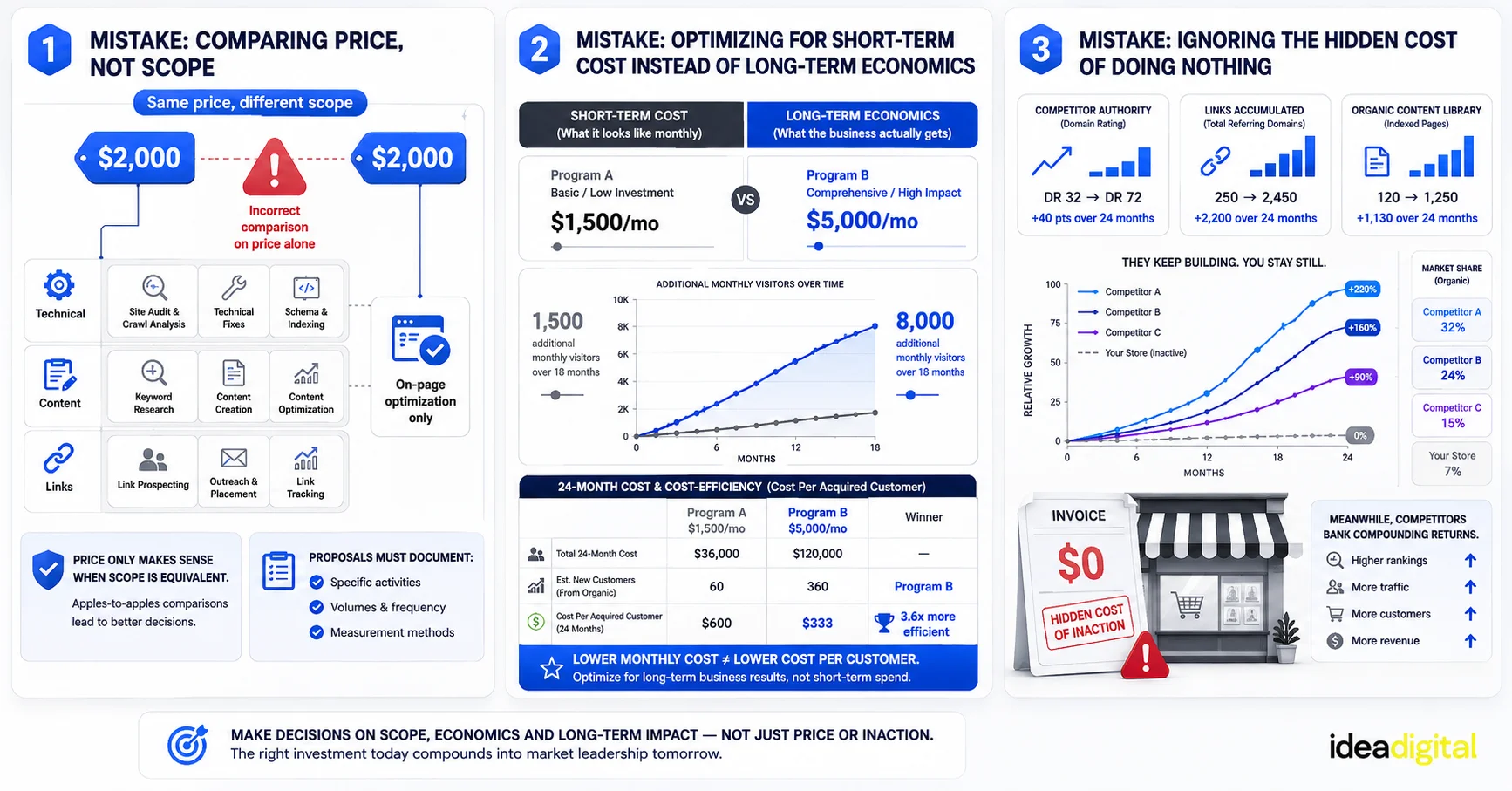
Mistake 1: Comparing Price Across Programs with Different Scopes
A $2,000 per month program that includes technical work, content creation, and link building cannot be meaningfully compared to a $2,000 per month program that covers only on-page optimization. Price comparison only makes sense when the scope is equivalent. When evaluating proposals, require each agency to document specifically what activities are included, at what volume, and how outcomes will be measured. Then compare scope, not price.
Mistake 2: Optimizing for Short-Term Cost Per Ranking Instead of Long-Term Cost Per Customer
Lower monthly investment produces slower progress and lower quality work. In the short term, the cost per ranking point looks similar across investment levels because competitive results take time regardless. In the long term, a comprehensive program at $5,000 per month that produces 8,000 additional monthly organic visitors over 18 months has a customer acquisition cost that a $1,500 per month program producing 1,500 additional visitors simply cannot match. Model the 24-month cost per acquired customer, not the monthly retainer rate.
Mistake 3: Not Factoring in the Cost of Inaction
Every month without a structured eCommerce SEO program is a month competitors are building authority, earning links, and publishing content that attracts buyers. The cost of inaction is not zero. It is the market share and organic revenue that your category’s top organic performers are accumulating while your store relies on paid acquisition. That cost is real even if it does not appear on an invoice.
FAQ’s
Is eCommerce SEO more expensive than regular SEO?
Yes, typically. eCommerce SEO addresses a more complex set of technical challenges, requires content optimization at catalog scale, and often involves more aggressive link building to compete in product categories that are commercially valuable. The same investment level that produces strong results for a service business or a SaaS company often covers a smaller fraction of the scope required for a mid-size eCommerce store. Expect to invest at least 20 to 40 percent more for eCommerce SEO than equivalent-quality local or service-business SEO.
Should I invest in SEO or paid ads for my eCommerce store?
The right answer for most eCommerce stores is both, sequenced appropriately. Paid ads deliver immediate traffic but stop when the budget stops. SEO builds compounding traffic that continues without proportional cost increases. Stores with immediate revenue pressure should use paid acquisition while SEO develops. Stores with a longer planning horizon should treat SEO as the primary long-term channel and use paid to amplify it during peak periods. Over a 24 to 36 month horizon, well-executed SEO consistently outperforms equivalent paid investment in cost per acquired customer.
What should an eCommerce SEO proposal include?
A credible proposal should include: an initial audit summary of current technical and content state, a scope of work specifying which activities are included and at what monthly volume, projected organic traffic and revenue outcomes with methodology explained, timeline to measurable results, reporting cadence and metrics tracked, and what happens at the end of the initial term. Proposals that skip the audit summary and go straight to package pricing have not done the work to understand your specific situation.
How do I measure eCommerce SEO ROI?
Track organic-attributed revenue in Google Analytics 4 by filtering transactions where the first or assisting traffic source was organic. Cross-reference with Google Search Console impressions, clicks, and average position data for target keywords.
Calculate: (organic-attributed revenue over the measurement period) minus (total SEO investment over the same period) equals organic SEO return. Divide return by investment to get ROI percentage. For most established eCommerce SEO programs at the $3,500 to $6,000 per month level, the 18 to 24 month ROI is significantly positive when measured on organic-attributed transaction revenue.
Conclusion
eCommerce SEO cost and pricing is not a simple answer, and any agency that gives you one without understanding your catalog, your category, and your current organic position is pricing a package, not a solution. The right investment is the one that matches the scope of work required to actually compete in your specific market, measured against the organic revenue opportunity that exists if you win.
If you are ready to work with a team that measures success the same way you do, by revenue not rankings, request your custom growth proposal today. We will assess your store’s current position, identify the specific opportunities in your category, and give you a realistic picture of what a structured program can produce for your business. Request your proposal here.