

Six months. That is all it took for a home services company in the Dallas metro area to go from 34 inbound leads per month to 112. This SEO case study of a US service business is not about a lucky algorithm update or a viral content push. It is about fixing a strategy that was structurally broken and building one that compounds.
The business had been paying for SEO for over a year before they came to us. Rankings were scattered. Traffic was flat. Leads were inconsistent. Sound familiar?
Here is what we found, what we changed, and why it worked.
The Starting Point: Activity Without Results
When we first audited the site, the surface indicators looked decent. Around 800 monthly organic sessions. A handful of page-one rankings for branded terms. Some blog posts published across the previous year. The previous agency had been “doing SEO.”
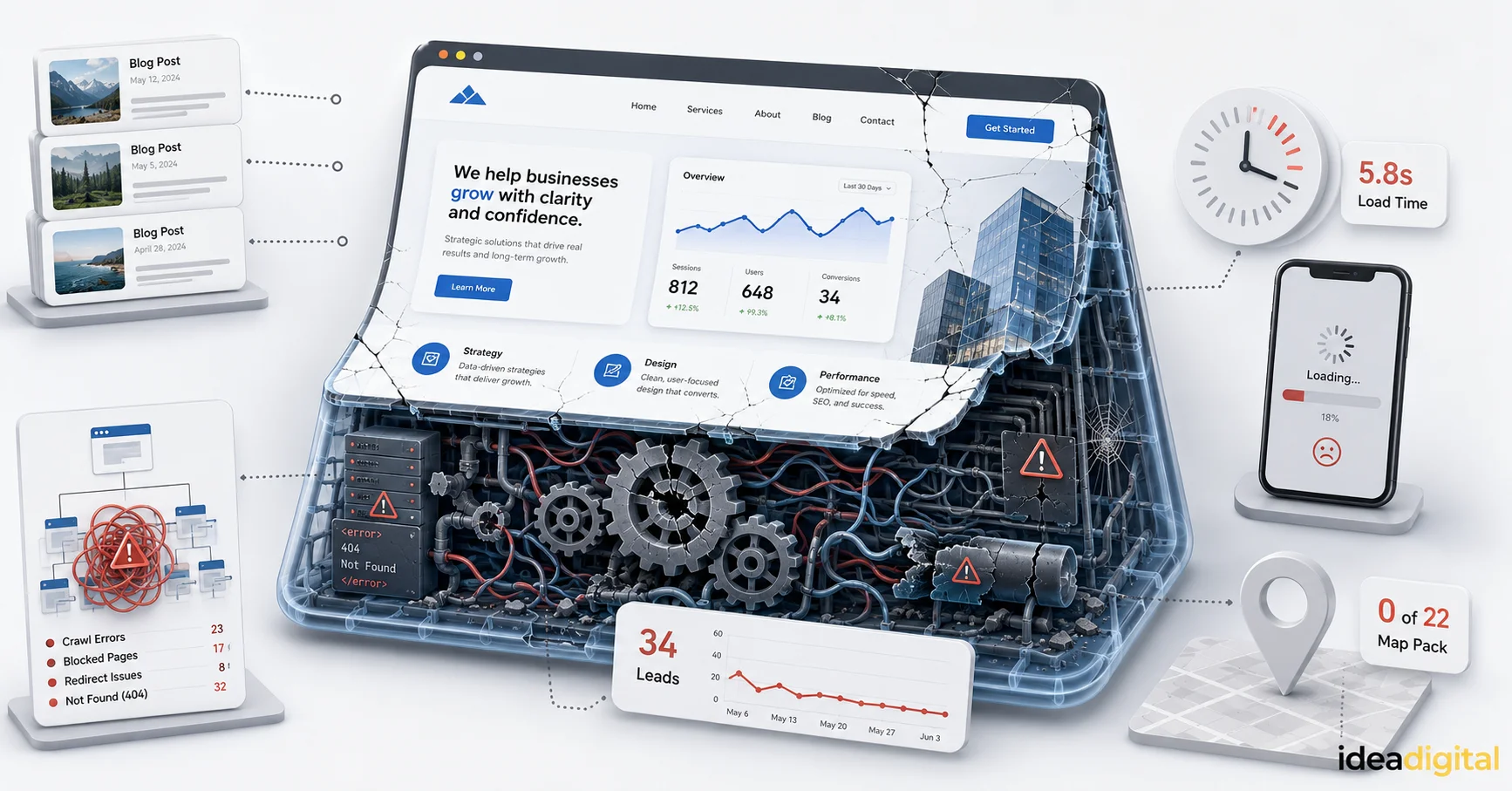
But the foundation was soft in ways that explained everything.
Technical SEO was a mess underneath a clean-looking front end. Core Web Vitals were failing on mobile. Crawl errors were blocking key service pages from being indexed properly. Internal linking was essentially nonexistent, with service pages floating in isolation from the blog content being produced. The content itself was targeting informational keywords in a market that needed transactional intent.
Our audits consistently show that this combination, surface activity with broken infrastructure, is one of the most common patterns in US service businesses that are stuck. The previous agency was producing content. They were not producing results. There is a difference.
The client was also spending zero effort on local SEO, despite being a business that lived entirely on service area rankings. No Google Business Profile optimization. No citation work. No location-specific pages for the surrounding cities they served.
The SEO Case Study: What We Actually Changed
We structured the engagement around three parallel workstreams: technical SEO, local SEO, and content repositioning. All three had to move at once. Running one without the others slows the compounding effect significantly.
Technical SEO: Removing the Ceiling
Within the first three weeks, we corrected the Core Web Vitals failures. The main culprits were render-blocking JavaScript, uncompressed images, and a slow hosting configuration. After implementation, LCP dropped from 5.8 seconds to 1.9 seconds on mobile.
We rebuilt the internal linking architecture. Every service page was mapped to supporting blog content, and every blog post was connected back to the most relevant service page. This created a link equity flow that had simply not existed before.

Crawl errors on four key service pages were resolved. Two of those pages had been intermittently de-indexed due to a robots.txt misconfiguration sitting there for months.
The technical work did not produce visible results immediately. That is normal. What it did was remove the ceiling on what the rest of the strategy could achieve.
Local SEO: Competing Where the Revenue Was
The business served a 40-mile radius around Dallas. They were not appearing in the map pack for any non-branded service terms. Not one.
We rebuilt their Google Business Profile from scratch, covering categories, services, photos, description, and a consistent weekly posting cadence. We ran a full citation audit and corrected NAP inconsistencies across 60-plus directories. We built five location-specific landing pages targeting the highest-value suburbs where competitors were weakest.
Within 90 days, the business was appearing in the local map pack for 14 of the 22 primary service terms we had targeted. For a detailed breakdown of the tactics that drive results in this space, the post on [local-seo-for-home-services] covers the full framework.
Map pack visibility alone accounted for roughly 30 percent of the lead increase by month six.
Content Repositioning: From Informational to Intent-Driven
The previous agency had been writing how-to blog content. Useful in theory, but wrong for the funnel stage this business needed to win. A service business competing in Dallas does not need traffic from people asking “how to fix a leaky pipe.” It needs traffic from people searching “emergency plumber Dallas” or “licensed HVAC repair near me.”
We audited every existing piece of content and categorized it by intent. Most of it was informational with no conversion path. We kept six pieces that had ranking traction, updated them with transactional angles and clearer calls to action, and built internal links from them to the service pages.
We then produced eight new pieces targeting high-intent, service-specific, and comparison queries. Each was structured to answer what a buyer in the research-to-decision stage was actually asking.
The Results: Month by Month

Here is how the numbers moved across the six-month engagement.
| Month | Organic Sessions | Inbound Leads | Map Pack Rankings |
| Month 1 (Baseline) | 812 | 34 | 0 of 22 targets |
| Month 2 | 890 | 38 | 4 of 22 targets |
| Month 3 | 1,240 | 61 | 9 of 22 targets |
| Month 4 | 1,680 | 84 | 12 of 22 targets |
| Month 5 | 2,010 | 99 | 14 of 22 targets |
| Month 6 | 2,440 | 112 | 14 of 22 targets |
Lead growth outpaced session growth. That is what intent alignment produces. More of the traffic arriving was the right kind, buyers ready to call, not browsers.
Month 3 was where the compounding effect became visible. Technical fixes, local buildout, and content updates all started reinforcing each other. This is the pattern we see across US service businesses when the full strategy is running together.
The business closed 28 percent more new contracts in months four through six compared to the same period the prior year. That translated directly to revenue the owner could point to. For context on calculating the financial return on an engagement like this, the [seo-roi-guide] walks through the methodology in detail.
Common Mistakes Service Businesses Make with SEO
Targeting informational keywords instead of transactional ones
Service businesses end up with content that educates but never converts. How-to guides have a place in a full SEO strategy, but a local plumber in Phoenix does not grow revenue by ranking for “how to unclog a drain.” The priority is ranking for “licensed plumber Phoenix” and “emergency pipe repair near me.” Most agencies do not have this conversation clearly enough, and the editorial calendar ends up built around the wrong intent entirely.
Ignoring technical SEO until something breaks visibly
Most service business websites look functional on the surface. The problems are underneath. Slow mobile load times, misconfigured redirects, orphaned pages, missing schema markup. These issues do not throw visible errors. They silently limit how well the site ranks. By the time a client notices flat traffic, months of potential traction have already been lost. A technical audit should happen before any new content is produced, not after.

Treating local SEO as a one-time setup task
Setting up a Google Business Profile and leaving it static is not local SEO. The businesses that dominate map packs in competitive US cities like Houston, Miami, and Atlanta are actively managing their profiles, building citations, earning reviews, and publishing local content on a consistent cadence. Service businesses that treat local as a checkbox rather than an ongoing discipline steadily lose ground to competitors who treat it seriously.
Producing content without a conversion path
A blog post that gets traffic but has no route to a call, a quote form, or a service page is a dead end. Content must connect to conversion. Every piece should give a ready-to-hire reader a logical next step. Most service business sites have content sitting in isolation from service pages, which breaks the buyer journey at exactly the moment it matters most.
FAQ’s
How long does SEO take to generate leads for a service business?
Timeline depends on market competitiveness, starting domain strength, and how much technical debt exists. For most established service businesses with an existing site, the first meaningful lead movement happens between 60 and 90 days after the strategy is properly implemented. The compounding effect typically becomes visible around month three. Businesses in more competitive markets like Los Angeles or Chicago may need six to nine months before the numbers shift substantially.
Does local SEO actually work for home services companies?
Yes, and it is one of the highest-ROI channels available when done correctly. The Google map pack appears above organic results for most service-based searches, which means local SEO directly affects whether a potential customer sees your business at all. A well-optimized Google Business Profile combined with consistent citations and location-specific content can produce lead volume that rivals paid search at a fraction of the ongoing cost.
What is the difference between a rankings report and a real SEO result?
A rankings report shows where your site appears for a set of tracked keywords. A real SEO result shows how many qualified visitors arrived from organic search, what they did, and how many became leads or customers. Rankings are a leading indicator. They tell you the strategy is moving in the right direction. But a business ranking on page one for 50 keywords that convert none of them has not achieved anything meaningful. Any agency worth hiring connects rankings to revenue.
How much does SEO cost for a US service business?
Meaningful SEO work covering technical SEO, local SEO, and content typically starts around $2,500 to $5,000 per month for most US service businesses, depending on market and scope. Engagements below this threshold tend to cover only part of the strategy, which limits the compounding effect. The right question is not what the monthly fee costs but what the revenue impact is relative to that investment. In the case above, the ROI became clear by month four.
Conclution
Most US service businesses are sitting on organic revenue they are not capturing. The searches are happening. The buyer intent is there. The question is whether your site is built to intercept it.
Six months from now, your business will be in roughly the same position it is today, or it will be generating meaningfully more leads from organic search. That difference comes down to strategy and execution, nothing more.
If you are ready to work with an agency that measures success the same way you do, by revenue not rankings, request your custom growth proposal today. We will be specific about what we would change, what it takes, and what results are realistic for your market.