

Content marketing ROI measurement is the part most businesses skip, and it is exactly why most content programs get defunded. A blog that generates traffic but cannot demonstrate business outcomes is a budget line waiting to be cut.
The problem is not that content does not produce returns. It is that most businesses are not measuring the right things, or are measuring nothing at all beyond page views and session counts.
We have reviewed content programs across dozens of US businesses in SaaS, eCommerce, professional services, and B2B. The pattern is consistent. Businesses that measure content ROI correctly protect their content budget during downturns, scale what works, and cut what does not.
Businesses that cannot connect content to revenue numbers spend the same budget year after year on posts that never produce a measurable outcome.
Here is how to set up content marketing ROI measurement that actually reflects what the content is doing for the business.
Why Most Content ROI Frameworks Fail Before They Start
This is where things usually break down. Most businesses try to measure content ROI by looking at traffic. Traffic goes up, so the program is working. Traffic goes down, so something is wrong. That connection is not useless, but it is incomplete and misleading.
Here is what actually happens when you measure content by traffic alone. A piece of content drives 3,000 monthly sessions from informational searchers who were never going to buy anything.
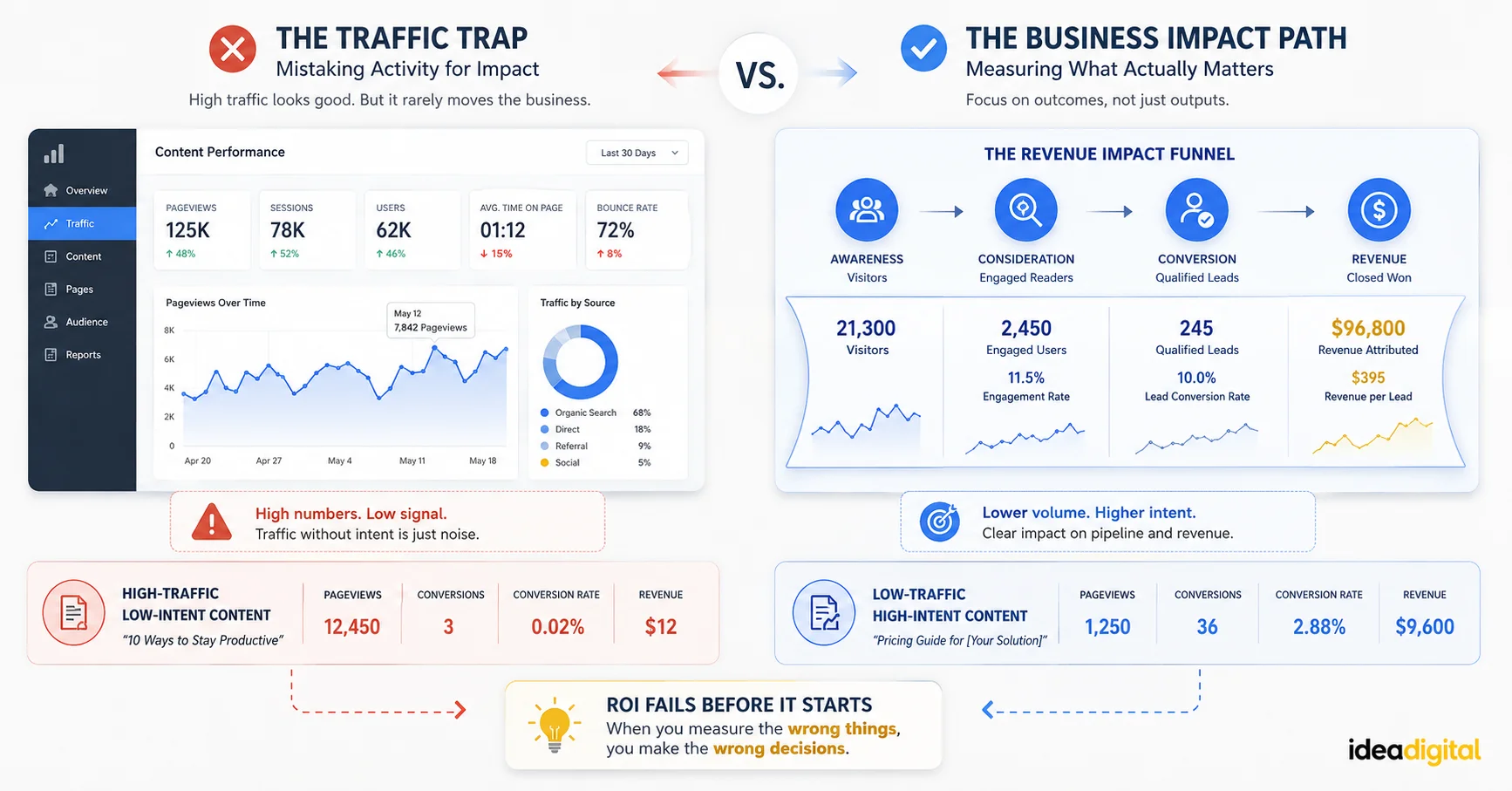
Another piece of content drives 80 monthly sessions from commercial-intent buyers actively evaluating your product. The first piece looks like a success by traffic metrics. The second piece looks almost invisible. But the second piece is actually doing the work.
Content ROI needs to be measured at the revenue connection, not the traffic connection. That requires attribution, conversion tracking, and an understanding of how different content types serve different stages of the buyer journey.
Content Marketing ROI Measurement: The Framework That Works
Step 1: Define What a Content Conversion Is for Your Business
Before any measurement infrastructure is built, you need to define what actions, taken by someone who arrived through content, count as a business outcome.
For a B2B SaaS company, this might be: a free trial signup, a demo request, or a pricing page visit following a content page visit. For a professional service firm, it might be: a contact form submission, a phone call from an organic visitor, or a live chat inquiry. For an eCommerce store, it is more direct: a transaction or an add-to-cart event.
Define these conversions specifically before building any measurement. “Organic traffic” is not a conversion. “Contact form submission from a visitor who entered through an organic blog post” is a conversion.
Step 2: Set Up Goal Tracking in Google Analytics 4
GA4 tracks events rather than sessions, which makes it better suited for content ROI measurement than Universal Analytics was. Configure key events as conversions in GA4:
- Form submissions: track the thank-you page load or the form_submit event
- Phone calls: use call tracking software that logs calls from your website with UTM source attribution
- eCommerce purchases: configure GA4’s eCommerce tracking to capture transaction value by source
- Engagement depth: configure scroll depth events (50%, 75%, 90%) and video completion events on content pages that have qualifying content
Once these are configured, GA4 allows you to filter conversions by traffic source, landing page, and content category. That is the foundation of content ROI reporting.
Step 3: Build Content-to-Conversion Attribution
A user who reads three blog posts before submitting a contact form is not typically attributed in last-click reporting. Last-click gives all credit to the final page before conversion, which might be a pricing page or a service page, not the content that influenced the decision.

For content ROI measurement, first-touch and multi-touch attribution models are more accurate than last-click. GA4 provides data-driven attribution modeling that distributes credit across the touchpoints in a conversion path. Using the Attribution section in GA4, compare how content-assisted conversions compare to content-only conversions. The assisted conversion number is almost always significantly higher than the last-click number, and it is the more accurate representation of what the content is contributing.
Step 4: Calculate the Metrics That Connect to Business Value
With attribution and conversion data in place, three metrics make content ROI tangible:
- Organic-attributed revenue or leads: the total value of conversions where the organic content was the first or assisting touchpoint
- Content cost per acquisition: the total content investment divided by the number of conversions attributed to content over the measurement period
- Content library asset value: an estimate of the ongoing traffic and conversion value from pieces that have already been published, treated as an asset rather than a sunk cost
The third metric is where content ROI becomes most compelling over time. A piece of content published 18 months ago that still generates 500 monthly sessions and 8 conversions per month has essentially zero marginal cost. Calculating the ongoing value of the full content library versus the cost of the current period’s production shows the compounding return that content delivers, which is qualitatively different from any paid channel.
For the broader strategic framework on how content measurement fits into an integrated SEO program, the content strategy for seo guide covers how content types, keyword strategy, and measurement align. And for how to incorporate content ROI into a monthly SEO reporting structure, the seo reporting guide covers what a complete monthly report should include.
A Practical Content ROI Reporting Template

Use this structure for monthly content ROI reporting:
| Metric | How to Measure | Benchmark |
| Organic sessions from content | GA4: organic traffic to blog/content paths | Baseline then MoM/YoY growth |
| Organic-attributed conversions | GA4: conversions with organic first touch | Total and by conversion type |
| Assisted conversions from content | GA4 Attribution report | Compare to direct-attributed count |
| Organic-attributed revenue (eCommerce) | GA4 eCommerce + source filtering | Dollar value and share of total organic |
| Content cost per acquisition | Total content investment / attributed conversions | Track trend over time |
| Highest-performing content pieces | GA4: landing pages by conversion rate | Informs future content priorities |
This is the minimum viable reporting structure for content ROI. It connects investment to outcomes and makes the business case for the content program every month.
Common Content Marketing ROI Measurement Mistakes

Mistake 1: Measuring at the Channel Level Instead of the Content Level
Reporting “organic traffic is up 15 percent” tells you the channel is growing. It does not tell you which content is working, which is not, and whether the investment is going to the right places. Content ROI measurement should get to the piece level, or at minimum the content category level, to enable optimization decisions. The pieces with high traffic and low conversion need different treatment than the pieces with low traffic and high conversion.
Mistake 2: Ignoring Assisted Conversions
Last-click attribution systematically undervalues content at the top and middle of the funnel. A buyer who reads two educational blog posts, visits the pricing page, and then submits a contact form will be attributed to the pricing page, not the content. If content ROI measurement is based on last-click data only, the program will appear to produce far fewer conversions than it actually does. Always use multi-touch or data-driven attribution when evaluating content contribution.
Mistake 3: Treating Every Piece of Content with the Same ROI Expectation
TOFU content, written to attract awareness-stage buyers, will produce fewer direct conversions than BOFU content written for buyers who are close to making a decision. Applying the same conversion rate expectation to both types produces a misleading picture of content performance. Evaluate TOFU content on assisted conversions and on the engagement metrics that predict future conversion (return visits, scroll depth, time on page). Evaluate BOFU content on direct conversion rate.
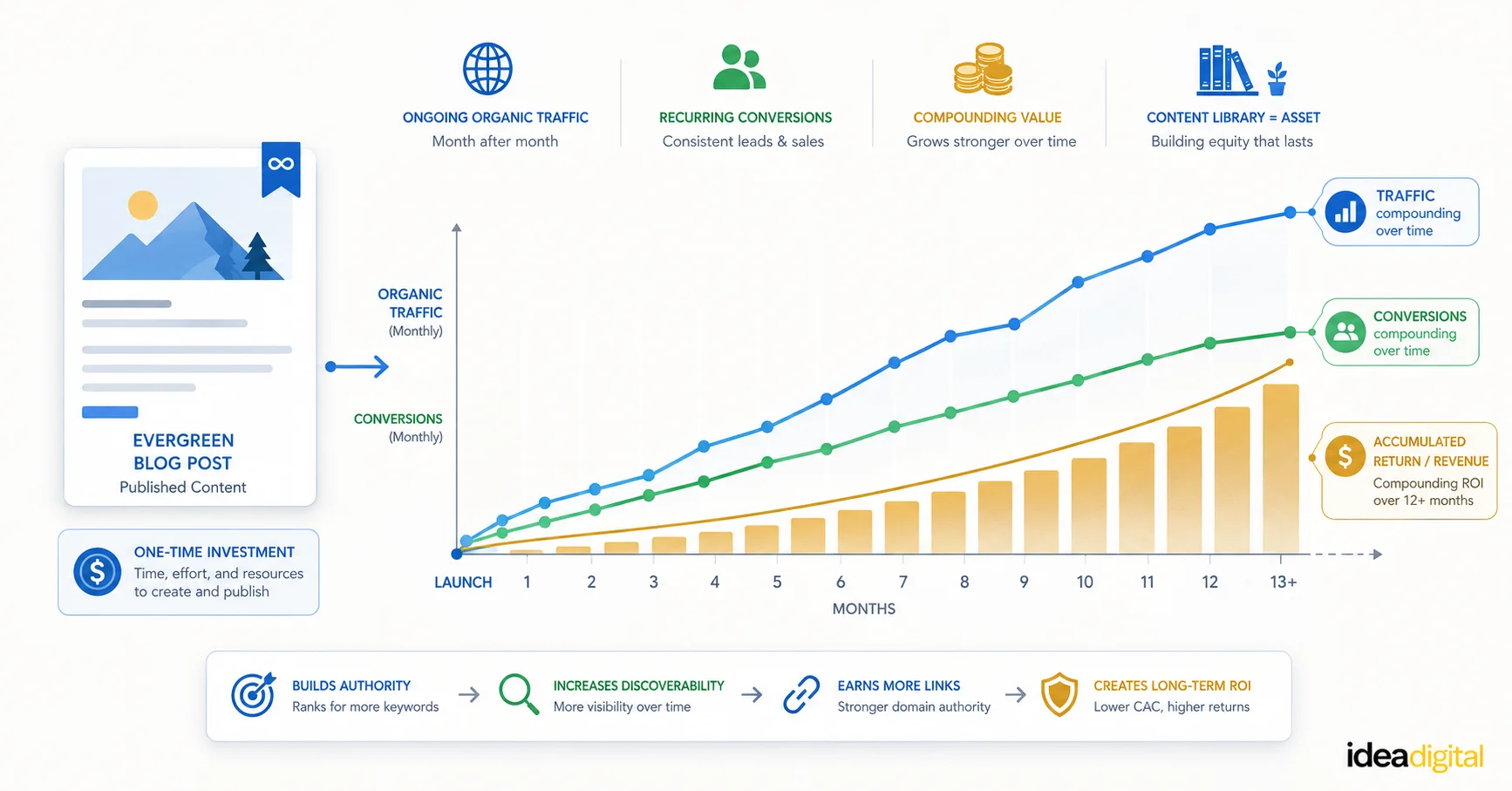
Mistake 4: Not Accounting for the Compounding Value of Published Content
A content investment made in January does not produce its full return in January. A well-optimized post may take six months to reach peak ranking. It may then generate consistent organic traffic for two to three years. Calculating content ROI on a monthly matching basis, where January’s content investment is expected to produce January’s return, severely underestimates the program’s actual return on investment. Content ROI should be calculated on a trailing basis (trailing 12 months of conversions versus the prior 12 months of investment) to capture the compounding effect.
FAQ’s
How long does it take for content marketing to show measurable ROI?
For most businesses, meaningful organic traffic from new content appears three to six months after publication. Conversion contribution from that traffic becomes visible on a 12-month trailing basis, as the content library matures and more pieces begin generating consistent monthly sessions. Businesses running structured content programs with proper keyword targeting typically see a clear content cost-per-acquisition figure that is competitive with or superior to paid channels by the 18 to 24 month mark.
What is a good content cost per acquisition?
It depends entirely on the industry and the average customer value. For a B2B SaaS company with a $12,000 annual contract value, a content CPA of $300 to $600 is excellent. For a local service business with a $500 average job value, the same CPA would need to be below $80 to $100. The right benchmark is your paid acquisition CPA as a comparison point. Content CPA that is below paid CPA and declining over time is the signal that the content program is creating compounding value.
Can I measure content ROI without a developer?
Yes, for most businesses. GA4 allows non-developers to configure conversion events for form submissions and page visits without code changes if the site is using Google Tag Manager. Basic goal tracking for thank-you page loads, outbound call click events, and organic landing page conversion rates can be set up through the GA4 interface directly. More sophisticated tracking, like dynamic phone number insertion or server-side eCommerce tracking, typically requires developer involvement but is not necessary for a functional content ROI framework.
Conclusion
Content marketing ROI measurement is not about proving that content works in the abstract. It is about knowing specifically which content, on which keywords, for which buyer profiles, is producing revenue for your business. That knowledge is what allows you to scale what works, cut what does not, and make a defensible business case for continued investment in a channel that compounds over time rather than resetting every month.
If you want to understand what your current content program is actually producing and how to build a measurement framework that connects content to revenue outcomes, book a free strategy call with our team. We will walk through your current analytics setup and show you exactly what a complete content ROI measurement process looks like. Schedule your call here.