

Most eCommerce keyword research starts with the wrong question. The question most store owners ask is “what are people searching for in my category?” The question that produces revenue is “what are people searching for right before they make a purchase in my category?” The difference between ecommerce keyword research buyer intent and general keyword research is the difference between traffic and sales.
A store that ranks for broad, high-volume category terms but not for the specific, purchase-ready searches its buyers use is generating impressions without conversions. The buyer who types “memory foam mattress queen size under $500 free shipping” is not the same buyer who types “best mattress.” Both are in the same category. Only one is ready to buy right now.
This guide covers how to find and prioritize the buyer-intent terms that actually drive eCommerce revenue, not just traffic.
Why General eCommerce Keyword Research Fails
Here is the failure mode that most eCommerce brands fall into.

They target the highest-volume keywords in their category because high volume looks like high opportunity. They build category pages and content for these broad terms. They compete against established retailers with years of domain authority and a link profile that dwarfs their own. They rank on page three or four. No traffic arrives. No revenue follows.
The high-volume terms are real opportunities, eventually, as the site builds enough authority to compete. But they are not the starting point for most stores, and they are not where the highest-converting searches live regardless of where the store is in its SEO maturity.
Here is what actually happens when a store targets buyer-intent terms instead. They identify specific, purchase-ready searches with realistic competition levels. They build product and category pages that match exactly what the buyer is looking for at the moment of search. They rank faster because the competition is thinner. And the visitors who arrive from these searches convert at two to four times the rate of visitors arriving from broad informational searches.
We have worked with eCommerce businesses across the US market and the pattern is consistent. The stores generating meaningful organic revenue are the ones whose keyword strategy starts with buyer intent rather than search volume.
eCommerce Keyword Research Buyer Intent: The Framework
Buyer intent in eCommerce searches is expressed through specific linguistic patterns and modifiers that signal a searcher is past the browsing phase and moving toward a purchase decision. Understanding these patterns is how you build a keyword map that produces revenue rather than just traffic.

The Three Layers of eCommerce Buyer Intent are following as:
Layer 1: Category exploration with qualifying modifiers
These searches indicate a buyer who knows the general product category and is narrowing their options. They include modifiers like “best,” “top rated,” “vs,” “review,” or “comparison.” The searcher is evaluating options but has not made a final decision. Content for these searches is comparison-oriented: best-of lists, review posts, buyer guides that help the searcher make a choice.
Examples: “best standing desk under $500,” “ergonomic office chair vs regular chair,” “waterproof hiking boots review 2026.”
Layer 2: Specific product searches
These searches target a specific product type with attributes that indicate the buyer’s requirements are defined. They include material, size, color, brand, compatibility, or use case modifiers. The searcher knows what they want and is looking for the right place to buy it. Product and category pages with precise attribute matching are the right content type.
Examples: “mens trail running shoes wide width size 12,” “stainless steel french press 12 cup,” “WooCommerce compatible barcode scanner.”
Layer 3: Transactional searches
The buyer has made their decision and is looking to complete the purchase. Search terms include “buy,” “order,” “free shipping,” “best price,” “coupon,” or specific product model numbers. These searches have the highest conversion rate and the tightest competition window. Product pages with price, availability, and conversion-optimized content are the target.
Examples: “buy Brooks Ghost 16 mens size 11,” “iPhone 16 Pro case best price free shipping,” “Vitamix 5200 coupon.”
Building a keyword map that covers all three layers creates the content architecture that captures buyers at every stage of their purchase decision, not just the moment of final intent.
How to Find Buyer-Intent Keywords for eCommerce
The research process for buyer-intent keywords is different from general keyword research because the filter criteria prioritize intent signals over volume alone.
Step 1: Start with Your Top-Revenue Products and Categories
Buyer-intent keyword research should connect directly to the products that generate the most revenue. Start with your top 20 percent of products by revenue contribution. For each one, map the product attributes that differentiate it: size, material, use case, compatibility, price range, brand.

These attributes are the building blocks of buyer-intent searches. A running shoe that is wide width, lightweight, and priced under $120 has buyers searching for exactly those combinations. The keyword research process is about finding which specific combinations have meaningful search volume.
Step 2: Apply Buyer-Intent Filters in Your Research Tool
In Ahrefs or Semrush, start with your seed category terms and apply filters to surface buyer-intent variants. Filter by keyword modifiers that indicate purchase intent:
- Include modifiers: “best,” “top,” “review,” “buy,” “cheap,” “affordable,” “deals,” “free shipping,” “vs,” “alternative to,” “for [specific use case]”
- Include attribute modifiers: size, color, material, brand names, model numbers, price range indicators
- Exclude purely informational modifiers: “what is,” “how does,” “history of,” “definition”
The filtered list will be significantly smaller than the raw keyword set for the category but will contain the terms with the highest revenue potential per ranking position.
Step 3: Mine Amazon Search Suggestions and Reviews
Amazon’s autocomplete is one of the best sources of buyer-intent keyword data available for eCommerce. The searches Amazon completes are real product purchase queries from real buyers. Type your core product terms into Amazon’s search bar and capture every autocomplete suggestion.
Customer review text is equally valuable. Buyers in reviews describe the product in the specific language they used to search for it. A review that says “I searched for a wireless keyboard compatible with Mac mini that had backlit keys and a longer battery life than my previous one” contains four specific buyer-intent search terms. Mining review language for product attribute descriptors surfaces buyer vocabulary that keyword tools often do not capture.

Step 4: Analyze Competitor Product and Category Pages
Your highest-ranking competitors have already done keyword research. Pull the organic keywords for their top product and category pages using Semrush or Ahrefs and filter for the terms that show purchase intent signals. Buyer-intent terms driving traffic to competitor pages are validated opportunities: real searches with real traffic that you are not currently capturing.
The keyword-research-guide covers the complete research and prioritization framework in depth, including how to evaluate difficulty and realistic ranking timelines for different intent levels.
Step 5: Map Keywords to the Right Page Types
Every buyer-intent keyword needs to be assigned to the correct page type before content is built around it.
| Keyword Type | Best Page Type | Content Goal |
| Category exploration with modifiers | Category page or buying guide | Help the buyer evaluate and decide |
| Specific product attribute combinations | Category page or collection page | Show the buyer their options exist |
| Individual product searches | Product page | Convert the buyer |
| Transactional with price or availability | Product page + schema | Close the sale |
| Comparison searches | Comparison blog post or landing page | Win the buyer from alternatives |
Mismatching keywords to page types is one of the most common errors in eCommerce SEO. A transactional keyword landing on an informational blog post will not convert. A comparison keyword landing on a product page does not address the evaluation need the searcher has.
Common eCommerce Keyword Research Mistakes
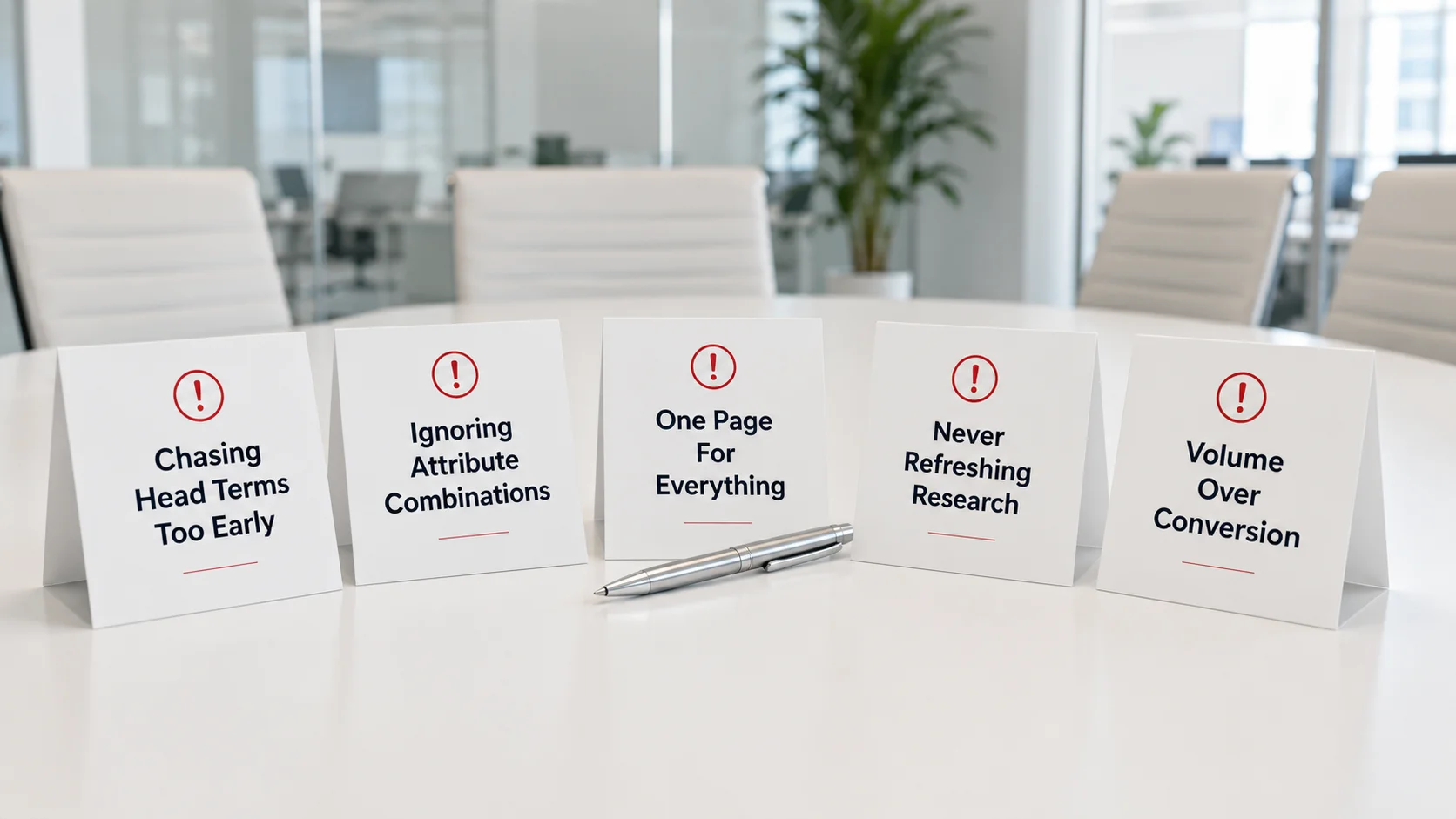
Targeting product category head terms before building authority.
“Running shoes” and “office chairs” are genuinely valuable terms, but they are competed for by major national retailers with enormous domain authority. A new or mid-authority eCommerce store competing for these terms will see no ranking for months or years. The buyer-intent long-tail terms in the same category can be won much faster and converted at higher rates.
Ignoring product attribute combinations as keyword targets.
A mattress store that targets “mattress” and “best mattress” but not “memory foam mattress queen size cooling gel,” “firm hybrid mattress for back pain,” or “organic latex mattress queen” is leaving the most specific, purchase-ready searches unaddressed. Attribute combinations are where the highest-intent buyers search and where the competition is most accessible.
Building one generic category page that tries to rank for every variation.
A single “running shoes” category page cannot simultaneously rank for “trail running shoes for wide feet,” “lightweight marathon training shoes,” and “barefoot running shoes for beginners.” Each specific buyer intent needs either its own dedicated page or a well-structured collection page that signals its specific focus clearly. Trying to cover everything with one page produces a page that ranks competitively for nothing.
Not refreshing keyword research as the product catalog grows.
Keyword research done once when the store launched does not account for new products, new seasonal trends, or new buyer vocabulary that emerges over time. A quarterly keyword research refresh aligned with catalog reviews ensures the SEO strategy stays current with what buyers are actually searching for.
Prioritizing keyword volume over conversion alignment.
A 10,000-monthly-search term that attracts informational searchers will produce less revenue than a 500-monthly-search term that attracts buyers who are ready to purchase. Evaluate buyer-intent keywords on their revenue potential per ranking position, not just their search volume.
How Buyer-Intent Keywords Connect to the Full eCommerce SEO Picture
Buyer-intent keyword research is one component of a complete eCommerce SEO program. The keywords determine which pages to build and how to structure them. Technical SEO ensures those pages can be crawled and indexed properly. Content optimization ensures they are compelling enough to rank and convert.
The ecommerce-seo-guide covers how keyword research connects to category page optimization, product page optimization, technical architecture, and authority building into a complete system. The keyword research is where the program starts. The full system is what makes it compound.
FAQ
What is buyer intent in eCommerce keyword research?
Buyer intent refers to the signal in a search query that indicates the searcher is close to making a purchase decision. Searches with buyer intent contain specific product attributes, comparison modifiers, price or availability signals, or brand and model specificity. These searches convert at higher rates than broad informational searches because the searcher has already done most of their research.
How many buyer-intent keywords should an eCommerce store target?
There is no target number. Build a keyword map that covers every meaningful buyer-intent variation for your top-revenue products, prioritized by conversion potential and realistic ranking difficulty. A store with 200 products can reasonably target hundreds of buyer-intent keyword variations. Start with the highest-revenue products and expand outward.
How do I know if a keyword has buyer intent?
Look at the modifiers in the phrase. Specific attributes like size, material, or use case indicate a buyer who has defined their requirements. Price or availability signals indicate someone ready to transact. Comparison and review modifiers indicate evaluation-stage buyers. Generic category terms with no modifiers indicate browsing intent rather than purchase intent.
Can I use Google Search Console to find buyer-intent keywords?
Yes. Pull the queries report and filter for terms where your pages already have impressions but low click-through rates or low ranking positions. Within those queries, identify the ones with buyer-intent modifiers. These are terms where you are already visible to purchase-ready searchers but not yet capturing their clicks. Optimizing for these terms often produces the fastest ranking and revenue improvement.
How does buyer-intent keyword research differ for different eCommerce categories?
The specific modifiers vary by category, but the framework is the same. Apparel buyers search by size, fit, occasion, and material. Electronics buyers search by compatibility, specifications, and use case. Home goods buyers search by dimensions, material, and style. The research process involves identifying which attributes your buyers use to narrow their options and building your keyword map around those attribute combinations.
The Bottom Line
eCommerce keyword research buyer intent is the bridge between search traffic and eCommerce revenue. A store that ranks for what buyers are searching at the moment of purchase decision, not just what they search at the beginning of their research, earns organic traffic that converts rather than traffic that bounces.
The stores that build their keyword strategy from buyer intent outward, rather than from search volume inward, consistently produce more revenue per organic visitor and reach positive ROI from their SEO investment faster than those chasing traffic metrics that do not correspond to purchase behavior.
Want to see which buyer-intent keywords your store is missing and what capturing them would mean for your organic revenue?
If you want a strategy that actually fits your business, book a free strategy call. We will walk you through your keyword opportunity map and show you exactly where the highest-value searches are going to your competitors instead of you. Visit our eCommerce SEO Page and SEO Strategy Page to learn more about how we approach this work.