

Most SEO reporting focuses on the metrics that are easiest to report, not the ones that tell you whether the investment is working. To properly measure seo success metrics, you need to separate the signals that indicate genuine progress from the vanity numbers that feel reassuring but have no direct relationship to revenue or business outcomes.
Ranking in position one for a keyword no one searches is a ranking. Traffic that does not convert is traffic. Page impressions from the wrong audience are impressions. All of these can appear in an SEO report and mean nothing for the business.
This guide covers the metrics that actually matter, how to interpret them correctly, and what patterns in the data indicate a program that is working versus one that is producing activity without results.
Why Most SEO Reporting Gets the Metrics Wrong
The problem starts with what is easy to measure versus what is meaningful.
Rankings are easy to measure. Pull a keyword position report and you have a clear number. The problem is that rankings without context are almost meaningless. A site can rank in position three for a keyword with 10 monthly searches and produce no traffic. A site can rank in position eight for a keyword with 5,000 monthly searches and produce significant organic traffic because of how the query resolves in search results.
Traffic is measurable. But traffic from the wrong audience produces no revenue. A law firm in Dallas that gets 10,000 monthly organic visitors from people researching legal topics for curiosity rather than searching for legal help in Dallas is receiving the wrong traffic.

Here is what actually happens when SEO is measured by rankings and total organic traffic alone. A business sees impressive numbers in the report and is satisfied. Then they look at leads from organic search and the number is low. The disconnect is that the metrics being tracked do not correspond to what the business actually needs the SEO program to produce.
We have seen this pattern across dozens of SEO programs across the US market, from SaaS companies and law firms to eCommerce brands and local service businesses. The businesses with the most clarity on whether their SEO is working are the ones that track the metrics that connect to revenue rather than the metrics that look good in a weekly report.
Measure SEO Success Metrics: The Framework
Measuring SEO performance requires three layers of metrics. Each layer tells a different part of the story.

Layer 1: Leading Indicators (Early-Stage SEO Health)
Leading indicators tell you whether the foundational work is being done correctly and whether early signals are pointing in the right direction. They are most relevant in the first three to six months of a program when revenue attribution is not yet meaningful.
Indexed page count and crawl coverage. How many pages is Google indexing? Is the indexed count growing as new content is published? Are important pages excluded from the index inadvertently? A stable or growing indexed count across important page types is a foundational health signal.
Search Console impressions for target keyword clusters. Impressions in Google Search Console indicate that Google is beginning to serve your pages for relevant queries, even if they are not yet clicking through. For new or recently optimized content, impression growth precedes traffic growth by weeks to months. Impressions from the right keyword clusters are the earliest meaningful signal that the content and technical work is producing results.
Core Web Vitals field data. Are the most important pages passing LCP, INP, and CLS? Failing Core Web Vitals suppress rankings and user experience simultaneously. This metric should be monitored monthly for all key page categories.
Technical health trend. Are the number of crawl errors, indexation issues, and structured data errors in Search Console declining as the technical program executes? A decreasing error count is a leading indicator that the technical foundation is improving.
Layer 2: Performance Indicators (Mid-Stage SEO Results)
Performance indicators measure how the traffic-generating aspects of the SEO program are performing. These become the primary measurement focus from months three to twelve.
Organic click-through rate by page and keyword. Click-through rate measures how often a searcher who sees your result in search actually clicks it. A page with 10,000 impressions and a 2 percent CTR is generating 200 clicks per month. Improving the CTR to 4 percent doubles the organic traffic without changing the ranking. Monitoring CTR by page identifies title tags and meta descriptions that are underperforming relative to their search position.

Organic traffic by intent segment. Not all organic traffic is equal. Traffic from commercial-intent and transactional-intent searches converts at a much higher rate than informational traffic. Segment organic traffic in GA4 by landing page and connect those landing pages to their intent classification. A program where commercial-intent traffic is growing faster than informational traffic is performing better than the aggregate traffic number suggests.
Keyword ranking movement for target terms. Track position changes for the specific keyword targets in your SEO strategy, not a broad set of thousands of keywords. Movement in the five to ten most important keywords for each content cluster is the meaningful signal. Random ranking shifts across hundreds of loosely related terms are noise.
Pages with improved rankings. How many pages have moved from positions 11 to 20 into the top 10 in the last 30 days? This metric directly reflects the impact of content optimization and authority building work on the pages that matter.
Layer 3: Business Impact Indicators (Revenue-Connected SEO)
Business impact indicators connect organic search performance to actual business outcomes. These are the metrics that tell a CEO or founder whether the SEO investment is producing a return.
Organic leads or conversions. How many form submissions, phone calls, demo requests, or purchases are being attributed to organic search traffic? Set up goal tracking in GA4 for every conversion event and attribute conversions to their organic landing pages. A program that generates organic traffic but no attributed conversions has a conversion rate problem on the pages capturing that traffic.

Revenue attributed to organic traffic. For eCommerce sites, GA4 can attribute direct revenue to organic search sessions. For lead-generation businesses, the attribution chain requires connecting organic-sourced leads to closed deals through CRM data. This is the hardest metric to measure accurately but the most important one for evaluating SEO as a business investment.
Organic share of total leads or revenue. As the SEO program matures, what percentage of total leads or revenue comes from organic search? A growing organic share indicates the channel is becoming more significant as a revenue source, reducing dependence on paid acquisition and its associated per-lead costs.
SEO Metrics Reference Table
| Metric | Layer | Source | Frequency |
| Indexed page count | Leading | Search Console | Monthly |
| Keyword impressions growth | Leading | Search Console | Monthly |
| Core Web Vitals field data | Leading | Search Console | Monthly |
| Click-through rate by page | Performance | Search Console | Monthly |
| Organic traffic by intent | Performance | GA4 | Monthly |
| Target keyword ranking movement | Performance | Ahrefs or Semrush | Monthly |
| Organic leads or conversions | Business Impact | GA4 | Monthly |
| Organic revenue | Business Impact | GA4 | Monthly |
| Organic share of total leads | Business Impact | GA4 + CRM | Quarterly |
For a complete reporting framework that structures these metrics into a regular review cycle, the seo-reporting-guide covers how to build reporting that connects each metric layer to business decision-making.
Common Measurement Mistakes
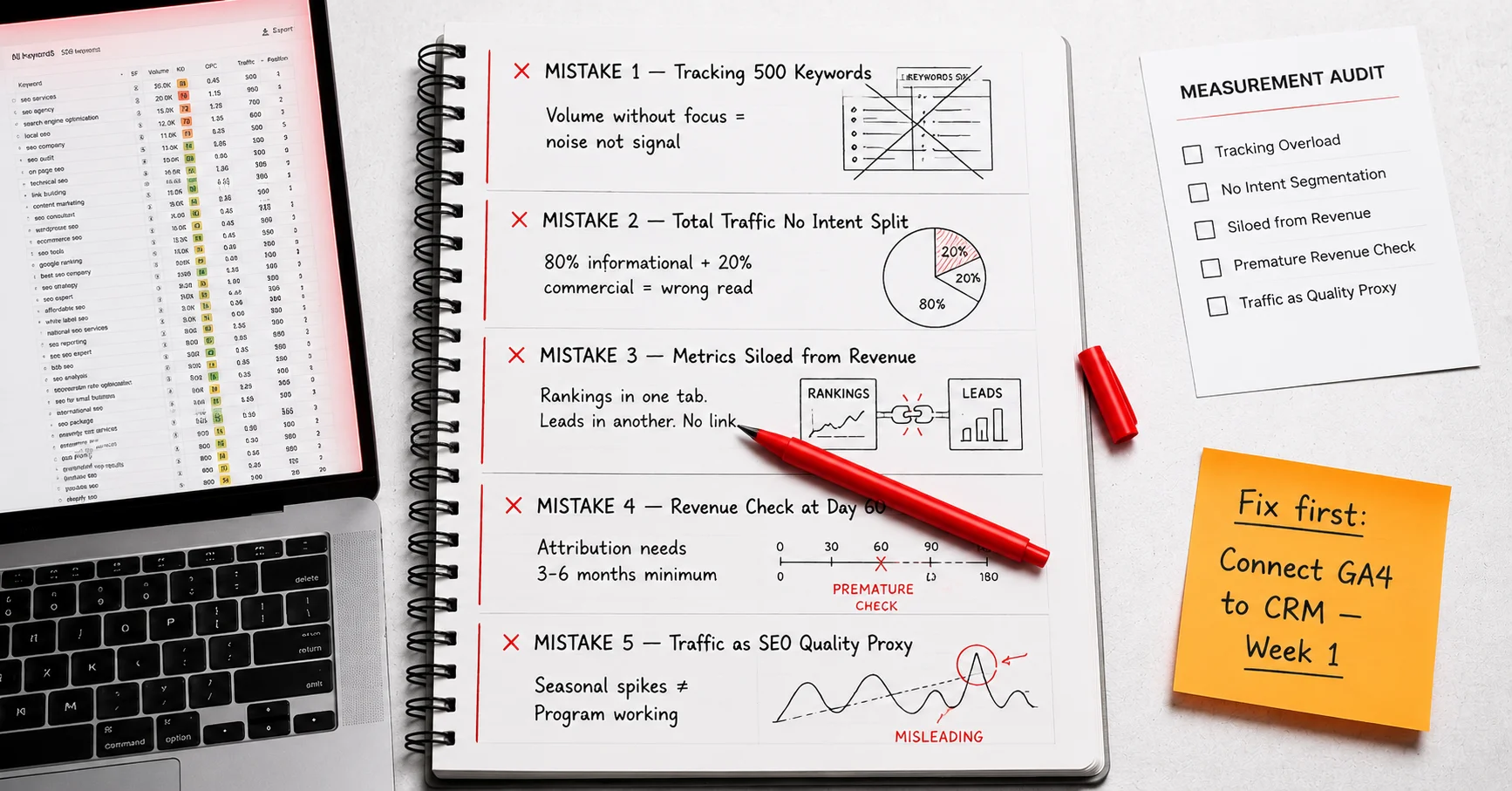
Tracking rankings without filtering for meaningful keywords.
Tracking 500 keywords that include every variation and related term produces a report that looks comprehensive and tells you very little. Tracking position movement for the 20 to 30 keywords that represent your most important ranking opportunities, and knowing the search volume and competition context for each, tells you what you actually need to know.
Measuring organic traffic without segmenting by intent.
Total organic traffic is a starting metric, not an evaluating metric. If 80 percent of organic traffic is from informational searches that never convert and 20 percent is from commercial searches that do convert, the commercial segment is where the real performance signal lives. Treat organic traffic as a segmented metric from the beginning.
Not connecting SEO metrics to conversion and revenue data.
Tracking rankings and traffic in one system and leads and revenue in another, without connecting them, makes it impossible to evaluate the SEO program’s business impact. Every organic traffic metric needs a corresponding conversion metric to be meaningful. A site that generates 10,000 organic visits per month with no attributed leads or revenue is not producing ROI regardless of how impressive the traffic number is.
Evaluating the program at 60 days using revenue attribution.
Revenue attribution from organic search typically requires three to six months of program execution before meaningful attribution data exists. Evaluating the program against business impact metrics at 60 days produces a false negative. Use leading indicators in months one through three and shift to performance and business impact indicators as the program matures.
Using organic traffic as a proxy for SEO quality.
Traffic can increase for reasons unrelated to SEO quality, including seasonal search demand, viral content, or changes in the competitive landscape. It can also decrease while the SEO program is producing genuine improvements if a seasonal traffic driver falls off. Organic traffic trend is useful context. It is not the primary evaluating metric for SEO program quality.
FAQ
What is the most important metric for measuring SEO success?
Organic leads or revenue attributed to organic search is the most important metric for any business where SEO is a growth investment. All other metrics are proxies or leading indicators. Rankings, traffic, and impressions are signals that lead to the business outcomes that SEO is actually supposed to produce. The revenue attribution metric is what tells you whether the investment is working.
How often should I review SEO metrics?
Monthly for most metrics. Keyword positions, organic traffic, Core Web Vitals, and conversion data should all be reviewed monthly with trend context. Some technical health metrics like crawl errors warrant weekly monitoring. Quarterly reviews should aggregate the monthly data into trend analysis that informs strategy adjustments.
Why do my rankings go up but traffic does not improve?
Several scenarios explain this. Ranking improvements for keywords with very low search volume produce ranking gains without traffic. Ranking improvements for keywords with high SERP features, like featured snippets or AI Overviews, may produce lower CTR because searchers find answers without clicking. And ranking improvements for keywords that do not match the actual search intent of your audience produce impressions from the wrong searchers.
What is the difference between SEO leading indicators and lagging indicators?
Leading indicators like impressions and technical health signal early-stage program momentum before revenue outcomes appear. Lagging indicators like attributed revenue reflect the cumulative result of months of compounding SEO work. Both are necessary. Leading indicators tell you whether the foundation is building. Lagging indicators tell you whether the investment is returning.
How do I know if my current SEO reporting is measuring the right things?
Ask whether each metric in your report connects to a specific business decision or outcome. If a metric appears in the report but no one can explain what business decision it informs, it is probably a vanity metric. The right metrics tell you what to do next: which pages to optimize, which content to produce, which technical issues to prioritize, and whether the program is on track to produce the business outcome it was designed for.
The Bottom Line
The way you measure seo success metrics determines whether you can make good decisions about the program, or whether you are measuring activity instead of outcomes. Rankings tell you where you are in search. Traffic tells you how many people found you. Conversions and revenue tell you whether any of that translated into business value.
A reporting framework that connects all three layers is not just useful for evaluating the program. It is the instrument that allows the program to improve over time, because you can see which changes in rankings or traffic correspond to changes in conversions and adjust accordingly.
The businesses that measure correctly are the ones that know exactly what is working and why. That knowledge compounds just as surely as the SEO itself does.
Want to know whether your SEO program is being measured the right way?
If you want a strategy that actually fits your business, book a free strategy call. We will walk you through your current metrics, identify the gaps between what you are tracking and what you should be, and show you what a complete measurement framework looks like for your specific business goals. Visit our SEO Strategy Page and Services Main Page to learn more about how we approach this work.