

Internal linking is one of the most consistently underused levers in SEO. Most businesses focus on external links, content quality, and technical fundamentals, and treat internal linking as something that happens incidentally as they publish content. That approach leaves a significant and entirely controllable ranking advantage on the table. A deliberate internal linking seo strategy is one of the fastest ways to improve rankings for pages that already have strong content but are not reaching their potential.
The reason internal linking is underused is that its effects are slower and less visible than other optimizations. An external link from a high-authority publication produces a measurable authority signal quickly. An internal link structure that routes authority efficiently across a site produces rankings improvements that build gradually and compound over time. That compounding is exactly why it deserves more strategic attention than it typically receives.
What Internal Links Actually Do for SEO
Before getting into the strategy, the mechanics need to be clear. Internal links serve two distinct functions, and understanding both determines how to use them effectively.
Authority distribution
Every external link pointing to a page on your site carries link equity, the authority signal that Google uses to evaluate how trustworthy and credible a page is. That equity does not stay on the landing page. It flows through the internal links on that page to the pages it links to, and from there to the pages those pages link to. A page with no internal links pointing to it from the rest of the site accumulates authority slowly. A page that receives internal links from high-authority pages elsewhere on the site benefits from that equity flow.
This is why homepage link placement matters. The homepage typically receives the most external links of any page on a site. The internal links from the homepage pass its accumulated authority to the pages it links to. Service pages, category pages, and key landing pages linked from the homepage benefit from that authority transfer in a way that pages buried three or four clicks deep do not.

Crawl path and discoverability
Googlebot follows links to discover content. A page that has no internal links pointing to it is harder for Googlebot to find and is crawled less frequently than pages that are linked from multiple locations on the site. For new content especially, internal links from existing pages signal to Google that the new page exists and is worth crawling.
On large sites, crawl budget matters. Googlebot has a finite amount of time and crawl allocation for any given site. Pages that receive internal links are crawled more frequently than those without. For content-heavy sites with hundreds or thousands of pages, internal linking structure directly affects which pages get crawled and how often.
Internal Linking SEO Strategy: The Framework
A strategic approach to internal linking is not random or incidental. It is a deliberate system built on three principles.
Principle 1: Route Authority to Your Most Important Pages
Identify the pages that are most important to your business. These are typically your primary service pages, product category pages, high-converting landing pages, and pillar content that forms the hub of your topic clusters. These are the pages you most want to rank.
Now trace the authority flow from your homepage and highest-authority pages. Which of these important pages are getting strong internal link support? Which are getting none? The pages that are important but poorly linked internally are your highest-priority internal linking opportunities.
The fix is to add internal links from high-authority pages on your site to the important pages that need equity. This does not require new content. It requires updating existing content to add contextually relevant links to the priority pages.
A homepage that links to services, about, and contact but not to specific service category pages or key blog posts is missing the opportunity to route its accumulated authority to the pages that generate leads. Adding internally relevant links to the homepage and to existing high-traffic pages is one of the fastest-producing internal linking investments.
Principle 2: Build a Topic Cluster Architecture
Topic clusters connect related content through internal links in a hub-and-spoke model. A pillar page covers a broad topic comprehensively. Cluster posts cover specific subtopics in depth. The pillar links to every cluster post. Every cluster post links back to the pillar.
This structure does two things. It routes authority between the pillar and the cluster posts, concentrating topical authority on the pillar page where the highest-competition keywords live. And it signals to Google the topical relationship between all the pages in the cluster, reinforcing the site’s authority on the overall topic.
A site that publishes about local SEO, local citation building, Google Business Profile optimization, and local SEO for specific industries should have a local SEO pillar page that links to all of those posts, and each post should link back to the pillar. Without that structure, the posts exist as isolated assets rather than a connected topic cluster.

Principle 3: Use Descriptive, Keyword-Relevant Anchor Text
The anchor text of an internal link carries a relevance signal for the page being linked to. “Local SEO services” as anchor text for a link to a local SEO service page tells Google that the linked page is about local SEO services. “Click here” or “learn more” tells Google nothing useful about the destination.
Every internal link should use anchor text that describes what the destination page is about. This does not mean stuffing every anchor with the exact keyword phrase. It means using descriptive, natural language that reflects the topic of the linked page.
The one caveat: vary the anchor text across multiple internal links to the same page. If every internal link to a page uses the exact same keyword phrase, it creates an over-optimization pattern that can look manipulative. Use variations, synonyms, and branded references alongside the primary keyword.
How to Audit Your Current Internal Linking Structure
Before building a new internal linking strategy, you need to understand what the current state of internal links looks like. A crawl audit reveals the gaps.
Step 1: Crawl the site
Use a tool like Screaming Frog, Ahrefs, or Semrush to crawl the site and pull the full internal link structure. The output shows how many internal links each page receives and which pages are linking to it.
Step 2: Identify orphaned pages
Orphaned pages are pages with no internal links pointing to them from the rest of the site. They rely entirely on direct traffic or external links for discovery and authority. For any page you want to rank, orphan status is a significant handicap. Identify all orphaned pages and prioritize the ones that are important for rankings.
Step 3: Identify pages receiving the most internal links
These are your site’s most internally supported pages. In a well-structured site, these should be your highest-priority pages. If they are not, the internal link structure is not aligned with the content strategy.

Step 4: Map the authority flow
For your five to ten most important pages, trace the internal link paths that lead to them from the homepage and from your highest-traffic pages. Are they well connected? Or are they buried in the site with limited internal link support?
Step 5: Identify internal linking opportunities in existing content
Review high-traffic pages for natural opportunities to add internal links to priority pages that are not yet linked. An existing guide about SEO strategy that does not link to the site’s keyword research guide is a missed internal linking opportunity that can be fixed with a single sentence addition.
The what-is-on-page-seo guide covers how internal linking fits within the broader context of on-page optimization. The technical-seo-checklist guide includes internal link health as part of the ongoing technical monitoring that maintains a site’s SEO foundation.
Common Internal Linking Mistakes
Publishing new content without adding internal links to it from existing pages
New content has no internal links pointing to it until someone explicitly adds them. A page published without internal links from existing content is an orphan from day one, accumulating authority slowly regardless of how good the content is. Every new page should receive internal links from at least two to three relevant existing pages on the same day it is published.
Using generic anchor text for all internal links
Menus, footers, and navigation links typically use generic labels like “Services,” “Blog,” and “About Us.” These are navigational links with minimal SEO signal value. Body content links should use descriptive, keyword-informed anchor text that tells Google what the linked page covers. If all internal links use navigation-style anchors, the relevance signal is almost entirely absent.
Linking only from new content to other new content
A common pattern is that internal links only connect recent posts to each other, while older high-authority pages sit unlinked from new content. Older pages that have accumulated external links over time are the highest-value internal link sources on the site. Regularly updating older high-authority posts to add internal links to newer priority pages transfers that accumulated authority efficiently.

Building a topic cluster without linking the cluster back to the pillar
Cluster posts that link to the pillar but where the pillar does not link back to the cluster posts are half a structure. Both directions of the link relationship matter. The pillar should comprehensively link to every relevant cluster post. The cluster posts should link back to the pillar and where relevant to other cluster posts in the same topic area.
Ignoring internal link structure on eCommerce sites
Category pages should link to subcategory pages. Subcategory pages should link to product pages. Related products should link to each other. A product page that does not link to the category it belongs to is missing the opportunity to pass its authority upward to the category page that carries the highest-value category keyword. On large eCommerce sites, internal linking structure is a primary lever for distributing the authority that external links bring in across the pages that need it.
Internal Linking and Site Architecture
Internal linking strategy is not separate from site architecture. It is the mechanism through which architecture produces ranking benefits.
A site with a well-planned three-level hierarchy, homepage linking to category pages linking to individual posts, produces compounding authority flow if the internal links are explicitly added and maintained. A site with the same architecture but only navigation-level links between levels wastes most of the authority distribution opportunity.
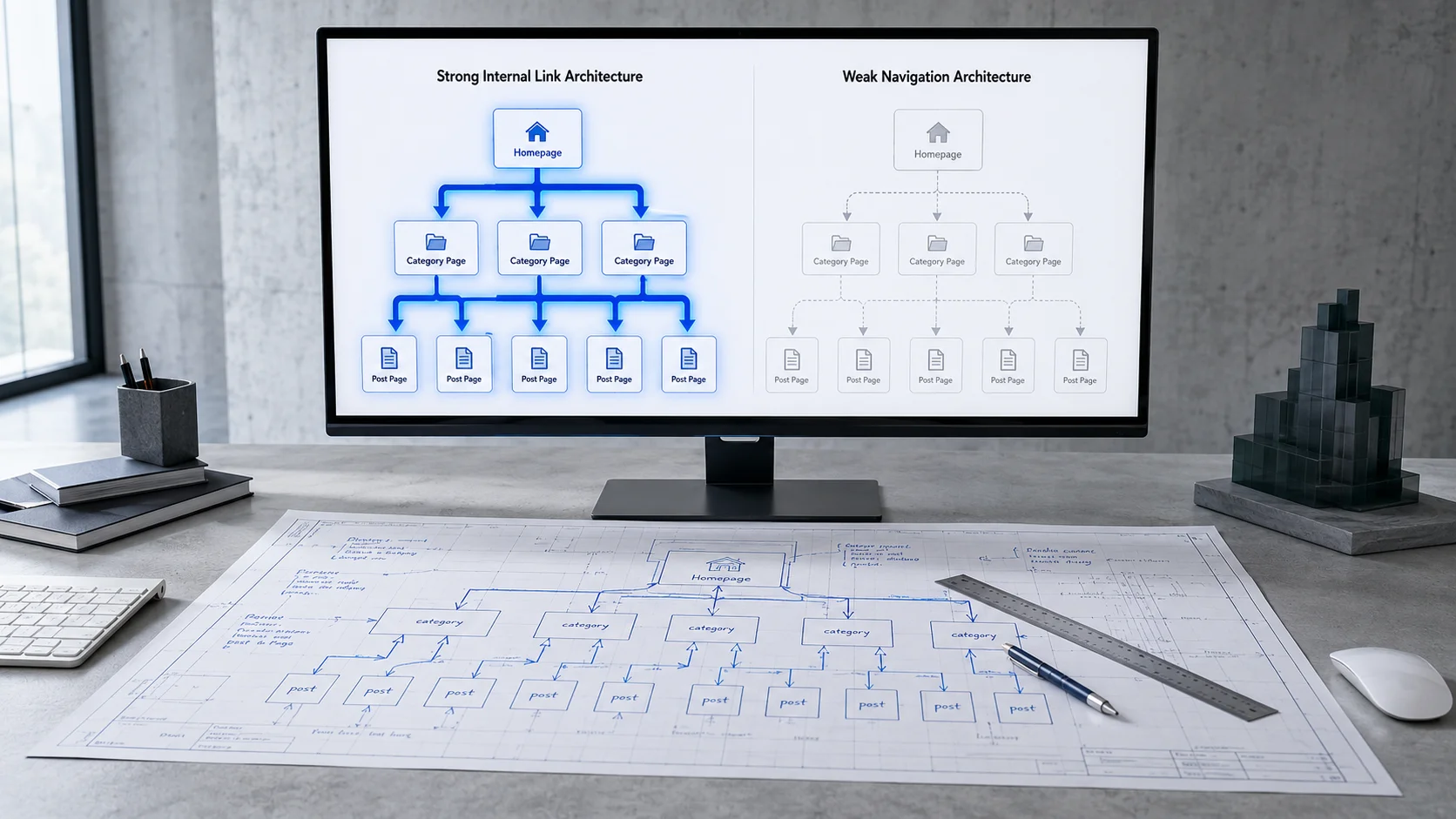
The practical implication: site architecture tells you where the links should go. The internal linking strategy tells you how to make them effective. Both have to be right for either to reach its potential.
For a complete view of how internal linking fits within the ongoing technical maintenance that keeps a site performing, the technical-seo-checklist guide covers the full set of elements that require periodic review.
FAQ
How many internal links should a page have?
There is no ideal number. Enough to link to all closely related content that a reader might benefit from, but not so much that the page becomes a navigation hub with no content focus. For most blog posts and service pages, four to eight contextual internal links within the body content is a reasonable range. Pillar pages can have more because they intentionally link to all cluster content.
Does internal linking actually improve rankings?
Yes. Internal links distribute authority from pages that have earned external links to pages that need ranking support. They also signal topical relationships between content, which Google uses to evaluate relevance and expertise. Businesses that implement a structured internal linking strategy consistently see ranking improvements for priority pages within eight to twelve weeks of implementation.
Should I update old content to add internal links?
Yes. Older content that has accumulated external links over time is the most valuable internal link source on the site. Regularly updating high-traffic older posts to include internal links to newer priority pages is one of the most efficient internal linking investments available. It does not require producing new content, and it activates authority that is already sitting in the existing content library.
What is the difference between contextual links and navigational links?
Navigational links are those in menus, headers, footers, and sidebars. They help users navigate the site but carry limited SEO signals because Google gives them less weight than editorial, in-body links. Contextual links are links embedded within body content that connect two topically related pieces of content. Contextual links carry stronger relevance signals because they reflect an editorial judgment that one page is related to another.
How do I handle internal linking on a large site with hundreds of pages?
Prioritize by importance. Identify the top 20 percent of pages by revenue contribution, traffic, or strategic value. Audit the internal link structure for those pages first, ensure they are well-connected, and expand from there. On large sites, internal link auditing tools like Screaming Frog or Ahrefs make the process manageable by providing a full map of the site’s link structure rather than requiring manual page-by-page review.
The Bottom Line
An internal linking seo strategy is one of the highest-leverage, lowest-cost SEO improvements available on most sites. The content already exists. The pages that need authority are already published. A deliberate audit and structured approach to internal links routes the authority that is already in the site to where it can produce the most ranking impact.
The businesses that build this system and maintain it as new content is published consistently outperform those treating internal linking as an afterthought. The effect is quiet. The compounding over 12 to 18 months is not.
Want to know how your internal link structure is affecting your rankings and what changes would produce the most impact?
If you want a strategy that actually fits your business, book a free strategy call. We will walk you through your internal link profile and show you exactly where the gaps are costing you ranking potential. Visit our On-Page SEO Service Page and Technical SEO Page to learn more about how we approach this work.