

Most contractors get their first customers through referrals and word of mouth. That works until it does not. When referrals slow down, the businesses that built a local search presence have a reliable pipeline to fall back on. The ones that did not are back to cold outreach and paid lead platforms charging per contact. Local SEO for contractors is the system that makes your phone ring from people who are already looking for exactly what you do, in your city, right now.
This is not a beginner’s overview. If you are reading this, you already know you need to show up in local search. This post covers what actually moves rankings for contractors, where most contractor SEO falls apart, and what a complete local SEO system looks like when it is built to generate real leads.
Why Contractor SEO Is Different from General Local SEO
Contractors operate in one of the most competitive local search environments that exists. Plumbers, electricians, HVAC companies, roofers, general contractors. Every city in the US has dozens of them competing for the same handful of Map Pack spots and the same first-page organic positions.
The challenge is compounded by the fact that the searches with the highest intent, “emergency plumber Houston,” “AC repair near me,” “licensed electrician Dallas,” trigger a Google Map Pack result that captures the majority of clicks before any organic listing appears. If you are not in those three spots, you are invisible to the most valuable segment of local search traffic.
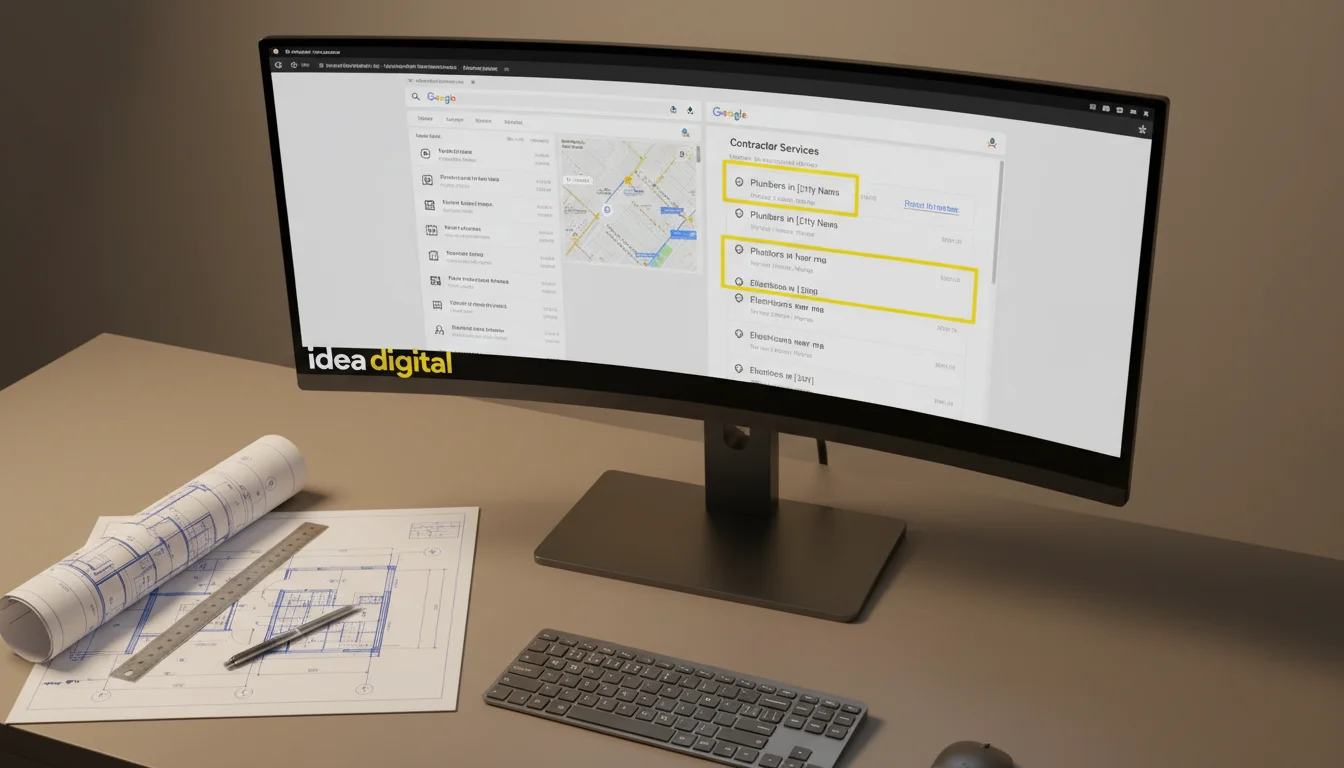
General local SEO advice treats all local businesses the same. Contractor SEO requires a different level of precision because the competition is concentrated, the stakes per lead are high, and the geographic targeting has to be granular enough to cover a real service area rather than just a single address.
We have worked with contractors across markets including Atlanta, Phoenix, San Diego, and Chicago. The pattern is consistent. The businesses winning in local search are not just the largest or the longest established. They are the ones that built the right foundation and maintained it systematically.
The Local SEO Framework That Works for Contractors
Winning local search as a contractor comes down to four interconnected systems. Each one reinforces the others, and none of them fully works without the rest.

1. Google Business Profile, Built and Maintained Correctly
Your Google Business Profile is the single most influential asset for Map Pack visibility. Most contractors have a profile. Very few have one that is fully optimized and actively maintained.
The specifics that matter most:
- Primary and secondary categories selected for how Google maps your trade, not just how you describe yourself
- Service area configured to match your actual operational geography, including suburbs and surrounding cities
- Services section completed with specific trade descriptions and keyword-relevant language
- Business description written with your primary services and service area naturally included
- Weekly or biweekly posts to signal that the profile is active
- Q and A section managed with accurate, useful answers
Contractors who treat the profile as a set-and-forget asset consistently lose Map Pack position to competitors who maintain theirs actively. Google reads engagement signals. An active profile ranks more consistently than a static one.
2. Review Volume, Recency, and Response
Reviews are both a ranking signal and a conversion signal. For contractors, they are often the deciding factor when two businesses appear side by side in the Map Pack.
Google weighs three dimensions of reviews: volume, recency, and your response rate. A contractor with 80 reviews, all from more than a year ago and none responded to, will lose Map Pack position over time to a competitor with 50 reviews, updated in the last 60 days, with consistent responses.
Build a review acquisition process into your post-job workflow. Send a direct link via text immediately after job completion. Follow up once if no review was left. Respond to every review, including negative ones. A well-handled negative review often converts prospective customers better than five-star reviews with no responses.
3. Citation Consistency Across the Web
A citation is any mention of your business name, address, and phone number online. Directories like Yelp, Angi, HomeAdvisor, Houzz, BBB, and dozens of others all carry your business information. When that information is inconsistent across platforms, old addresses, wrong phone numbers, name variations, Google reads conflicting signals and your local authority suffers.
Audit your existing citations before building new ones. Fix inconsistencies at the aggregator level first, since aggregators feed downstream directories automatically. Then build outward to industry-specific contractor directories and local platforms. A clean, consistent citation profile is foundational to stable Map Pack rankings. It is also one of the most consistently overlooked fixes in contractor SEO campaigns.
4. Website Authority and Location-Specific Content
The Map Pack and your website rankings are not fully separate. Google evaluates your website as part of the local ranking algorithm. A fast, mobile-friendly site with location-specific service pages, proper local schema markup, and consistent NAP information matching your Business Profile ranks and holds position better than a generic contractor website with no local content.
Each service area you actively target should have its own dedicated page. A roofing contractor covering Dallas, Plano, and Frisco should not rely on a single generic service page. Three location-specific pages, each targeting the relevant geography with unique content, each internally linked from the main site, is the right structure.
How to Rank in the Google Map Pack as a Contractor
The Map Pack is where the highest-intent contractor searches resolve. For a detailed breakdown of the full framework for Map Pack visibility, the rank-in-google-map-pack guide covers every ranking signal in depth. Here is the contractor-specific summary.
Google’s Map Pack algorithm evaluates three signals: relevance, distance, and prominence.
Relevance is about how well your profile and website match the search. Proper category selection, complete service descriptions, and keyword-aligned website content all feed this signal. Distance is partly outside your control, but your service area settings and the geographic signals in your content influence how Google interprets your operational geography. Prominence is the big one. It is built through reviews, citations, links, and the overall credibility of your online presence.
For contractors in competitive markets, prominence is where the differentiation happens. Any contractor can fill out a Business Profile. Fewer build the external authority signals that make prominence genuinely competitive.
Common Mistakes That Cost Contractors Local Rankings

Running Google Ads instead of fixing local SEO
Paid search and local SEO are not interchangeable. Ads produce traffic while they run and stop the moment the budget stops. Local SEO builds an asset that compounds. Contractors who redirect their entire digital budget to ads because they want faster results often find themselves in the same position two years later, still dependent on paid traffic with no organic foundation underneath.
Relying on Angi and HomeAdvisor instead of building owned search presence
Lead aggregators have their place, but the leads are expensive, shared with competitors, and do not build any lasting equity for your business. A contractor that owns page one and the Map Pack for their primary service terms in their city does not need to pay per lead for the searches those rankings capture. Building toward that independence is a different orientation than optimizing for lead platform performance.
Targeting one city when the real service area is much larger
A contractor in Phoenix may serve Tempe, Scottsdale, Mesa, and Chandler. A single location page for Phoenix misses the search volume from those surrounding areas. Each city or suburb with meaningful search volume for your services deserves its own location page. This is one of the most straightforward ranking opportunities most contractors overlook.
Having a website that is not mobile-optimized
The majority of local contractor searches happen on mobile, often in a moment of need. A website that loads slowly, displays poorly on a phone, or requires desktop navigation to find a phone number is losing leads in real time. Google’s mobile-first indexing means your mobile experience is also your ranking experience.
Never updating the website after launch
Google evaluates freshness as a quality signal. A contractor website that has not changed since 2021 sends a stale signal. Adding new project photos, updating service descriptions, publishing occasional local content, and keeping the site technically current all contribute to maintaining and improving search visibility over time. The broader principles behind this connect to the local-seo-for-home-services framework, which applies across contractor verticals.
FAQ
How long does local SEO take to work for contractors?
In moderately competitive markets, meaningful Map Pack movement typically happens within 60 to 90 days when the foundational work is done correctly. In highly competitive markets like Los Angeles or Houston, expect three to six months before consistent top-three visibility develops. The businesses that stay consistent beyond that window compound their advantage significantly.
Do I need a website to rank in the Google Map Pack?
Technically, you can appear in the Map Pack without one. But your website is a significant ranking signal for prominence, and without it, your ceiling for competitive terms is lower. A properly structured, mobile-optimized website with location-specific content consistently outperforms a profile-only approach in competitive contractor markets.
How important are reviews for contractor local SEO?
Critical. Reviews are one of the highest-weight signals in the Map Pack algorithm and the primary conversion factor when prospective customers choose between two similar listings. Volume, recency, and your response rate all matter. A consistent review acquisition process is not optional for any contractor serious about local search visibility.
Should I use the same content on multiple location pages?
No. Duplicate content across location pages is one of the most common reasons location pages fail to rank. Each page needs unique content that addresses the specific geography, references local context where it fits naturally, and is structured around location-specific keyword targets. Google will not rank multiple pages with the same content for different city searches.
Is local SEO worth it for smaller contractor businesses?
Yes, and often more so than for larger ones. Smaller contractors in specific niches or service areas can dominate the Map Pack for their exact geography with a fraction of the effort required to compete at a metro-wide level. Focused local SEO that matches the actual scale of your service area produces faster results and higher-quality leads than a broad strategy that tries to compete everywhere at once.
The Bottom Line
Local SEO for contractors is not about gaming Google. It is about building the kind of clear, consistent, trustworthy online presence that Google is already looking for when it decides which three businesses to put in the Map Pack.
The contractors that own their local search results in 2026 started building that presence systematically. Clean profiles, consistent citations, real reviews, mobile-optimized websites, and location-specific content. Not all at once, but in the right sequence, maintained over time.
That is what separates the businesses getting calls every morning from the ones still relying on whatever came in from Angi last week.
Ready to find out exactly what is holding your local rankings back?
If you want a strategy that actually fits your business, book a free strategy call. We will walk you through your current local SEO profile, identify the gaps, and show you what a realistic improvement plan looks like for your market. Visit our Local SEO Service Page to learn more about how we work with contractors.