

A plumber in Dallas does not need to rank across the United States. A SaaS company selling nationally does not need to optimize for the Map Pack in Atlanta. The local seo vs national seo question is not a technical debate. It is a fundamental strategic question about who your customers are and how they find you, and getting the answer wrong wastes time and budget on signals that will never reach the buyers you are actually trying to reach.
Most businesses make this decision based on what sounds more ambitious. National SEO sounds bigger. It often gets chosen over locals even by businesses that only serve a specific city or region. The result is a strategy built for an audience that is not the actual customer base.
This guide cuts through the noise on both approaches, explains what makes each one appropriate, and helps you identify which one, or which combination, your business actually needs.
What Local SEO and National SEO Actually Are
Before comparing them, the definitions need to be clear.
Local SEO
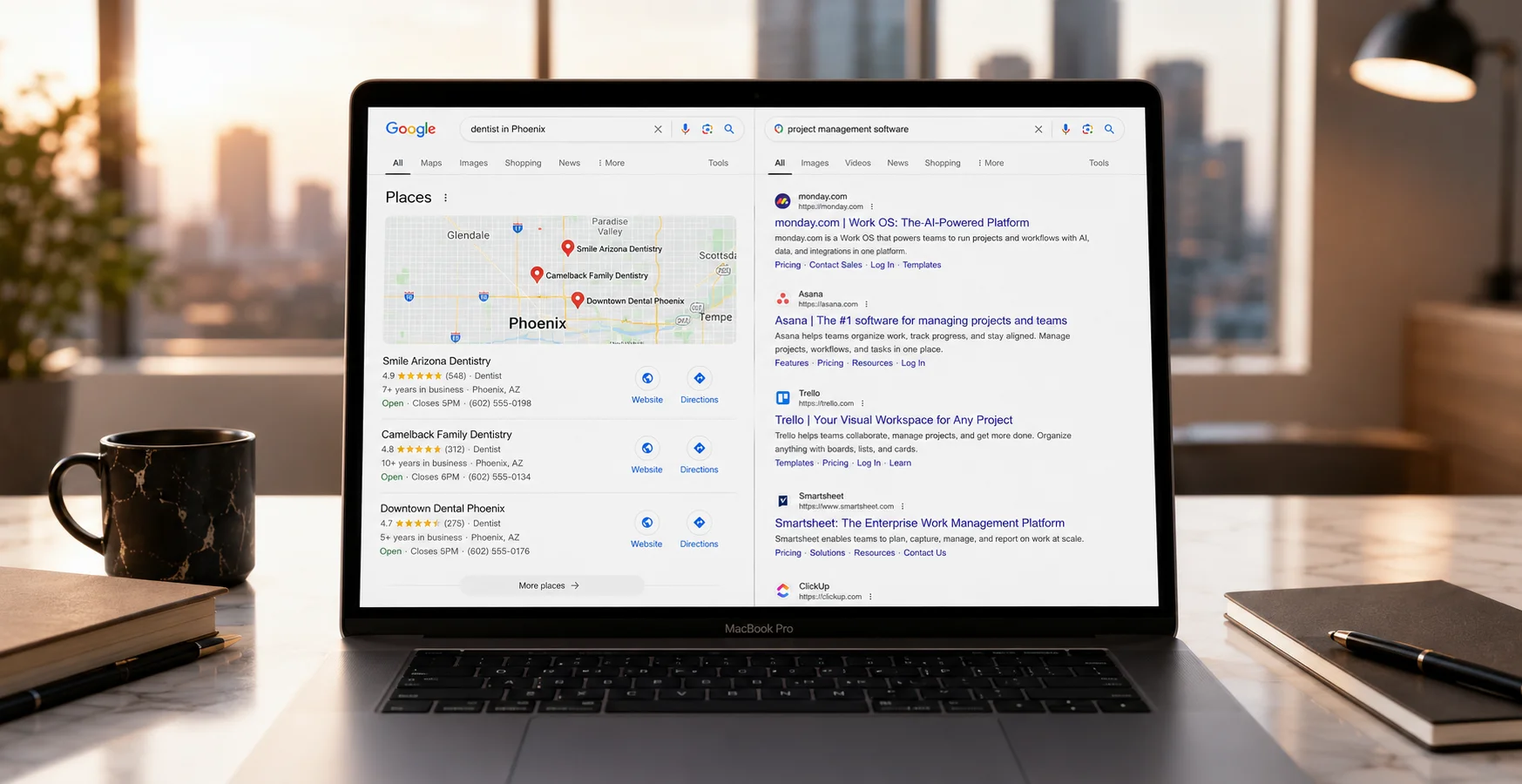
Local SEO is the discipline of optimizing a business’s visibility for geographically bounded searches. It targets searches that include a location modifier, like “dentist in Phoenix” or “best HVAC contractor Dallas,” and near-me searches where Google infers the searcher’s location. Local SEO also drives Map Pack visibility, which is the set of three business listings that appear in Google search results for local queries. The Google Business Profile is the primary asset in a local SEO program.
National SEO
National SEO is the discipline of optimizing for search queries without geographic restriction. A business targeting “project management software,” “personal injury law firm,” or “best protein powder” is competing for searches that come from anywhere in the country. The audience is defined by interest and intent, not location. National SEO relies heavily on content depth, domain authority, and link acquisition from credible national sources.
The mechanics of both involve keywords, content, technical optimization, and link building. But the keyword targets, the content structure, the citation strategy, and the signals that drive rankings differ meaningfully between them.
Local SEO vs National SEO: The Direct Comparison
| Factor | Local SEO | National SEO |
| Geographic target | Specific city, region, or service area | Entire US market or broader |
| Primary ranking asset | Google Business Profile | Website content and domain authority |
| Key signals | Citations, reviews, local links, GBP activity | Content depth, backlinks, topical authority |
| Timeline to results | Faster (2 to 6 months typically) | Slower (6 to 18+ months typically) |
| Competition level | Bounded by local market | National or category-wide |
| Best measurement | Map Pack position, local traffic, calls | Organic traffic, keyword rankings, conversions |
| Who it fits | Location-dependent businesses | Location-independent businesses |
The comparison simplifies to one question: does your customer need to be in a specific place to buy from you, or can they be anywhere?
A hair salon, a chiropractor, a contractor, a restaurant, a law firm serving a specific jurisdiction. These businesses have customers defined by geography. Local SEO is the primary strategy.
An eCommerce brand, a SaaS platform, a national consulting firm, a publisher. These businesses have customers defined by interest or need, not location. National SEO is the primary strategy.
Many businesses are somewhere in the middle, and that is where the strategy gets more nuanced.
When You Need Local SEO
Local SEO is the right primary investment when your revenue depends on customers who are physically near your business or in a specific service area.
The most obvious examples: restaurants, medical and dental practices, law firms practicing in specific states or cities, home services businesses like plumbers and electricians, retail stores, gyms, salons, and any business that serves customers in person.
Less obvious but still local: service-area businesses that go to the customer, like landscapers, mobile mechanics, and cleaning services. These businesses do not need foot traffic, but their customers still search with location intent. A homeowner searching for “gutter cleaning near me” in Atlanta is not looking for a national brand. They are looking for someone who can show up at their house.

The defining characteristic is that the geography of the customer determines whether the sale happens. If a customer in Houston cannot realistically use your business, ranking nationally in Houston is irrelevant. Local SEO concentrates the ranking signal on the geography that actually produces revenue.
For local businesses new to SEO, the what-is-local-seo guide covers the foundations, including how Google evaluates local search differently from traditional organic search and what the Map Pack ranking factors look like.
When You Need National SEO
National SEO is the right primary investment when your customer can be anywhere and the limiting factor is interest or intent, not geography.
eCommerce brands shipping nationwide. SaaS products serving businesses of any type anywhere in the country. Online education platforms. Publishing businesses with national audiences. Consulting and professional services firms that work remotely.
National SEO is also appropriate for businesses that are looking to scale beyond a single market. A law firm that practices federal law and serves clients nationally, a healthcare provider offering telehealth nationally, or a professional services firm that works remotely with clients across the US.
National SEO competes in a fundamentally different environment than local. There are no geographic boundaries limiting the competition. Every business in the category, including well-funded incumbents with years of authority building, is competing for the same search terms. This is why the timeline for meaningful national rankings is longer, the authority requirements are higher, and the content investment is typically greater.
The Hybrid Strategy: When You Need Both
Some businesses genuinely need both, and building a strategy that serves both without diluting either requires deliberate architecture.
A multi-location service business, a regional healthcare network, or a law firm with offices in multiple cities needs local SEO for each location combined with national SEO for the broader brand. The local presence generates leads from specific markets. The national authority supports the brand credibility that makes local prospective customers trust the business when they find it.
A small eCommerce brand that also has a physical retail presence needs both. Local customers need to find the store. National customers need to find the product online. The local and national strategies address different audiences with different content and different ranking signals, but they share a domain and need to be built compatible.

For smaller businesses choosing between the two due to budget constraints, local should almost always come first if the business is location-dependent. Local SEO produces results faster, has a more bounded competitive environment, and more directly corresponds to the revenue-generating customer base. The seo-strategy-for-small-business guide covers how to prioritize and sequence an SEO program for businesses with limited resources.
Common Mistakes When Choosing Between Local and National SEO
- Choosing national SEO to sound more ambitious when the customer base is local
A personal injury attorney in Chicago who optimizes for “personal injury attorney” nationally is competing against every firm in the US for a term that almost no one in Chicago searches for without a geographic qualifier. Building local authority for “personal injury attorney Chicago” competes in a more bounded market and delivers a higher percentage of leads that can actually convert. - Not building local SEO signals even when primarily pursuing national SEO
A national brand with a physical location is leaving local Map Pack visibility on the table if it does not maintain a Google Business Profile and local citation profile for each location. The local and national signals coexist and reinforce each other. Ignoring one weakens the overall presence even if the primary strategy is national. - Applying a generic national content strategy to a business that needs local landing pages
A home services company serving five cities publishes general content about its services but has no location-specific pages. It competes nationally for terms that are searched locally, which means the content reaches the wrong audience and converts almost no one. Each market needs its own content that speaks to the local searcher’s intent. - Underestimating the competition in national SEO for resource-constrained businesses
A new small business deciding between local and national SEO because national sounds more scalable is often choosing a strategy where they cannot realistically compete for years. The local market is more accessible, produces faster results, and builds the authority foundation from which national expansion becomes viable later.

FAQs
Can I do both local SEO and national SEO at the same time?
Yes, and many businesses need to. The key is building each signal set correctly: a Google Business Profile and citation strategy for local, a content and link strategy for national. When both are needed, the foundational elements (site architecture, technical SEO, and keyword strategy) serve both programs. The geographic targeting of content and the local-specific signals are what differ.
Which is faster, local SEO or national SEO?
Local SEO typically produces results faster. Map Pack visibility for local service terms can appear in two to four months for businesses in moderately competitive markets. National SEO for competitive terms in established categories typically takes nine to eighteen months before meaningful ranking traction appears. For a business that needs lead generation quickly, local SEO produces faster returns.
Does my small business need national SEO?
Only if your customers can be anywhere in the country and geography does not limit whether they buy from you. If your business serves local customers, local SEO is not just sufficient, it is the higher-return investment. Resources spent pursuing national rankings for search terms your local customers are not using produce traffic that does not convert into your actual customer base.
How do I know if my business needs local SEO?
If a customer’s physical location determines whether they can use your service or product, you need local SEO. Test it by asking: could someone in Los Angeles become a customer without ever visiting your area or receiving a physical delivery? If no, your primary SEO strategy should be local.
What happens if I do national SEO but my competitors are all doing local?
You may rank for some national terms and miss significant local traffic. Competitors targeting local keywords with Google Business Profiles, local citations, and location-specific content will capture the high-intent nearby searches that convert at a higher rate than national informational traffic. This is a common gap for businesses that have invested in content-led national SEO without building the local presence that captures the searchers most likely to buy.
The Bottom Line
Local seo vs national seo is not a choice between something small and something big. It is a choice between strategies designed for fundamentally different audiences and competitive environments. The right choice is determined by who your customer is and where they need to be to buy from you, not by which sounds more impressive.
Businesses that match their SEO strategy to their actual customer geography consistently outperform those chasing the wrong audience with the wrong signals. That alignment is where every effective SEO program starts.
Not sure which type of SEO your business needs or where to start?
Start with a free SEO audit and find out exactly where your site stands. We will assess your current visibility in both local and organic search and show you which signals are missing for your specific business type and market. Visit our Local SEO Service Page and SEO Strategy Page to learn more about how we approach strategy decisions for different business types.