

B2B SEO is not harder than B2C SEO. It is different, and most B2B companies are running a B2C playbook on a B2B problem. SEO for B2B companies works when the strategy accounts for longer sales cycles, multi-stakeholder buying decisions, lower search volume with higher intent, and content that needs to serve the researcher before it serves the decision-maker.
The businesses that generate consistent qualified leads through organic search in B2B are not the ones producing the most content. They are the ones producing the right content for the right buyers at the right stage of a purchase process that might take three months to complete. That distinction changes almost every strategic decision downstream.
Here is how B2B SEO works when it is built correctly.
Why Generic SEO Advice Fails B2B Companies
Most SEO content is written for eCommerce, local services, or consumer products. The keyword volumes are higher, the buying decisions are faster, and the funnel is shorter. Applying the same frameworks to a B2B company selling enterprise software or professional services produces a strategy optimized for the wrong buyer behavior.
Here is what actually happens when a B2B company follows generic SEO advice. They target high-volume informational keywords because the traffic numbers look good. They publish content that gets read but never converts.
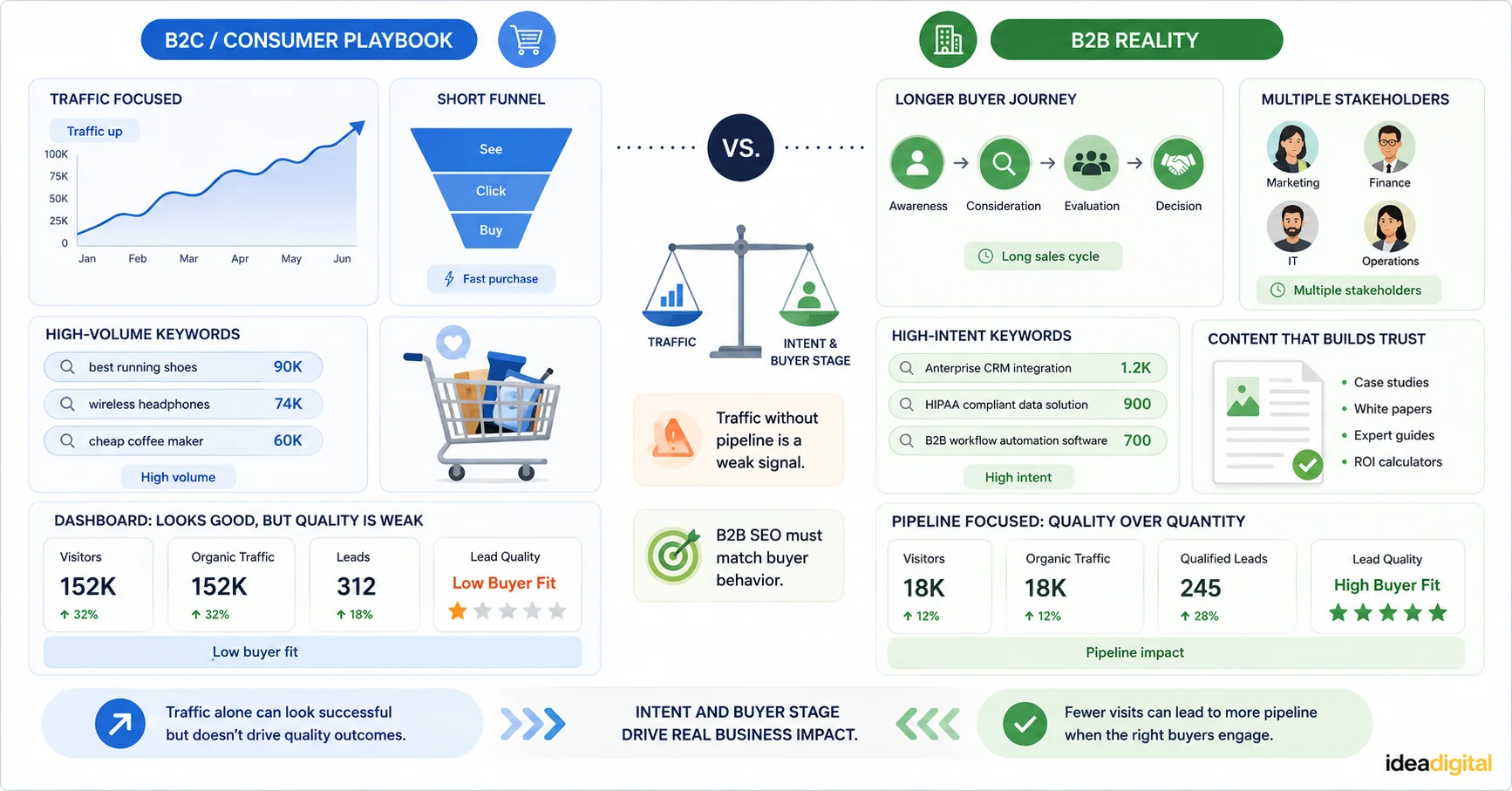
The marketing team celebrates traffic milestones. The sales team sees no pipeline influence from organic. The program loses internal support, gets defunded, and the company doubles down on paid acquisition.
The problem is always the same. The content strategy was built around search volume instead of search intent, and the intent that matters in B2B is fundamentally different from consumer intent. A procurement manager at a manufacturing company searching for “enterprise inventory management software” is not browsing. They have a budget, a problem, and a timeline. The content that serves them needs to address the decision, not just the category.
B2B SEO produces a qualified pipeline when it targets buyers at every stage of a months-long evaluation, not just at the moment of generic informational interest.
SEO for B2B Companies: The Strategic Framework
Layer 1: Keyword Strategy Built Around Buyer Stages, Not Volume
B2B keyword strategy starts with mapping the entire purchase process, from the moment a buyer recognizes a problem to the moment they sign a contract. Each stage produces different search behavior and requires different content.
The B2B buyer journey typically runs through these search stages:
- Problem awareness: the buyer knows something is not working but has not yet framed it as a category need. Searches at this stage are vague problem-oriented: “why is customer churn increasing SaaS,” “how to reduce manual invoicing errors.”
- Category definition: the buyer understands the type of solution they need and is researching the category. Searches become more specific: “accounts payable automation software,” “best customer success platforms for mid-market.”
- Vendor evaluation: the buyer is comparing specific solutions. Searches are comparative and intent-heavy: “[competitor] alternative,” “HubSpot vs Salesforce for manufacturing,” “[product name] pricing.”
- Decision validation: the buyer is close to choosing and is checking credibility signals. Searches include reviews, case studies, and integration queries.
Every stage of this map has an organic search opportunity. Most B2B companies only create content for stages three and four, which are the smallest stages by total search volume but the highest by conversion rate. The companies winning in organic B2B lead generation create content for all four stages and build internal linking paths that move buyers from stage one toward stage four.
Layer 2: Content That Serves the Researcher and the Decision-Maker
B2B purchases involve multiple people. The person doing the research is often not the person making the final decision. The content needs to serve both.
The researcher, typically a manager or analyst, needs content that helps them understand the problem and the category. They are building the business case internally. They need frameworks, data, and specifics that they can bring into a conversation with their leadership. Content that acknowledges this dynamic and explicitly helps the reader build an internal case performs significantly better in B2B than content that assumes the reader will make the decision alone.

The decision-maker, typically a VP or C-suite leader, needs credibility signals, outcome data, and risk reduction. Case studies with specific metrics, ROI calculators, and content that names the cost of the problem all serve this audience.
The researcher may arrive through a blog post and the decision-maker may arrive through a case study link from the same post. Both journeys need to be served from the same content ecosystem.
For a detailed framework on how content types, funnel stages, and keyword strategy align across a B2B content program, the content strategy for seo guide covers the planning and execution approach.
Layer 3: Technical Foundation That Supports Lead Attribution
B2B SEO requires tight technical and analytics infrastructure because the sales cycles are long and the touch points are many. A prospect who finds a blog post in January may not convert until April. If conversion tracking is not configured to capture first-touch attribution, the organic channel appears to produce no leads, and the content budget gets cut.
The technical requirements for B2B SEO to be measurable:
- GA4 configured with conversion events for form submissions, phone calls, and gated content downloads
- Multi-touch attribution or data-driven attribution enabled in GA4 to capture organic-assisted conversions
- CRM integration that records the original traffic source for each lead through the full sales cycle
- Content performance reporting that connects organic content to pipeline value, not just page views
The last point is where most B2B companies’ measurement fails. Without connecting organic content to pipeline attribution, the marketing team cannot demonstrate the value of SEO investment to revenue leadership, and the program loses the internal support it needs to grow.
For a complete framework on how to build this measurement structure into a monthly reporting cadence, the seo strategy small business guide covers how reporting, attribution, and strategy connect for smaller B2B operations.
Layer 4: Authority Building That Demonstrates Industry Expertise
B2B link building is not just about domain authority scores. It is about building the kind of credibility signal that makes a procurement team comfortable shortlisting a vendor they found through search.
The link types that build authority most effectively for B2B companies:
- Editorial mentions and quoted expertise in industry publications specific to the buyer’s sector
- Original research reports that earn links because they produce data other publications want to cite
- Conference and association memberships that result in authoritative institutional links
- Integration and partner links from complementary platforms that serve the same buyer
B2B authority building is slower than B2C but significantly more durable. A link from an industry trade publication carries trust signals that a general business directory link simply does not. The buyers who search for solutions in your category also read those publications. The same authority signal that moves rankings also builds recognition with the buyers you are trying to reach.
What to Expect: B2B SEO Timelines

B2B SEO follows a slower but more consistent compounding curve than most other SEO contexts.
| Time Period | What Typically Happens |
| Months 1 to 3 | Technical foundation set, keyword strategy mapped, early content published |
| Months 4 to 6 | First content pieces ranking on lower-competition terms, organic impressions growing |
| Months 7 to 9 | Pipeline-stage content appearing in relevant searches, first organic-attributed leads visible |
| Months 10 to 12 | Organic contributing measurably to lead volume, content cluster authority building |
| Year 2 | Competitive keyword rankings, organic as primary or co-primary acquisition channel |
B2B companies that invest consistently in all four layers, technical health, content for all buyer stages, proper attribution, and authority building, consistently see this progression play out. The businesses that stall at months four to six are almost always missing one layer, typically either technical attribution that would make organic contribution visible, or content for buyer stages one and two.
Common B2B SEO Mistakes

Mistake 1: Targeting Category Keywords Without Addressing Problem Keywords
B2B buyers start their search at the problem level, not the category level. A company producing only content about their product category (enterprise CRM, supply chain software, B2B payment processing) is invisible to buyers who have not yet named their problem in category terms. Content targeting the problems that drive category searches (sales forecast accuracy, supplier payment delays, customer data fragmentation) captures buyers earlier, builds brand familiarity, and creates multiple paths into the content ecosystem.
Mistake 2: Not Creating Comparison and Alternative Content
B2B buyers evaluate alternatives before choosing a vendor. Searches like “[competitor] vs [product type]” and “[competitor name] alternatives” are high-intent, commercially relevant, and often have attainable competition levels. Companies that do not create dedicated comparison and alternative content are handing high-intent traffic to review sites, competitor pages, and affiliate publishers who have figured this out. This content is not aggressive or inappropriate. It is what buyers are actively looking for.
Mistake 3: Publishing Case Studies Without SEO Optimization
Case studies are the most powerful B2B content type and consistently among the least SEO-optimized pages on company websites. They are often gated (reducing Google’s ability to index them), have no keyword-informed title tags (making them invisible to specific searches), and lack internal links from the content that attracts buyers earlier in the journey. Make case studies indexable, optimize them for the specific outcome terms buyers search for, and link to them contextually from TOFU and MOFU content.

Mistake 4: Measuring Success by Traffic Without Pipeline Attribution
Traffic growth in B2B is a leading indicator, not a success metric. A B2B company generating 10,000 organic sessions per month from informational keywords that do not attract buyers in their ICP is not achieving SEO success by any measure that matters to the business. Measuring content by pipeline influence, qualified lead generation, and organic-attributed opportunity value is the only way to ensure the SEO investment is building something that the sales team benefits from.
FAQ’s
How is B2B SEO different from B2C SEO?
B2B SEO targets lower-volume, higher-intent keywords because B2B search volumes are inherently smaller than consumer search volumes. The content strategy needs to serve multiple decision-makers in a single organization rather than a single consumer. Attribution and measurement are more complex because B2B sales cycles span months and involve multiple touchpoints. And authority building in B2B is more focused on industry-specific credibility signals than on broad domain authority metrics.
How long does B2B SEO take to generate qualified leads?
Most B2B companies see the first organic-attributed leads appearing between months six and nine of a structured program, assuming content for evaluation-stage keywords is being published and attribution tracking is in place. Significant pipeline contribution, where organic becomes a meaningful percentage of total lead volume, typically appears in the 12 to 18 month range. B2B SEO compounds significantly in year two and three as domain authority grows and the content library matures.
Should B2B companies gate content or leave it accessible to Google?
Gated content, like white papers and reports requiring an email submission to access, is valuable for lead capture but invisible to Google if the content itself is behind the gate. The recommended approach is to make the first half or a summary of high-value gated content accessible to Google for indexing, with the full version requiring registration. This allows organic discovery while maintaining the lead capture mechanism. Fully gating content that has strong SEO potential is leaving organic visibility on the table.
What content types drive the most qualified leads in B2B SEO?
The content types that consistently produce qualified B2B leads through organic are: comparison and alternative content for buyers in vendor evaluation, case studies indexed and optimized for outcome terms, ROI and cost calculator tools that attract buyers quantifying the problem, and long-form buying guides that help buyers navigate the category decision. These types target buyers who already understand their problem and are evaluating solutions, which is why they convert at significantly higher rates than general educational content.
Conclusion
SEO for B2B companies is a long-term investment in the infrastructure of qualified pipeline generation. The businesses that build it correctly, with keyword strategy mapped to buyer stages, content that serves the researcher and the decision-maker, technical attribution that makes the investment visible, and authority signals that build industry credibility, create an organic acquisition channel that compounds in value every year it runs.
If you want a strategy built for where your B2B business is right now and what it takes to rank for the terms your buyers are actually searching, book a free strategy call with our team. We will walk through your current organic position and show you exactly what a revenue-connected B2B SEO program looks like. Schedule your call here.