

Most businesses investing in SEO have no idea what it’s actually worth. That’s not a criticism. It’s a systems problem. This SEO ROI calculation guide exists to fix that, because if you can’t measure the return, you can’t justify the spend, optimize the strategy, or hold anyone accountable.
Let’s be honest: “we’re ranking better” is not a business result. Revenue is.
Why Most Businesses Cannot Measure SEO ROI
The problem starts before you write a single piece of content or fix a single technical issue. Most companies measure SEO like it’s a marketing expense rather than a revenue channel. They track rankings, traffic, and impressions. Those metrics matter, but only as leading indicators. They’re not the outcome.

We’ve worked with businesses across multiple US markets and the pattern is always the same. A company invests in SEO for six to twelve months, sees traffic climb, and still cannot tell the CFO whether it was worth it. The data exists. No one built the framework to connect it to revenue.
This is where things usually break down: the gap between SEO metrics and business outcomes. Fix that gap and the ROI calculation becomes straightforward.
The SEO ROI Formula (And What It Actually Requires)
The core formula is simple:
SEO ROI = (Revenue from Organic Traffic – SEO Investment Cost) / SEO Investment Cost x 100
So if your SEO program generates $80,000 in revenue and costs $20,000, your ROI is 300%.
Simple formula. Hard inputs.
Here’s what you actually need to calculate it accurately:

1. Monthly Organic Revenue
This is not traffic. This is the dollar value that organic search visitors generate. Pull it from Google Analytics 4 by segmenting revenue or lead value by the “Organic Search” channel. For eCommerce brands, this is direct purchase revenue. For service businesses and SaaS, you multiply leads by close rate by average deal value.
Example: If organic traffic generates 40 leads per month, you close 20% of them, and your average client is worth $5,000, organic SEO is producing $40,000 per month in pipeline.
2. Total SEO Investment
This includes everything. Agency retainer or internal salaries, content production costs, link building, tools (Ahrefs, SEMrush, Screaming Frog), and any technical development work tied to SEO improvements. Most businesses undercount this by ignoring internal time.
3. Organic Traffic Value (Alternative Method)
If you’re not yet generating trackable revenue from organic, calculate the media value equivalent. What would it cost to buy that traffic through Google Ads? If your keywords have an average CPC of $8 and you’re getting 5,000 organic visits per month, you’re getting $40,000 worth of paid traffic value from SEO every month. This isn’t revenue ROI, but it establishes a floor on the investment’s value.
How to Actually Track SEO Revenue
The formula only works if your tracking is clean. Most audits we run reveal the same issues: GA4 is not configured properly, goals are not set up, and organic traffic is being miscategorized.

Fix these first:
- Set up GA4 conversion tracking for every meaningful action: form fills, phone calls, purchases, quote requests, demo bookings.
- Assign monetary values to non-eCommerce conversions. A law firm in Atlanta that closes 30% of consultations at an average case value of $15,000 should be tracking that, not just counting form submissions.
- Use UTM parameters on all paid and email campaigns so organic traffic stays clean and uncredited.
- Check your channel groupings in GA4. Direct traffic often contains misattributed organic visits, especially for branded searches.
For a deeper look at which metrics actually reflect SEO health versus vanity numbers, read our guide on [measure-seo-success-metrics].
SEO ROI by Business Type
Return on SEO investment varies significantly depending on your model. Here’s a realistic breakdown:
| Business Type | Avg. Time to Positive ROI | What Drives the Return |
| Local Service Business | 4 to 8 months | Map Pack rankings, location pages, reviews |
| eCommerce | 6 to 12 months | Category page rankings, product visibility |
| SaaS / B2B | 9 to 18 months | High-intent content, comparison pages |
| Law / Healthcare | 6 to 12 months | Local SEO, authority content, E-E-A-T |
These are general ranges based on competitive markets in cities like New York, Los Angeles, and Chicago. Thinner competition in markets like Phoenix or San Diego can compress timelines. The variables are always domain authority, keyword difficulty, and how much technical debt the site is carrying.
SEO vs. Paid: The ROI Comparison That Changes Decisions
Paid search delivers traffic immediately. SEO takes time but compounds. Most businesses need both, but they rarely see the comparison laid out clearly.

The key difference is what happens when you stop paying. PPC traffic stops the moment your budget runs out. SEO continues generating returns after the core investment is made. A page that ranks well in Houston or Dallas keeps producing leads at zero incremental cost per click.
Over a 24-month horizon, SEO almost always produces a higher return per dollar than paid search for the same keyword set. The trade-off is the ramp-up period. If you want a full breakdown of how to think through this allocation decision, we’ve covered [seo-vs-ppc] in detail.
Common Mistakes That Destroy SEO ROI
1. Measuring Too Early
SEO compounds over time. Expecting meaningful ROI at 60 days is like expecting a planted tree to provide shade by next week. Our audits consistently show that businesses who abandon SEO between months three and six are quitting exactly when results are about to accelerate. Set ROI benchmarks at six, twelve, and twenty-four months.
2. Not Connecting SEO to Revenue in Reporting
Most agencies report on rankings and traffic. Those are inputs, not outcomes. If your monthly report doesn’t show you organic leads, organic revenue, or organic pipeline value, your measurement framework is broken. This is not a data problem. It’s a reporting discipline problem.
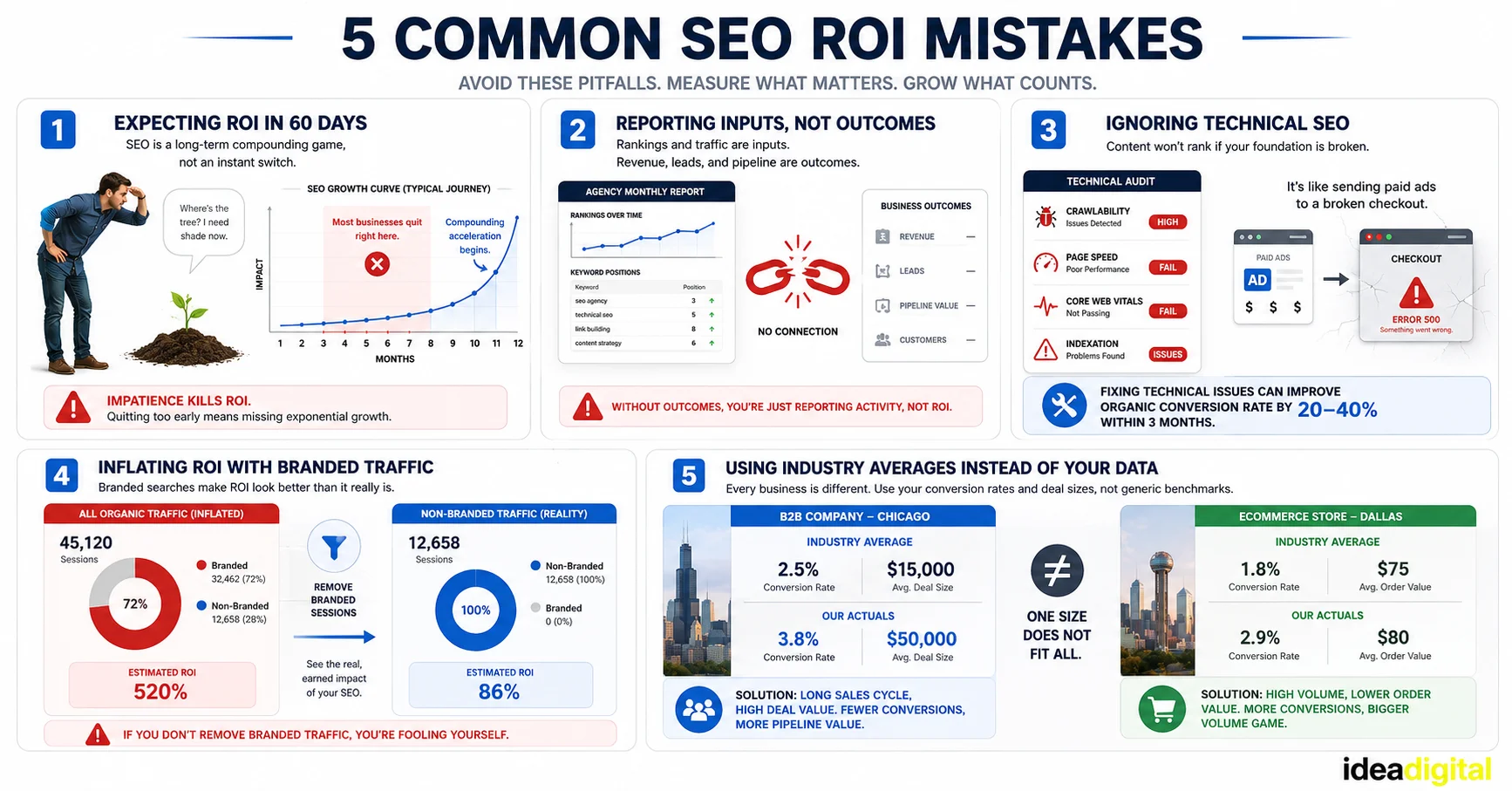
3. Ignoring Technical SEO as a Cost Center
Businesses that fix crawlability issues, page speed, and Core Web Vitals typically see 20 to 40 percent improvements in organic conversion rates within three months. Technical SEO is not a nice-to-have. It’s the foundation. Spending on content while your site has serious technical issues is like running ads to a broken checkout page.
4. Attributing All Organic Revenue to Brand
If your organic traffic is dominated by branded searches (people already looking for you by name), the ROI from SEO is being inflated. Real SEO ROI comes from non-branded, intent-driven traffic. Filter for non-brand organic sessions and recalculate. That’s your actual earned return.
5. Using Industry Averages Instead of Your Own Data
Benchmarks are useful for context. Your own conversion rate, deal size, and sales cycle are what matter. A B2B company in Chicago selling a $50,000 annual contract has a completely different ROI model than a Dallas eCommerce store selling $80 products. Build your model from your numbers, not from published averages.
FAQ’s
How long does it take to see a positive ROI from SEO?
For most US businesses in competitive markets, expect six to twelve months before SEO produces a clearly measurable positive return. Local service businesses in mid-sized markets can see returns in four to six months. Enterprise-level SEO campaigns targeting high-difficulty keywords in national markets often require twelve to eighteen months. The timeline is driven by your starting domain authority, technical site health, and keyword competition. Businesses that have done foundational technical work and have some existing content often move faster.
What is a good SEO ROI?
There’s no universal benchmark, but most well-executed SEO programs for US businesses should target a 3x to 5x return over twelve months. That means for every $1,000 invested, you’re generating $3,000 to $5,000 in organic revenue. High-intent verticals like legal, financial services, and healthcare often see significantly higher returns because of large deal values. eCommerce brands with strong technical SEO and content programs have reported 10x or higher returns over a 24-month period.
Can I calculate SEO ROI without eCommerce tracking?
Yes. For service businesses and B2B companies without direct eCommerce revenue, you calculate ROI using lead value. Assign a dollar value to each lead type based on your historical close rate and average deal value. If you close 25% of SEO leads at $8,000 average, each lead is worth $2,000. Track lead volume from organic traffic in GA4 and multiply. It’s not perfect attribution, but it’s accurate enough to make investment decisions.
Should I compare SEO ROI to paid search ROI?
Absolutely, and most businesses should. PPC gives you a direct cost-per-acquisition benchmark you can compare against SEO’s blended cost-per-acquisition once the program matures. In most industries, SEO produces a lower cost-per-acquisition over 18 to 24 months. The mistake is comparing them at month three, when SEO is still in ramp-up. Run a proper 12-month comparison that accounts for the compounding value of organic rankings.
How do I know if my SEO agency is actually generating ROI?
Ask for a revenue-focused report, not a rankings report. A good agency should show you organic traffic by channel segment, conversion rate from organic sessions, organic lead or revenue volume, and trend lines month over month. If they can’t tie their work to a dollar figure or a clear pipeline impact, that’s a problem. Transparent reporting and honest timelines are non-negotiable. Rankings are a means to an end. Revenue is the goal.
Ready to Know What Your SEO Is Actually Worth?
If you are ready to work with an agency that measures success the same way you do, by revenue not rankings, request your custom growth proposal today. We’ll show you exactly what a properly structured SEO program looks like for your market, your model, and your goals.
Conclusion
SEO ROI is not complicated in principle. You need clean tracking, the right formula, and a reporting structure that connects activity to outcomes. What makes it hard is that most businesses skip the setup work and then wonder why they can’t justify the investment.
The businesses that win with SEO are not the ones who spend the most. They’re the ones who treat it like a revenue channel, measure it like one, and optimize it like one. Rankings will follow. Revenue will follow. But only if the foundation is right.