

Publishing blog posts on random topics does not build topical authority. It builds a content archive. The distinction matters because topical authority is what drives the compounding rankings that make SEO a genuine revenue channel, while a content archive is just a collection of pages that may or may not rank for anything useful. Pillar pages and topic clusters seo is the structural approach that turns random publishing into a coherent authority-building system.
The model is not new, but most businesses implement a version of it that misses the mechanism that makes it work. Understanding why the structure produces the results it does, not just what the structure looks like, is what separates executions that compound from ones that stall after the first few months.
This guide covers the full framework: what pillar pages and topic clusters actually are, how they build authority, how to build them for your specific business, and what commonly goes wrong.
Why Isolated Content Publishing Underperforms
Most businesses publish content without a structural plan. A topic seems relevant, an opportunity appears, a competitor publishes something so the team produces a response. The result is a site with dozens or hundreds of pages that each cover related territory but do not connect to each other in any systematic way.
Google evaluates topical authority by looking at a site’s content as a whole. A site with 30 posts on various aspects of local SEO, all interconnected and supporting a central hub page, signals significantly more topical expertise than a site with 30 posts on 30 loosely related topics across different clusters. The first site looks like a credible, authoritative resource on local SEO. The second looks like a blog with no particular focus.

Here is what actually happens to pages on the unfocused site. They rank for long-tail terms in positions 10 to 20, never breaking into the top five because there is no internal authority network routing equity to them and no topical signal saying this site is specifically about this subject. The pages exist but they do not compound.
A pillar and cluster structure changes this by creating explicit topical concentration through content organization and internal linking.
What Pillar Pages and Topic Clusters Actually Are
The terminology is widely used but frequently misunderstood. Precision here matters for building the structure correctly.
The Pillar Page
A pillar page is a comprehensive, authoritative piece of content that covers a broad topic in enough depth to serve as the definitive resource on that topic within the site. It is the hub around which a cluster of related content is organized.
The pillar page targets a broad, high-competition keyword that represents the core topic. It covers that topic comprehensively at an overview level, touching on all major subtopics, but does not go exhaustively deep on each one. Depth on the subtopics is the job of the cluster content.

The pillar page links to every major cluster post in the topic. This outgoing link structure signals to Google the topical scope of the page and creates the internal link paths through which cluster posts return authority to the pillar.
A pillar page is typically longer than average blog content, often 2,500 to 4,000 words, because it needs to cover the full breadth of the topic. Length is not the goal. Comprehensive coverage at the right depth is.
The Cluster Posts
Cluster posts cover specific subtopics within the pillar’s topic in depth. Where the pillar provides an overview of “local SEO” and mentions citation building as an important factor, the cluster post covers local citation building comprehensively, including the specific process, the key platforms, and the common mistakes.
Each cluster post:
- Targets a more specific keyword within the pillar’s topic area
- Links back to the pillar page
- May link to other cluster posts in the same topic
- Receives internal links from the pillar page
The two-directional linking creates the authority network. The pillar’s external links and internal links from the rest of the site pass authority to the cluster posts. The cluster posts’ backlinks from other sites and their links back to the pillar reinforce the pillar’s authority on the broad topic.
Pillar Pages Topic Clusters SEO: How the Authority Mechanism Works
The mechanism is not intuitive, so it is worth explaining clearly.
Google evaluates topical authority by assessing how comprehensively and credibly a site covers a given subject. A site that has a well-structured pillar page on local SEO, supported by 12 cluster posts covering citations, Google Business Profile optimization, review strategy, local link building, and other specific subtopics, is signaling very clearly that it is a credible resource on local SEO.
The internal linking structure reinforces this signal in two ways.
First, it routes internal link equity efficiently. Authority that the pillar page has accumulated from external links and site-wide internal links flows to the cluster posts through the pillar’s outgoing links. Authority that cluster posts accumulate from their own external links flows back to the pillar through the cluster posts’ return links. The cluster functions as a network that amplifies the authority of every page within it.

Second, it helps Google understand the topical relationships between pages. When Google crawls a cluster post and follows the internal link to the pillar, then crawls the pillar and finds links to 11 other cluster posts on related subtopics, it builds a clear picture of the site’s topical coverage. That picture feeds into the topical authority evaluation that determines which pages Google surfaces for searches on that topic.
The result, when the structure is built correctly, is that the pillar page ranks for the broad, competitive term and the cluster posts rank for their specific subtopics. The authority flows in both directions and compounds as more cluster content is added and more external links are earned.
How to Build a Pillar and Cluster Structure for Your Business
The implementation sequence is important. Getting the order wrong produces a structure that looks right but does not function correctly.

Step 1: Identify Your Core Topic Areas
Start with the topics that represent your business’s core expertise and revenue focus. For an SEO agency, core topics are local SEO, technical SEO, content marketing, link building, and eCommerce SEO. For a law firm, core topics are practice area clusters. For a SaaS company, core topics are the problems the product solves.
Each core topic becomes a pillar cluster. The number of clusters should match the number of genuine expertise areas the site will cover, typically four to eight for most businesses. More than that it is difficult to execute well simultaneously.
Step 2: Map the Cluster Posts for Each Pillar
For each pillar topic, identify every meaningful subtopic that deserves its own dedicated page. These become the cluster posts. The cluster posts should cover every significant dimension of the pillar topic that a person researching that topic would want to understand.
A practical way to identify cluster topics: for each pillar topic, ask what the five to ten most common questions are that someone deeply interested in that topic would want answered. Each question is a potential cluster post.
Step 3: Build the Pillar Page First
The pillar page should be built before the cluster posts, because the cluster posts need something to link back to from day one. A cluster post that goes live with a “coming soon” reference to the pillar page it is supposed to link to is an orphan in a temporary state. Build the pillar first and let the cluster posts find the complete network when they are published.
The pillar page should include sections that overview each major cluster subtopic and link to the dedicated cluster post for each one. Where a cluster post does not yet exist, acknowledge the topic briefly and indicate that a deeper resource is coming or skip the reference until the cluster post is ready.
Step 4: Publish Cluster Posts with Bidirectional Internal Links
Each cluster post published should immediately include a contextually natural link back to the pillar page. The anchor text should reflect the pillar topic, not a generic phrase.
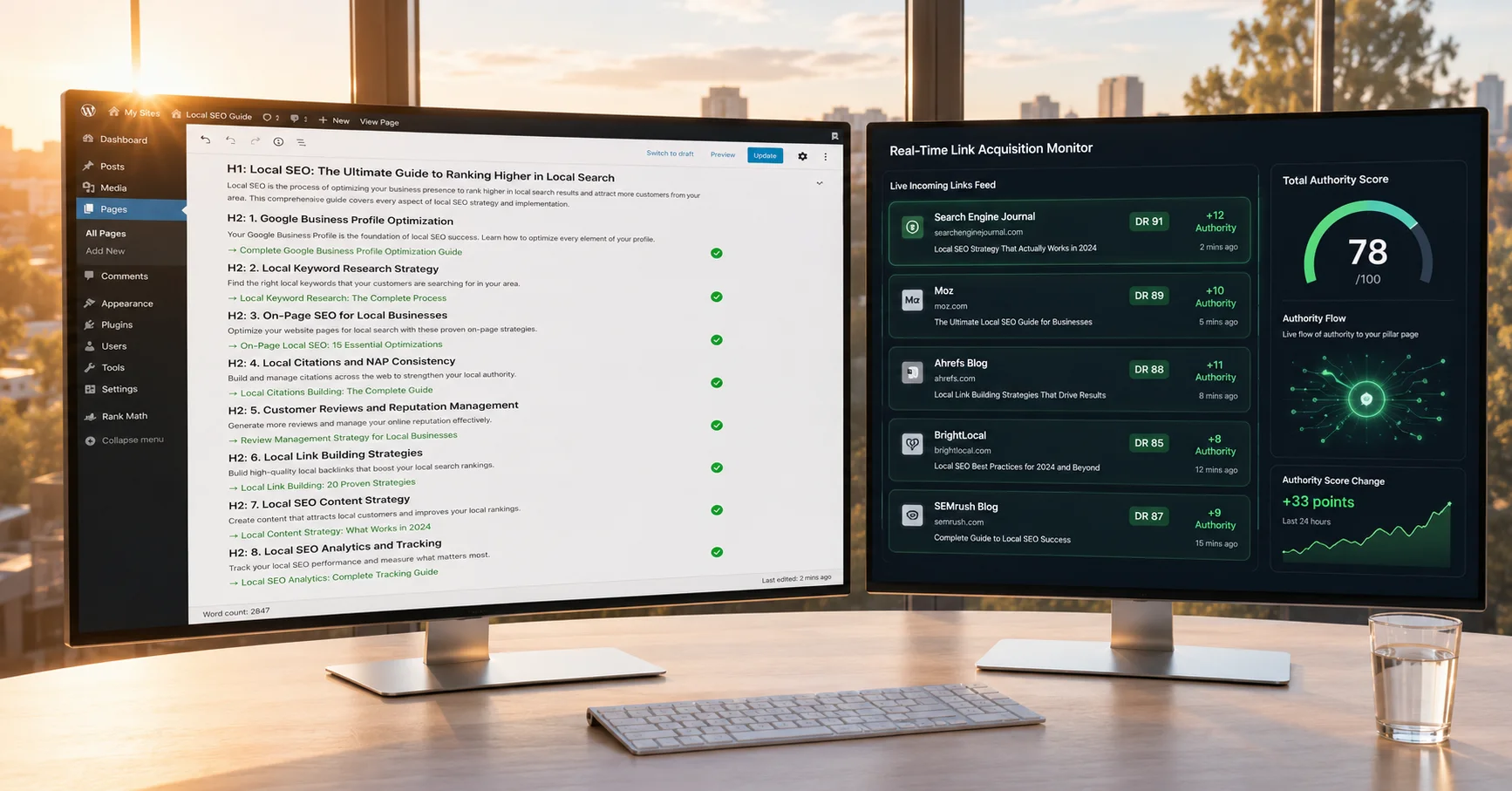
When the cluster post is published, update the pillar page to include a link to the new cluster post if it was not already referenced there. The link from the pillar to the cluster should be contextually placed within the relevant section of the pillar, not just added as a list at the bottom.
The internal-linking-seo-strategy guide covers how to maximize the authority distribution effect of the pillar-cluster link network, including how anchor text choices and link placement within the content affect the signal strength.
Step 5: Build Content That Earns External Links
The pillar page and the most comprehensive cluster posts should be built with external link acquisition in mind. Original research, unique perspectives, comprehensive resources, and authoritative coverage are the content types that earn editorial links from other publications.
A cluster post that earns five external links from credible sources passes that authority back to the pillar through its return link. The pillar page that earns external links passes authority to every cluster post through its outgoing cluster links. Every link earned anywhere in the cluster benefits the entire network.
The full content planning and keyword strategy framework that makes this system produce sustained results is covered in the content-strategy-for-seo guide.
Common Pillar and Cluster Mistakes

Building the cluster posts before the pillar page
Cluster posts that link back to a pillar page that does not yet exist either have a broken internal link or a link to a placeholder. The authority network requires the pillar to exist first. Publish the pillar, then build the cluster outward from it.
Making the pillar page too narrow
A pillar page on “local SEO for HVAC companies” is not a pillar page. It is a cluster post for a pillar on local SEO. The pillar needs to cover a topic broad enough to sustain 10 to 15 cluster posts around it. If the topic cannot support that many meaningful subtopics, it is a cluster post, not a pillar.
Not updating the pillar page as cluster posts are added
The pillar should evolve as the cluster expands. When a new cluster post is published, the pillar should be updated to reference it in the relevant section. A pillar page that was built at launch and never updated does not reflect the full scope of the cluster and misses the opportunity to route internal equity to new cluster content.
Treating the pillar and cluster as a one-time build rather than an ongoing program
A cluster that was built with eight posts two years ago and has not been expanded since is not building topical authority. It is maintaining a static structure. Adding new cluster posts quarterly, updating the pillar annually, and refreshing cluster posts as information evolves is what keeps the authority signal fresh and growing.
Building clusters without a clear topical boundary
A pillar on “SEO” with cluster posts covering link building, local SEO, technical SEO, content marketing, keyword research, and eCommerce SEO is so broad that the topical concentration signal is diluted. Each of those subtopics is a pillar in its own right. The pillar-cluster architecture requires genuine topical focus. Trying to make one cluster cover too much territory produces a hub without coherent authority signals.
FAQ
How long should a pillar page be?
Long enough to cover the full breadth of the topic and link to every cluster post, typically 2,500 to 4,000 words for most business topics. The goal is comprehensive coverage at the right depth, not length for its own sake. Shorter is fine if the topic can be genuinely covered well at that length. Longer is appropriate for complex topics with many dimensions.
How many cluster posts does a topic cluster need?
A minimum of five to six cluster posts is needed for the cluster to signal meaningful topical depth. Eight to twelve cluster posts is the range that produces the strongest topical authority signal for most topics. Beyond 15 cluster posts per pillar, the cluster may be covering territory that warrants a new pillar rather than further expanding the existing one.
Does the order in which cluster posts are published matter?
The pillar must come first. After that, the order is less critical. Prioritize publishing cluster posts for the specific subtopics that your business most needs to rank for, or those where the competition is most accessible, rather than publishing them in an arbitrary sequence.
Can a page be in multiple clusters?
Occasionally yes, when a subtopic is genuinely relevant to two different pillar topics. A page about keyword research, for example, could legitimately be a cluster post in both a content strategy cluster and a local SEO cluster. The page should link to both pillar pages and should be linked from both. Do not force pages into clusters where they are not genuinely relevant.
How long does it take for the cluster structure to produce ranking improvements?
The first visible improvements typically appear within 60 to 90 days of completing the initial cluster structure. The compounding effect, where the pillar begins ranking for its broad target keyword as cluster authority accumulates, usually becomes visible over six to nine months of consistent cluster development. The structure produces accelerating returns as the cluster expands.
The Bottom Line
Pillar pages topic clusters are not a framework you build once and leave. It is the content architecture that makes every piece you publish more valuable than it would be in isolation, because each new cluster post strengthens the pillar and every link the pillar earns strengthens every cluster post.
The businesses that build their content programs on a coherent cluster architecture consistently outrank those that publish without structure. The mechanism is real: topical authority compounds, isolated posts do not.
Want to know which topic clusters would produce the most authority and ranking impact for your business?
If you want a strategy that actually fits your business, book a free strategy call. We will walk you through your content opportunity map and show you exactly how a cluster structure would be built for your specific topics and competitive situation. Visit our Content Marketing Page and On-Page SEO Page to learn more about how we approach this work.